
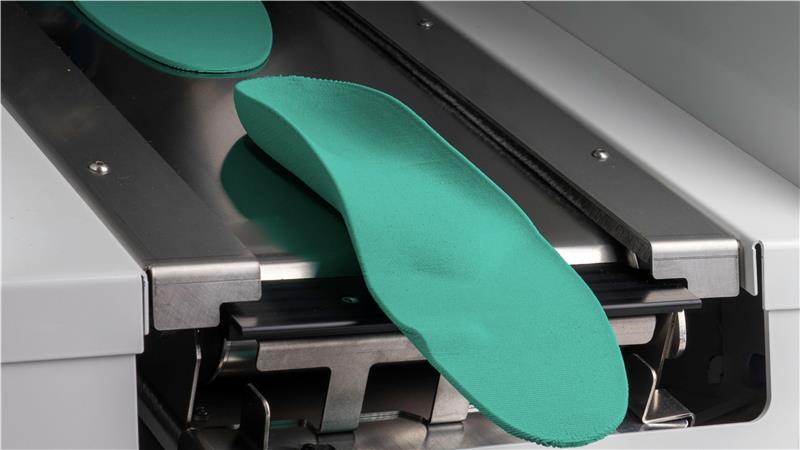
Qwadra, the digital division of Eqwal Group, has announced an exclusive licence agreement with BEGO Medical GmbH covering patented 3D belt printing technology for the continuous manufacturing of foot orthotics, including custom insoles.
The agreement, announced in Eindhoven on 19 May 2026, gives Qwadra exclusive commercial exploitation rights for 3D belt printers used in the foot orthotics segment. Through its PodoPrinter / Arkad platform, Qwadra is now positioned as a major reference player in belt-based 3D printing for insoles.
For India’s prosthetics, orthotics and podiatry ecosystem, this is more than a European technology announcement. It is a sign of where foot orthotic manufacturing is heading globally — toward faster digital workflows, continuous production, platform-based manufacturing and greater automation.
Why This Matters for India
India has a large and growing need for effective foot orthotic services. The demand comes from multiple directions: diabetes-related foot risk, sports injuries, paediatric foot conditions, musculoskeletal pain, neurological rehabilitation, workplace-related foot strain and general mobility support.
At the same time, India’s O&P and podiatry infrastructure remains uneven. Major cities may have access to advanced clinical services and private orthotic labs, but many smaller cities and rural regions still face limited access to trained professionals, specialist materials and consistent fabrication quality.
This is where digital manufacturing could become important. Technologies such as 3D belt printing may help orthotic laboratories and larger clinical providers produce custom insoles at greater scale, with improved repeatability and shorter turnaround times.
For India, the question is not whether every clinic needs a 3D belt printer. The more important question is how digital production can support wider access to consistent, clinically appropriate orthotic care.
What Is 3D Belt Printing?
Traditional 3D printers usually build objects on a fixed platform. Belt printers use a moving print surface, which can support longer parts or continuous serial production. In the context of foot orthotics, this can help manufacturers produce multiple custom insoles in a more automated workflow.
For busy orthotic laboratories, this matters because insole production is often repetitive but still highly individualised. Each patient may need a different arch profile, stiffness zone, heel geometry, forefoot design or accommodative feature. A digital workflow can allow those variations to be designed and manufactured without relying entirely on hand shaping or manual duplication.
This makes belt printing especially relevant for laboratories that want to move from low-volume craft production toward higher-volume, digitally controlled production.
A Shift from Craft Alone to Digital Craft
India has a strong tradition of hands-on orthotic and prosthetic fabrication. Manual skill remains essential and should not be replaced blindly. Clinical assessment, casting, rectification, material handling and fitting experience are still central to good patient outcomes.
However, digital tools are now becoming part of the modern orthotic workshop. Foot scanning, CAD design, pressure mapping, CNC milling and 3D printing are already reshaping how custom insoles are made in many markets.
Qwadra’s agreement with BEGO Medical shows that this sector is becoming more formalised and commercially mature. Companies are not simply experimenting with 3D printed insoles. They are building protected manufacturing platforms, securing intellectual property, developing software ecosystems and targeting international deployment.
For Indian providers, this means digital orthotics should no longer be seen as a distant future. It is already becoming part of mainstream orthotic manufacturing.
Implications for Indian Orthotic Labs and Clinics
The Indian market has several types of providers who may be affected by this trend:
- Independent O&P clinics producing custom insoles manually.
- Orthotic laboratories serving hospitals and private clinics.
- Podiatry and diabetic foot centres.
- Sports medicine and physiotherapy clinics.
- Rehabilitation hospitals.
- Start-ups offering digital foot scanning and insole services.
- Educational institutions training future CPOs and technicians.
For these groups, 3D belt printing points to a future where custom foot orthoses can be produced with greater consistency and speed. A clinic may still perform the assessment and prescription, while a centralised lab could manufacture the device digitally and deliver it back to the provider.
This hub-and-spoke model may be particularly relevant for India, where smaller towns may not be able to support expensive manufacturing equipment but could still benefit from access to high-quality digital production through regional centres.
Potential Benefits for the Indian Market
If implemented correctly, digital insole manufacturing could bring several benefits to India’s O&P sector.
First, it may improve consistency. Manual fabrication depends heavily on the skill and experience of the technician. Digital workflows can help standardise design libraries, correction parameters and production quality.
Second, it may reduce turnaround time. Faster production can be important for diabetic foot patients, working adults, athletes and children who need timely intervention.
Third, it may support scale. India’s population size means that orthotic services need models that can serve large numbers without compromising quality.
Fourth, it may reduce material waste compared with some subtractive manufacturing methods. This could become increasingly relevant for clinics and labs looking at cost control and sustainability.
Fifth, it may create new opportunities for Indian manufacturers, distributors and education providers to build digital orthotic capacity.
The Clinical Warning: Technology Is Not the Prescription
While digital production is promising, BharatCPO’s professional audience should be clear about one point: a 3D printed insole is only as good as the assessment and prescription behind it.
A scan can capture foot shape. A printer can manufacture a designed structure. But neither can independently determine why a patient has pain, whether there is diabetic risk, how gait is affected, what footwear is appropriate, or whether an insole is even the correct intervention.
This is especially important in India, where diabetic foot complications, neuropathy, post-stroke mobility issues, paediatric deformities and complex trauma cases are common in rehabilitation settings. These patients need qualified clinical assessment, not just a digital product.
Digital orthotics should therefore strengthen the role of trained CPOs, podiatrists, physiotherapists and rehabilitation physicians — not bypass them.
Opportunity for Indian Education and Training
The rise of platforms such as PodoPrinter also highlights a training challenge. Indian O&P education and continuing professional development will need to keep pace with digital manufacturing.
Students and technicians should increasingly understand:
- Foot scanning and digital capture.
- CAD-based insole design.
- Material behaviour in 3D printed orthoses.
- Pressure data interpretation.
- Workflow quality control.
- Finishing, fitting and patient review.
- When digital insoles are appropriate and when traditional methods remain better.
If India wants to build a strong digital orthotics sector, training cannot be limited to equipment demonstrations. It must include clinical reasoning, fabrication knowledge and outcome-based decision making.
A Possible Boost for Make in India and Local Manufacturing
Although Qwadra and BEGO Medical are European companies, the wider trend is highly relevant to India’s local manufacturing ambitions.
India already has a growing health technology and medical device ecosystem. Digital foot orthotics could become an area where Indian companies develop local scanning, design, printing, material and fabrication solutions adapted to Indian pricing, climate, footwear habits and clinical needs.
The Indian market may not simply import European or North American models. It may require lower-cost equipment, rugged service support, regional production hubs and workflows that can operate across public hospitals, private clinics, NGOs and rehabilitation centres.
This is where BharatCPO readers should pay attention. The future of orthotics in India may not be only about adopting imported technology. It may also be about building Indian digital manufacturing capability for Indian clinical realities.
Why the Announcement Should Be Watched Closely
Qwadra’s exclusive licence from BEGO Medical shows that the digital insole market is becoming more competitive and more protected. Companies are moving to secure patents, manufacturing rights and platform control.
For Indian distributors and clinics, this matters because procurement decisions may increasingly involve not only printer price but also software access, material supply, patent position, service support and long-term platform stability.
For Indian orthotic labs, it also raises strategic questions:
- Should production remain fully manual?
- Should labs invest in milling, 3D printing or both?
- Is centralised production more viable than every clinic owning equipment?
- How can digital workflows be priced affordably for Indian patients?
- How can CPOs ensure clinical quality in a more automated production chain?
These are not future questions. They are decisions that Indian clinics and labs will increasingly face over the next few years.
A Signal of the Direction of Travel
Qwadra’s BEGO Medical licence is not only about one company or one printer category. It is a marker of where foot orthotic manufacturing is heading: digital, scalable, software-led and increasingly protected by intellectual property.
For India, the opportunity is significant. Digital orthotics could help improve access, speed and consistency in custom insole production. But the risk is also clear. If technology is adopted without clinical governance, it may reduce orthotics to a consumer product rather than a professional healthcare service.
The best outcome for India will come from combining modern digital manufacturing with strong clinical assessment, skilled technicians and appropriate patient follow-up.
For BharatCPO’s audience, the message is simple: digital foot orthotics is no longer a niche topic. It is becoming part of the future of O&P practice, laboratory production and rehabilitation service delivery in India.
- Qwadra official website
- Qwadra announcement on BEGO Medical licence
- PodoPrinter by Qwadra
- Eqwal Group
- Eqwal Group announcement on PodoPrinter joining Qwadra
- BEGO Medical
- BEGO Selective Laser Melting information
- BharatCPO
[…] Bharat CPO previously examined this distinction in its coverage of digital foot orthotics and 3D printing. […]