
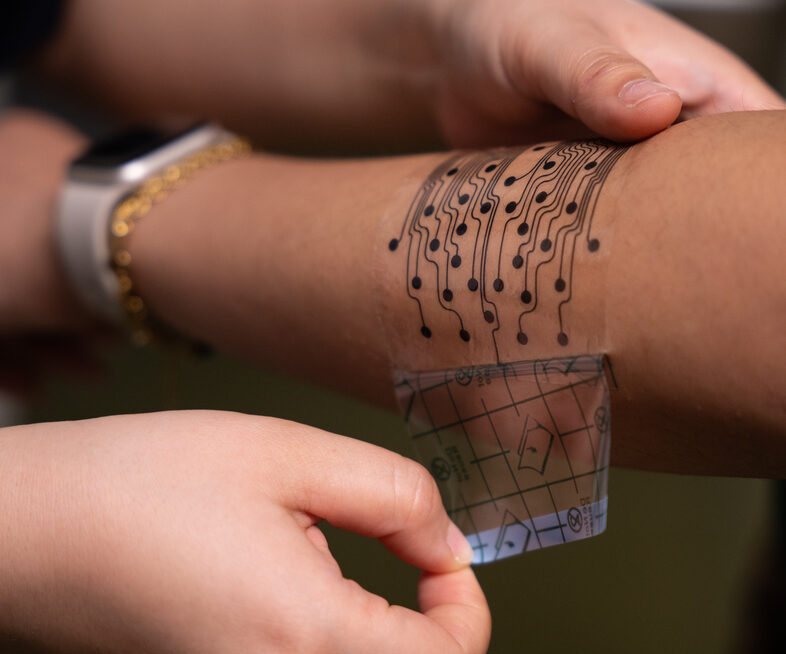
A new stretchable wearable sensor platform developed at Michigan State University could help improve the way artificial intelligence systems interpret muscle signals for prosthetic control.
The technology, called AdapSkin, is designed to collect biological data more reliably from the surface of the skin. According to a report in Design World, the sensor platform uses soft, flexible electronics that conform closely to the skin and maintain stable contact during movement.
This matters because many AI-driven prosthetic systems depend on the quality of muscle signal data. If the input signals are weak, noisy or inconsistent, the AI system may struggle to correctly interpret the user’s intended movement. AdapSkin aims to address that problem by improving the data before it reaches the algorithm.
Why Skin Contact Is a Major Challenge
Many wearable sensors and myoelectric prosthetic control systems rely on surface electromyography, or sEMG. These signals are generated when muscles contract and relax. In upper limb prosthetics, sEMG signals from remaining muscles can help control a prosthetic hand, wrist or arm.
However, reliable signal capture is not always easy.
Conventional electrodes can lose stable contact with the skin during movement. This can create motion artefacts, signal noise and poor data quality. The problem can be even greater in older adults, whose skin may be thinner, drier, wrinkled or less elastic.
The Design World report notes that AdapSkin was developed to better interface with different skin conditions and age groups. In testing, the technology improved gesture recognition accuracy in older adults from approximately 60% to more than 97%.
Better Data, Not Just Better AI
One of the most important lessons from AdapSkin is that smarter prosthetic control does not depend only on better algorithms.
The research highlights a simple but important point: AI systems are only as good as the data they receive.
If the sensor cannot collect clean and stable muscle signals, even a sophisticated AI model may perform poorly. AdapSkin’s value is therefore not only in being flexible or wearable. Its importance lies in improving the quality of the biological input used to interpret movement intention.
The Design World report explains that AdapSkin uses dense arrays of electrodes to create a more detailed map of muscle activity, allowing researchers to distinguish more subtle movements, including individual finger motions.
Relevance for Upper Limb Prosthetics
For upper limb prosthetic users, control remains one of the biggest challenges.
Many users need a prosthesis that is responsive, intuitive, comfortable and reliable during daily tasks. Myoelectric prostheses can offer functional benefits, but control problems, socket comfort, training demands, weight, cost and maintenance can limit long-term use.
If stretchable sensor platforms can improve signal quality, they may help future prostheses respond more accurately to user intention. This could support better control of hand opening and closing, grip patterns, wrist movement and more complex functional tasks.
AdapSkin may also be relevant because it detects faint electrical patterns from remaining muscles. This is important after limb loss because the brain may continue to send movement signals to muscles in the residual limb, even when the hand or arm is no longer present. Improved sensing can help translate those intended movements into prosthetic control commands.
Why This Matters for India
For India, technologies such as AdapSkin are important because the country is entering a new phase of assistive technology development.
India has a large population of people with limb loss and upper limb disability caused by trauma, congenital limb difference, workplace injury, road traffic accidents, electrical burns and other conditions. At the same time, access to advanced myoelectric prosthetic systems remains limited for many users due to cost, service availability and training requirements.
Indian prosthetic care includes a wide spectrum: public-sector services, charitable providers, private clinics, startups, university innovation labs and imported technology providers. As AI-driven prosthetic control becomes more advanced, India will need to consider how such technologies can be made affordable, durable and clinically practical.
The AdapSkin research is therefore relevant not only because it points towards more advanced prosthetic control, but because it highlights a key design principle for Indian innovators: better prosthetic function may begin with better sensing.
Potential Applications Beyond Prosthetics
The technology may also have implications for rehabilitation and neuromuscular monitoring.
Design World reports that AdapSkin could support stroke rehabilitation and neuromuscular recovery by giving clinicians clearer information about muscle function over time. The sensor remained stable during long-term wear and movement, which is important for real-world monitoring.
For India’s rehabilitation sector, this could be relevant in several areas:
- Stroke rehabilitation
- Upper limb motor recovery
- Neuromuscular assessment
- Remote rehabilitation monitoring
- Assistive robotics
- Therapy outcome tracking
- Human-machine interface research
- Prosthetic training and control optimisation
The broader challenge will be translating laboratory success into affordable, robust and clinically validated systems that can be used in Indian hospitals, rehabilitation centres and prosthetic clinics.
A Reminder for Indian Prosthetic Startups
India has a growing assistive technology startup ecosystem. Several Indian innovators are working on prosthetic hands, robotic devices, 3D-printed prosthetics, rehabilitation robotics and sensor-based therapy systems.
The AdapSkin example offers an important message for this ecosystem: AI prosthetics are not only about the mechanical hand or the machine learning model. The interface between the body and the device is equally important.
For a prosthetic system to work well, it needs:
- Reliable signal capture
- Comfortable skin contact
- Stable performance during movement
- Adaptation to different users
- Durability in real-world conditions
- Ease of donning and doffing
- Compatibility with sockets and liners
- Serviceability and cost control
In India, where heat, humidity, perspiration, dust, rural use environments and limited follow-up access may affect device performance, sensor robustness is especially important.
The Ageing Factor
One of the most interesting aspects of the AdapSkin work is its focus on older adults.
Many wearable technologies are developed and tested on younger users, even though older adults are often among the people most likely to need assistive and rehabilitation technologies. Skin changes with ageing can reduce the performance of conventional electrodes, making it harder to capture clean signals.
India’s ageing population is expected to increase demand for rehabilitation technologies, stroke care, mobility support and assistive devices. Technologies that can work reliably across different age groups and skin conditions will therefore be increasingly important.
This is especially relevant for prosthetic users with vascular disease, diabetes-related amputation or age-related limb loss, where skin condition and tissue health may already be compromised.
From Research to Clinical Adoption
Although AdapSkin is promising, several questions remain before such sensor platforms can become part of routine prosthetic care.
Clinicians and manufacturers will need to understand:
- How the sensor performs during daily prosthetic use
- Whether it works with different socket designs
- How it handles sweat, heat and long wear times
- Whether it can be cleaned and reused
- How durable it is over months or years
- How much it will cost
- Whether it can be integrated with commercial prosthetic hands
- How easily clinicians can calibrate and troubleshoot it
- Whether users find it comfortable and acceptable
For India, affordability and serviceability will be especially important. A high-performance sensor that is too expensive or difficult to maintain may remain limited to research settings or premium private care.
The Future of Prosthetic Control Is Interface-Driven
The AdapSkin development shows that the future of AI prosthetics will depend on the quality of the human-machine interface.
Better motors, smarter algorithms and advanced prosthetic hands are important. But without reliable and comfortable signal capture from the body, the system cannot fully understand what the user wants to do.
For BharatCPO readers, this is the key takeaway. The next generation of prosthetic innovation may come not only from bionic hands or robotics, but from the soft, flexible sensors that connect the user’s body to the device.
As India develops its own assistive technology ecosystem, the country has an opportunity to focus on practical, user-centred design: sensors that work in real climates, with real skin conditions, across different income groups and service settings.
AdapSkin is a reminder that better prosthetic control begins at the interface.
- Design World: AdapSkin stretchable sensor improves AI-driven prosthetic control
- Michigan State University College of Engineering
- Michigan State University Institute for Quantitative Health Science and Engineering
- Device journal
- World Health Organization: Assistive Technology
- World Health Organization: Rehabilitation
- WHO Standards for Prosthetics and Orthotics