
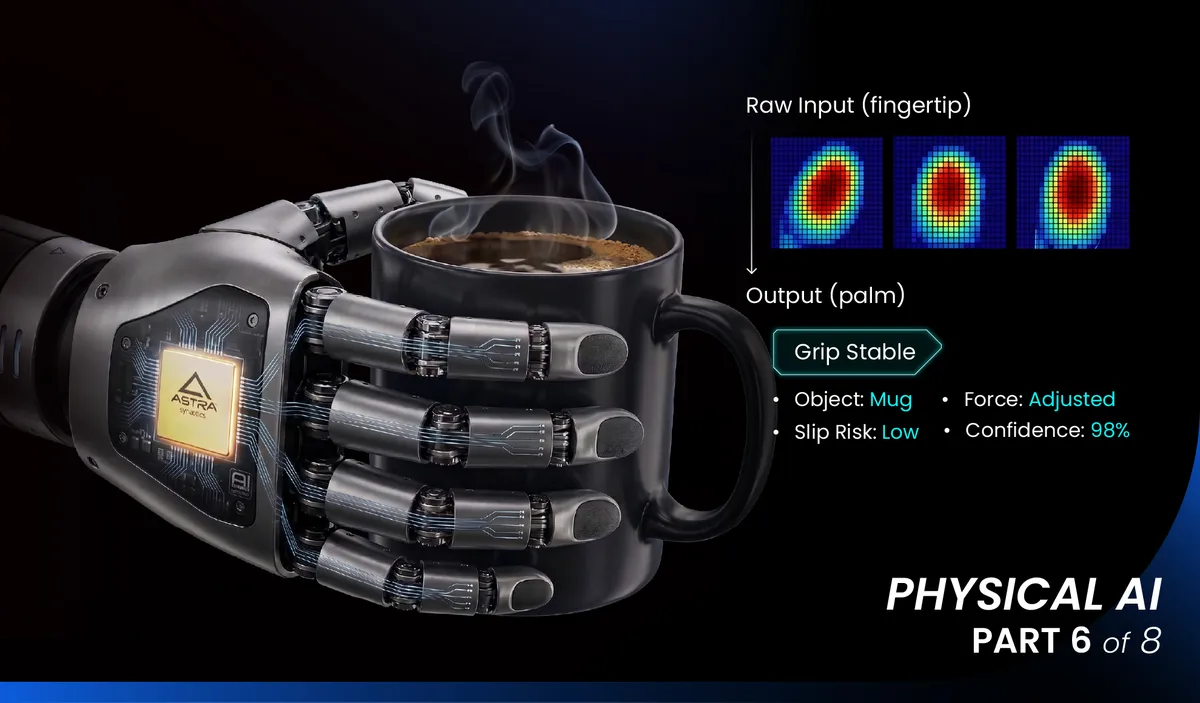
Advanced prosthetic hands can open, close and perform several predefined grip patterns. Yet many still depend heavily on the user’s vision because the hand has limited ability to interpret what it is touching.
A recent technical article from Synaptics explores a possible part of the solution: placing artificial intelligence close to tactile sensors so that robotic fingertips can recognise contact, pressure, shear and the early signs of an object slipping.
The technology is being developed primarily for robotic hands, grippers and other “physical AI” systems. Synaptics has not presented it as a clinically available prosthetic-hand system. Nevertheless, the architecture offers a useful indication of how future upper-limb prostheses might become more responsive, autonomous and easier to control.
Why robotic touch produces a data problem
A tactile robotic hand may contain numerous sensing points across its fingers and palm. These sensors can generate continuous streams of information about:
- Contact location
- Applied pressure
- Force distribution
- Normal force
- Shear force
- Movement across the sensor
- Vibration associated with slipping
Sending every raw measurement to one central processor creates two problems: the quantity of data and the delay involved in processing it.
A secure grip can depend on recognising slip and adjusting finger force within milliseconds. Synaptics argues that sending all tactile information away from the hand for central processing may add enough delay for an object to fall before the system responds.
Its proposed approach is to move part of the intelligence directly into the hand.
Giving each fingertip a local processor
In the architecture described by Synaptics, a small processor positioned near each tactile sensor performs the first level of interpretation.
Instead of forwarding an uninterrupted stream of raw measurements, the fingertip determines what is happening locally. It might report that contact has occurred, force is increasing, the contact area is moving or the object is beginning to slip.
Local processing could also help filter out false signals caused by motors, temperature changes, electrical noise or gradual wear of the sensing surface.
This turns each fingertip into a specialised sensing unit capable of reporting meaningful events instead of overwhelming the central controller with raw data.
Synaptics compares this with a form of artificial reflex. The company cites a human grip correction occurring approximately 74 milliseconds after slipping begins and explains that an engineered system must detect and respond within a similarly short period if it is to prevent the object from falling. Synaptics
Five intelligent fingers still need coordination
A fingertip can understand its own point of contact, but it cannot independently determine the stability of the entire grasp.
When a person holds a cup, different forces act across the thumb, fingers and palm. If the cup begins to rotate, the hand redistributes force across several contact points rather than responding through one finger alone.
Synaptics therefore proposes a second layer of edge intelligence operating across the whole hand. This processor would combine information from the individual fingertips, palm, motors and potentially a camera.
The system could translate several separate sensor readings into a higher-level instruction such as:
- Grip is secure
- Object is beginning to rotate
- Increase pressure through these fingers
- Reduce force elsewhere
- Object position has changed
- Slip has been detected
The central controller would communicate the user’s intended action, while the hand would manage rapid adjustments at the point of contact. Synaptics
What could this mean for prosthetic hands?
Current multi-articulating prosthetic hands can provide valuable function, but operation may still require considerable concentration. A user may need to select a grip, visually monitor finger position and judge whether sufficient force has been applied.
Edge-based tactile intelligence could eventually support a more cooperative relationship between the prosthesis and its user.
The wearer might provide the intention to grasp an object through myoelectric signals or another control interface. The hand could then manage some of the rapid mechanical details automatically, including:
- Detecting first contact
- Balancing force between the digits
- Recognising object movement
- Correcting an unstable grip
- Reducing excessive force
- Preventing fragile objects from being crushed
- Maintaining grasp while the arm changes position
This would not necessarily mean that AI replaces user control. A more realistic model would allow the user to direct the task while the prosthetic hand manages low-level adjustments, much as biological reflexes operate without requiring conscious attention to every muscle.
Sensing is not the same as feeling
An important clinical distinction must be maintained.
A sensor-equipped hand can detect pressure or slipping without delivering any sensation to the wearer. The device may use tactile information internally to adjust its motors, but the user may still receive no conscious perception of touch.
Restoring sensation requires an additional feedback pathway. Information from the prosthetic hand could potentially be communicated through:
- Vibration against the residual limb
- Pressure or skin-stretch feedback
- Electrical stimulation
- Peripheral nerve interfaces
- Implanted neural systems
- Visual or auditory alerts
The most appropriate method may vary between users. Some may value naturalistic sensory feedback, while others may prefer simple alerts or automatic grip correction.
Synaptics’ article focuses on machine interpretation and robotic control rather than on transferring tactile sensation into the human nervous system. Any connection with clinical prosthetic feedback should therefore be regarded as a potential future application, not a demonstrated feature of the current platform.
Synaptics’ tactile sensing platform
Synaptics has also announced support for its capacitive tactile sensing platform within NVIDIA Isaac Sim and Holoscan.
The company’s first tactile module uses the SN6012T touch controller and is designed for dexterous robotic hands and grippers. Reported specifications include:
- A 5 × 12 sensing-point array
- A 2.5mm taxel pitch
- Force measurement up to 100N
- Claimed resolution of 0.1N
- A rebound response described as ten times faster than traditional foam sensors
The associated Astra edge processors are intended to combine touch, vision and motion information locally. Integration with simulation software allows developers to model tactile interactions and test algorithms before deploying them on physical hardware. Synaptics
These are manufacturer-reported capabilities for robotics development. Independent testing, prosthetic integration and clinical evidence would be required before drawing conclusions about performance in upper-limb prostheses.
The durability challenge
A compelling laboratory demonstration is not equivalent to a durable prosthetic product.
A prosthetic hand must operate repeatedly in uncontrolled environments and may be exposed to heat, sweat, dust, water, impact and changing loads. A fingertip sensor must remain accurate after thousands or millions of contacts.
Synaptics acknowledges several unresolved challenges, including:
- Sensor drift
- Surface wear
- Hysteresis
- Temperature-related changes
- Maintaining calibration
- Long-term reliability
These issues are particularly relevant in India, where a prosthesis may need to perform in hot, humid or dusty environments and where access to specialist repair facilities can be limited.
Additional processors and sensors may also increase power consumption, cost, weight and maintenance requirements. Clinical value will depend on whether the improvement in function justifies this added complexity.
Relevance for Indian O&P
India has considerable engineering, software, electronics and prosthetics expertise. This creates opportunities for collaboration between prosthetists, rehabilitation clinicians, engineering institutions, start-ups and established component manufacturers.
Possible development priorities include:
- Affordable tactile fingertips for locally manufactured hands
- Automatic slip detection for work and daily-living tasks
- Low-power processing that does not significantly reduce battery life
- Modular sensors that can be replaced without changing the complete hand
- Control systems compatible with different terminal devices
- User-selectable feedback options
- Validation using activities relevant to Indian homes and workplaces
- Designs capable of operating in demanding environmental conditions
Indian research teams should also involve prosthesis users from the beginning. Technical performance alone will not determine adoption. Weight, appearance, comfort, noise, charging, repairability and the cognitive effort required to operate the hand may be equally important.
A promising direction, but not yet a prosthetic solution
Synaptics’ work shows how tactile sensors and local AI could help robotic hands progress from detecting contact to understanding the state of a grasp.
For prosthetics, the concept is significant because the next major advance may not come only from adding more motors or grip patterns. It may come from giving the hand enough local intelligence to manage contact automatically while allowing the user to concentrate on the activity.
However, the technology described remains centred on robotics and physical AI. Its translation into a medical prosthesis would require clinical design, safety engineering, regulatory approval, durability testing and evidence that it improves meaningful daily activities.
For Indian prosthetists and orthotists, the development is best viewed as an emerging technology to follow—and an invitation to participate in its clinical translation.
- Synaptics: The Brains in Your Fingertips
- Synaptics Tactile Sensing and Edge AI Announcement
- Synaptics Physical AI
- NVIDIA Isaac Sim