
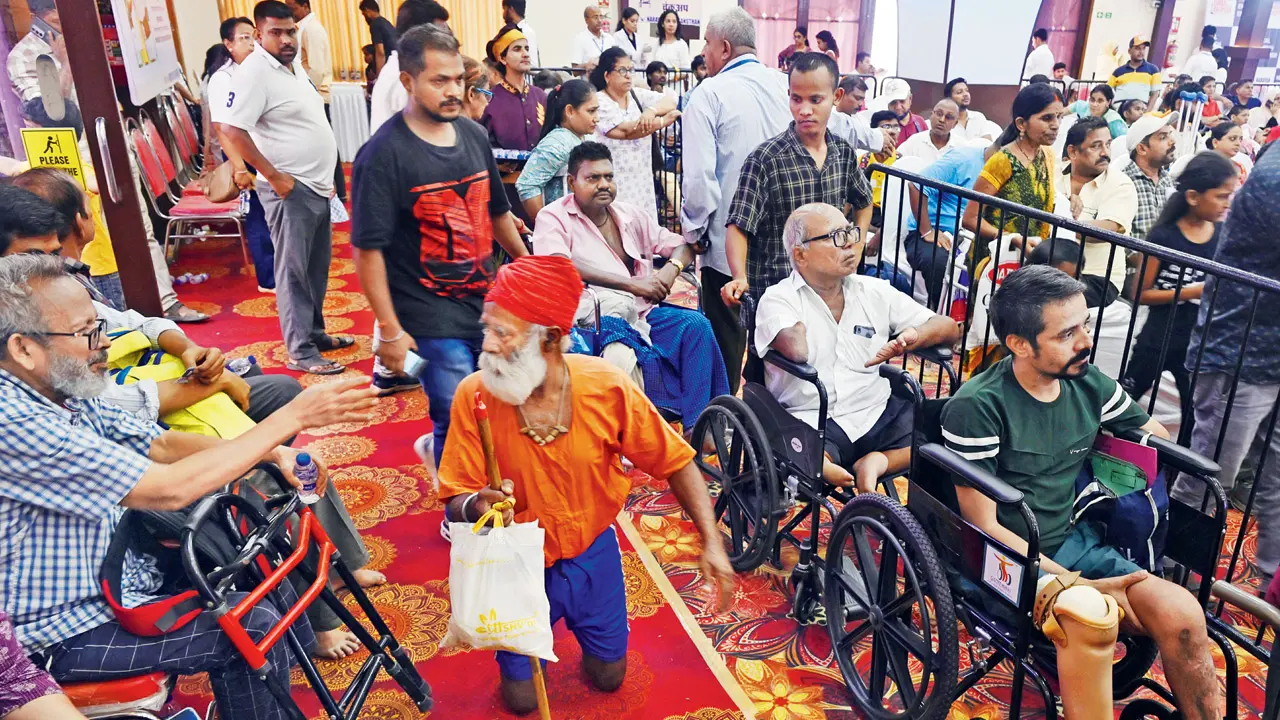
More than 100 amputees gathered at Nico Hall in Dadar East, Mumbai, for a free prosthetic screening camp that offered many participants a renewed pathway toward mobility, independence and dignity.
The camp, reported by Mid-Day, brought together people who had lost limbs through railway accidents, illness, workplace injuries and other traumatic events. The event was organised by Narayan Seva Sansthan in association with Shri Radha Krishna Charitable Foundation USA, with beneficiaries screened for customised prosthetic limbs that are expected to be provided over the next two months using digital measurement and 3D socket technology.
For BharatCPO readers, the story is important because it highlights one of India’s most urgent rehabilitation realities: prosthetic access remains life-changing, but it must be timely, affordable, clinically appropriate and supported by follow-up. A prosthesis is not simply a donated device. It is part of a rehabilitation pathway that can determine whether a person returns to work, education, family life and community participation.
The Dadar camp was designed as a screening, selection and measurement programme for Narayan Modular Artificial Limbs, with reports noting the use of Japanese and German technology-based components and 3D-printed socket processes. Related coverage of the camp said doctors and prosthetic and orthotic specialists assessed each person’s physical condition, balance, muscle control and movement before beginning the customised design process.
This clinical assessment step is essential. Amputees attending camps may have different levels of limb loss, residual limb shapes, skin conditions, balance capacity, pain levels, work demands and environmental needs. A daily-wage worker, a railway accident survivor, an older diabetic amputee and a young trauma survivor may all require different prosthetic designs and rehabilitation plans.
According to additional coverage, more than 170 differently abled individuals benefited from the wider camp activities. Organisers reported that digital measurements were taken for 70 beneficiaries for 3D-printed Narayan modular artificial arms and legs, 29 beneficiaries were measured for calipers, and around 31 patients were selected for free corrective surgeries.
The use of digital measurement and 3D socket technology is particularly relevant for India’s O&P sector. Traditional prosthetic socket fabrication can be time-consuming and heavily dependent on manual casting and modification. Digital workflows may help improve repeatability, reduce production time and support more customised fitting when used by trained prosthetists and technicians.
Narayan Seva Sansthan has also described its wider use of Japanese 3D technology and AI-supported processes for artificial limb provision, stating that 3D scanning captures limb shape, software supports custom design and 3D printing helps produce lighter and more precise prosthetic sockets. The organisation says this approach is intended to reduce discomfort, friction and imbalance while helping users walk more confidently.
For amputees, socket comfort is one of the most important determinants of prosthetic success. A poorly fitting socket can cause pain, skin breakdown, instability and eventual prosthesis abandonment. A well-fitted socket, combined with appropriate alignment and gait training, can support comfort, confidence and long-term use.
This is why free limb camps should be understood as more than charitable events. At their best, they can become entry points into structured rehabilitation. They identify people who have been excluded from care, measure and prescribe appropriate devices, connect them with clinicians and create a route toward follow-up. But their long-term success depends on what happens after the camp.
A strong prosthetic camp model should include:
- Careful clinical assessment before prescription
- Digital or manual measurement by trained O&P personnel
- Custom socket design based on each user’s residual limb and activity needs
- Safe fitting, alignment and gait training
- Education on stump care, socks, skin checks and prosthetic use
- Follow-up appointments for adjustment and repairs
- Replacement planning as components wear out or limb volume changes
- Links to livelihood, social support and disability documentation where needed
The Mumbai camp also reflects a larger national access issue. Across India, many amputees remain without appropriate prosthetic care due to cost, travel distance, lack of awareness, limited specialist services and irregular follow-up. For some, especially those from economically weaker backgrounds, a free camp may be the first realistic opportunity to receive assessment and mobility support.
For BharatCPO, the key message is that India needs both compassion and systems. Charitable camps can restore hope, but the country also needs stronger public rehabilitation pathways, trained prosthetists and orthotists, regional fabrication capacity, maintenance services and long-term replacement support. Digital tools can help, but they must be embedded in clinically governed service models.
The Dadar camp shows the promise of combining social service, modern prosthetic technology and community outreach. For more than 100 people who attended, the event represented the possibility of walking again, working again and participating more fully in daily life. For India’s O&P profession, it is also a reminder that access, fit, follow-up and dignity must remain at the centre of every prosthetic intervention.
- Original Mid-Day article on the Dadar prosthetic camp
- Narayan Seva Sansthan official website
- Narayan Seva Sansthan article on Japanese 3D technology for free artificial limbs
- The Indian Practitioner report on 3D-printed Narayan Modular Limbs
- Passionate in Marketing report on Narayan Seva’s Mumbai artificial limb camp
- Department of Empowerment of Persons with Disabilities, Government of India
- Artificial Limbs Manufacturing Corporation of India
- WHO standards for prosthetics and orthotics