
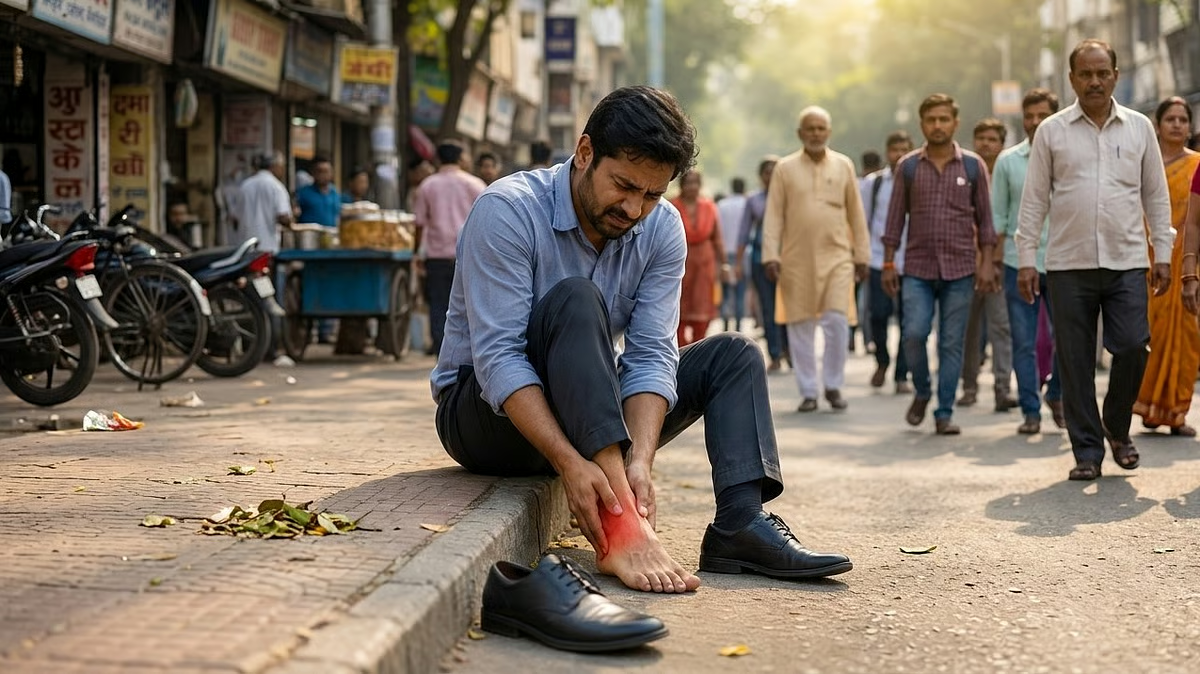
Foot pain is often treated as a normal part of daily life in India. People stand for long hours at work, commute on hard surfaces, walk in sandals or slippers, and continue using footwear that feels familiar even when it may not properly fit or support the foot.
But the article from The Free Press Journal makes an important point: what many people dismiss as ordinary foot soreness, heel pain or tiredness may actually be a sign of a much deeper problem — footwear that has not been designed around Indian feet, Indian working conditions or India’s growing chronic disease burden. Read the original Free Press Journal article here.
For Bharat CPO, this is not only a consumer footwear story. It is a rehabilitation, orthotics, diabetic foot and public health story. Footwear is the daily interface between the body and the ground. If it is poorly designed, poorly fitted or unsuitable for the user’s lifestyle, the consequences can affect pain, posture, gait, balance, skin health and long-term mobility.
India’s Footwear Fit Problem
The article highlights research from the Central Leather Research Institute (CLRI) and the CSIR-CLRI national sizing initiative, which found that India’s footwear sizing system has largely been adopted from elsewhere and does not fully account for the width and shape variations of Indian feet. The CSIR-CLRI initiative reportedly used data from 1.25 lakh samples across 79 districts and called for a sizing system that considers width as well as length.
This matters because foot length alone does not define fit. A person with a shorter foot may have a wider forefoot than someone with a longer foot. If shoes are built mainly around length, many users may buy footwear that is too long simply to get enough width, or they may tolerate pressure in the forefoot because the shoe technically matches their “size”.
The article also notes that CLRI research has described Indian feet as generally flatter, with wider and lower forepart, ball and waist regions compared with European feet. Footwear built on European lasts may therefore fail to fit many Indian users properly.
For orthotists, prosthetists, podiatrists and footwear specialists, this is a familiar problem. Fit is not just a matter of comfort. It affects load distribution, pressure, gait and long-term tissue tolerance.
Foot Pain Is Not Always “Normal”
Millions of Indians work in occupations that require prolonged standing and walking. Street vendors, factory workers, healthcare workers, teachers, security guards, retail staff, hospitality workers, delivery personnel and agricultural labourers may spend most of the day on their feet.
The Free Press Journal article cites a 2025 study of 936 street vendors in Delhi, where 46.1% reported heel pain, linked to prolonged standing, foot dysfunction and non-ergonomic footwear.
That figure should be taken seriously. When almost half of a working group reports heel pain, the issue is not just individual discomfort. It becomes an occupational health concern.
Common complaints such as heel pain, forefoot burning, arch fatigue, callus formation, knee discomfort or lower-back strain may reflect poor footwear design, excessive standing, foot posture issues or lack of proper support. In some patients, these symptoms may also be early signs of plantar fasciitis, flatfoot-related strain, arthritis, neuropathy, vascular problems or diabetic foot risk.
Footwear Shapes Movement
Footwear does more than cover the foot. It influences how a person stands, walks, balances and loads the lower limb.
The article notes that CLRI’s work on gait analysis and healthcare footwear suggests that footwear can influence stability, stance, locomotion and risk of slips and falls, particularly among older adults, people with fallen arches, people with obesity and those with deformities.
This is central to orthotic practice. A poorly designed shoe can increase pressure, restrict natural toe function, create instability, encourage compensatory movement or fail to support a patient who already has weakness, deformity or pain.
For Indian CPOs, footwear should be seen as part of the clinical pathway, especially for patients with:
- Flat feet or high arches
- Heel pain or plantar fasciitis
- Diabetes or neuropathy
- Rheumatoid arthritis
- Stroke or neurological weakness
- Cerebral palsy
- Clubfoot history
- Partial-foot amputation
- Charcot foot
- Knee or hip pain linked to lower-limb alignment
- Long working hours on hard surfaces
Diabetes Raises the Stakes
The footwear issue becomes even more important when India’s diabetes burden is considered. The article cites ICMR-INDIAB data estimating that India has 10.1 crore people living with diabetes. It also refers to a Mumbai community-based study in which foot ulcers were among the common causes of hospitalisation for people with diabetes, with 15.29% of diabetic foot ulcer patients requiring amputation in that sample.
For diabetic foot care, footwear is not a lifestyle accessory. It can become a limb-preservation tool.
Patients with diabetic neuropathy may not feel pressure, heat, friction or trauma properly. A shoe that feels comfortable may still be too tight, too narrow, too hot, too rigid or unsafe. A slipper may feel soft but may expose the foot to injury. A sandal may feel practical but may fail to protect the toes, heel or plantar surface.
This is why diabetic footwear, custom insoles, offloading devices and foot orthoses should be part of India’s preventive health conversation.
Why This Matters for Indian CPOs
For prosthetists and orthotists, the article highlights a major opportunity: India needs stronger clinical involvement in footwear and foot health.
CPOs already understand pressure, fit, alignment, materials, gait and patient function. These skills are directly relevant to diabetic foot care, orthopaedic footwear, custom insoles and long-standing occupational foot pain.
Indian O&P providers can support foot health through:
- Foot assessment and digital scanning
- Custom-moulded insoles
- Heel pain orthoses
- Diabetic footwear and accommodative insoles
- Rocker sole modifications
- Toe fillers after partial-foot amputation
- AFOs and orthoses for neurological or structural conditions
- Pressure redistribution for high-risk feet
- Advice on footwear fit, width and depth
- Follow-up and replacement schedules
The key is to move beyond selling insoles as comfort products. Foot orthotics and therapeutic footwear should be positioned as clinical interventions when they are prescribed for pain, deformity, diabetic risk or mobility problems.
India Needs Better Footwear Designed for Indian Feet
The Free Press Journal article argues that India does not simply need more footwear. It needs better footwear designed around Indian foot geometry, Indian lifestyles and public health realities.
This means footwear brands, orthopaedic footwear providers and O&P clinics should pay more attention to:
- Width as well as length
- Roomier toe boxes
- Better arch and heel support
- Safer soles for long standing
- Proper accommodation for deformity
- Diabetic foot protection
- Footwear for older adults
- Women’s foot health needs
- Occupational footwear for workers on hard surfaces
- Affordable options for low-income patients
The article also notes that BIS and FDDI discussed a draft Indian standard for therapeutic footwear in late 2025, focused on people with diabetes, neuropathy, at-risk feet and vulnerability to foot ulcers. This suggests that India’s standards ecosystem is beginning to recognise footwear as a health and safety category, not only a fashion or apparel category.
Bharat CPO Perspective
Foot pain should not be dismissed as normal. In India, it may be a warning sign of poor footwear fit, long standing hours, weak foot health awareness, limited access to podiatry and underuse of orthotic expertise.
For Bharat CPO, the message is clear: foot health must become part of preventive healthcare in India.
India’s CPOs, podiatrists, diabetologists, physiotherapists, orthopaedic surgeons, footwear designers and public health bodies need to work more closely together. Better footwear and better foot orthotic services can reduce pain, support mobility, protect diabetic feet and help prevent avoidable disability.
The future of Indian foot health will depend on designing for Indian feet, assessing footwear clinically and recognising that pain in the foot is not always just a small problem. Sometimes, it is the first sign that the whole system needs to change.
- Free Press Journal original article
- CSIR – Central Leather Research Institute
- Footwear Design and Development Institute
- Bureau of Indian Standards
- ICMR – INDIAB Study
- Rehabilitation Council of India
- Department of Empowerment of Persons with Disabilities
- World Health Organization – Diabetes
- World Health Organization – Rehabilitation
- World Health Organization – Assistive Technology