
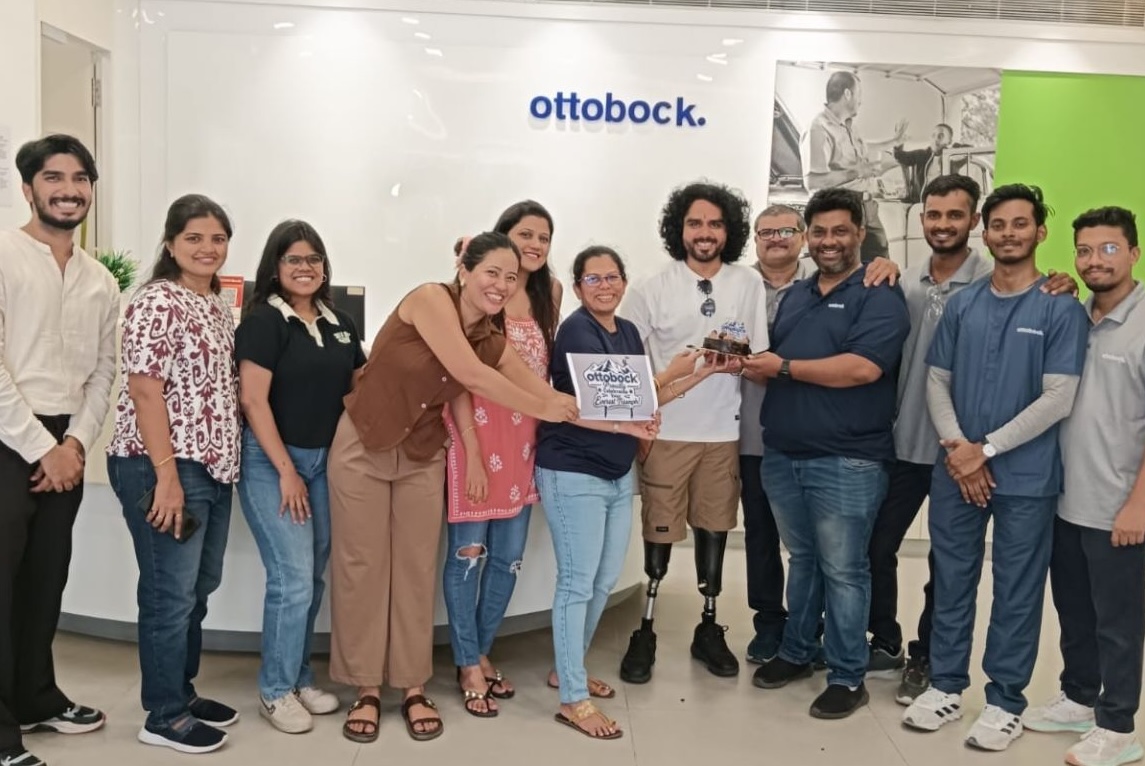
Indian adaptive adventure leader and triple amputee Tinkesh Kaushik received a warm welcome at the Ottobock Mumbai Centre after successfully completing and leading what he described as India’s largest inclusive trek to Everest Base Camp.
In a recent LinkedIn post, Kaushik expressed gratitude to Shraddha Pednekar and the Ottobock team for supporting his journey and celebrating the milestone. He wrote that moments like these are a reminder that “every challenge becomes lighter when amazing people stand beside you.”
For India’s prosthetics and rehabilitation community, the achievement is more than a personal milestone. It highlights the powerful connection between advanced prosthetic technology, clinical support, user determination and inclusive participation in high-performance outdoor activities.
A milestone for inclusive adventure in India
Tinkesh Kaushik is the founder of the Tinkesh Ability Foundation, a national awardee, motivational speaker, TEDx speaker, Rubaru Mr. India 2022 titleholder and Limca Book of Records holder. He is widely recognised as the world’s first triple amputee to trek to Everest Base Camp, a feat that was reported in 2024 by outlets including NDTV and ThePrint.
His latest achievement, leading India’s largest inclusive Everest Base Camp trek, further expands that story from individual endurance to collective inclusion. The trek brought together people with and without disabilities, demonstrating that adventure, mobility and access should not be limited by traditional assumptions about disability.
For BharatCPO readers, this is an important development. Inclusive adventure is not only about inspiration; it is also about infrastructure, prosthetic readiness, rehabilitation planning, peer support, safety systems and the confidence to take assistive technology into demanding real-world environments.
The role of prosthetic support in extreme environments
Everest Base Camp is one of the world’s most demanding trekking destinations. The route involves long walking days, uneven terrain, cold conditions, altitude exposure and limited access to technical repair support. For a prosthetic user, these conditions place significant demands on the socket, suspension, alignment, prosthetic feet, skin tolerance and energy expenditure.
In a separate post about his preparation, Kaushik highlighted the importance of choosing the right prosthetic setup for the trek, including comfortable sockets, lightweight and flexible feet, toe movement, strength and reliability in mountain conditions. He also mentioned choosing Ottobock Evanto feet after research and trials for the Everest Base Camp journey.
This underlines a key lesson for the Indian O&P sector: prosthetic care does not end at walking indoors or managing routine daily activities. For many users, the goal is full participation in life, including sport, employment, travel, adventure and leadership.
High-demand users require detailed clinical planning. This includes:
- Careful socket comfort and residual limb protection
- Appropriate prosthetic foot selection for terrain and activity level
- Reliable suspension and alignment
- Training for uneven surfaces, slopes and long-distance walking
- Backup planning for repairs and component stress
- Skin monitoring and fatigue management
- Coordination between prosthetists, physiotherapists and the user
When these elements come together, prosthetic technology becomes a platform for participation, not simply a medical device.
Ottobock Mumbai welcome recognises a wider achievement
Kaushik’s welcome at the Ottobock Mumbai Centre reflects the role that prosthetic providers and industry teams can play in enabling ambitious mobility goals. His public thanks to Shraddha Pednekar and the Ottobock team highlighted not only technical support, but belief, encouragement and celebration.
This matters because successful prosthetic rehabilitation is deeply collaborative. The user’s motivation is central, but outcomes are shaped by the quality of clinical fitting, component selection, gait training, follow-up and emotional support.
For prosthetic companies and clinics across India, stories like this demonstrate the value of long-term user relationships. A prosthesis must perform in clinics, homes, workplaces, streets, sports settings and, in exceptional cases, the Himalayas. Each environment provides feedback that can help improve service quality and device selection.
Changing the narrative around disability
Kaushik’s journey also challenges the way disability is often presented in India. Too often, disability is framed only through limitation, charity or dependency. Inclusive adventure offers a different model: one based on capability, preparation, access and leadership.
By leading an inclusive Everest Base Camp trek, Kaushik has helped move the conversation from “can persons with disabilities participate?” to “how can systems be designed so participation becomes normal?”
This is especially important for young amputees and new prosthetic users. Representation matters. Seeing a triple amputee lead an expedition to one of the world’s most recognised trekking destinations can change expectations for patients, families, clinicians and policymakers.
It also strengthens the argument for wider access to quality prosthetic care in India. Advanced rehabilitation should not be available only to a few. India needs stronger pathways that connect limb-fitting services, physiotherapy, peer mentoring, sports participation, adaptive recreation and long-term follow-up.
A lesson for India’s rehabilitation ecosystem
The success of Kaushik’s trek points to several wider priorities for India’s prosthetics and orthotics sector.
First, device selection must be linked to user goals. A prosthesis for a student, office worker, farmer, athlete or trekker may require different design choices.
Second, rehabilitation must prepare users for real-world environments. Uneven roads, public transport, stairs, rural terrain and outdoor activity are all part of life in India.
Third, prosthetic users should be included in service design. Their feedback is essential for improving comfort, durability and usability.
Fourth, industry partnerships can help expand ambition. Companies, clinics and technology providers can support users not only by fitting devices, but by enabling participation in meaningful activities.
Finally, inclusive adventure should become part of the broader disability access conversation. Treks, sports events, marathons and outdoor programmes can help build confidence, visibility and community.
From personal achievement to collective movement
Tinkesh Kaushik’s Everest Base Camp story has already made history. His latest inclusive trek shows that the next phase is not just about individual records, but about bringing others along.
His welcome at Ottobock Mumbai is therefore symbolic. It represents a meeting point between lived experience, prosthetic technology, clinical support and India’s growing disability inclusion movement.
For BharatCPO, the story is a reminder that the purpose of prosthetics is not only mobility in a clinical sense. It is independence, participation, confidence and the freedom to pursue ambitious goals.
As India continues to develop its prosthetics, orthotics and rehabilitation services, Kaushik’s journey stands as a powerful example of what becomes possible when technology, determination and inclusive support come together.
- Tinkesh Kaushik’s LinkedIn post on the Ottobock Mumbai welcome
- Tinkesh Kaushik LinkedIn profile
- NDTV: Tinkesh Kaushik becomes world’s first triple amputee to reach Everest Base Camp
- ThePrint: 30-year-old triple amputee from Goa climbs Everest Base Camp
- Times of India: Goa-based amputee leads India’s largest inclusive Everest Base Camp trek
- Ottobock India
- Ottobock Evanto prosthetic foot
- World Health Organization: Rehabilitation