
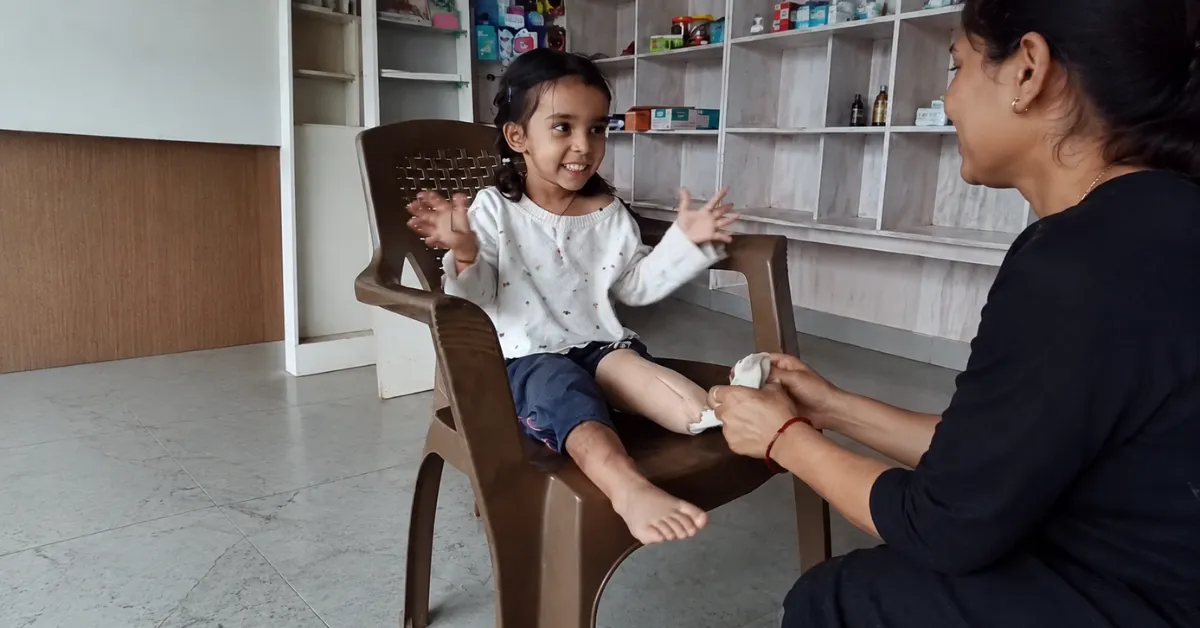
Three-year-old Aavi from Delhi is learning to walk again with a prosthetic leg after a devastating bus accident led to a below-knee amputation and serious injury to her other leg.
Her story, shared by The Better India, is one of courage, family support and the long journey of paediatric rehabilitation. It also highlights an important reality for India’s prosthetics and orthotics community: children with limb loss need much more than a device. They need long-term, age-appropriate rehabilitation, regular follow-up and support that grows with them.
According to the report, Aavi’s accident required doctors to perform a below-knee amputation to save her life. Her other leg was also severely injured and required two metal rods to rebuild the broken bone. Today, she is adapting to a prosthetic leg and learning to walk again, one step at a time.
A Child’s Recovery Is Different
Paediatric prosthetic rehabilitation is very different from adult prosthetic care.
A child is still growing physically, emotionally and socially. Their prosthetic needs may change quickly as they gain height, weight, confidence and mobility. The device must support function, but it must also allow the child to play, explore, fall safely, get up again and participate in family and school life.
For a young child like Aavi, even standing can become a milestone. Balance, trust, strength and confidence all need to be rebuilt gradually. The Better India report describes how she continues trying despite the difficulty, supported closely by her family.
This is where paediatric prosthetics becomes a team effort. The prosthetist, orthotist, physiotherapist, surgeon, rehabilitation physician, family and child all play a role.
More Than a Prosthetic Leg
A prosthetic limb is an important part of recovery, but it is not the full rehabilitation pathway.
A child with lower-limb loss may need:
- Residual limb care and skin monitoring
- Prosthetic socket fitting and adjustment
- Gait training
- Strength and balance work
- Pain and comfort review
- Regular prosthetic replacement as they grow
- Support for the opposite limb if it was also injured
- Family education
- School reintegration support
- Psychological and social encouragement
In Aavi’s case, the injury to her other leg adds another layer of complexity. The report notes that her other leg was severely injured and required metal rods, meaning her rehabilitation is not only about adapting to a prosthesis but also about protecting and strengthening the limb that remains biologically intact.
Why Paediatric Prosthetic Follow-Up Matters
Children grow quickly. A socket that fits well today may become uncomfortable or unsafe in a few months. Components may need to be changed as the child becomes more active. Alignment may need to be reviewed as walking patterns develop.
For this reason, paediatric prosthetic care cannot be treated as a one-time fitting.
Regular follow-up is essential to check:
- Socket fit
- Skin pressure areas
- Walking pattern
- Knee and hip movement
- Balance and falls
- Component wear
- Comfort during school and play
- Whether the child has outgrown the device
For Indian rehabilitation services, Aavi’s story is a reminder that paediatric amputees require structured long-term care pathways, not only emergency surgery and initial device provision.
The Role of Family in Recovery
The Better India report places strong emphasis on Aavi’s family support. Her mother describes how Aavi keeps trying, even when walking is difficult, and how the family began documenting her progress to share hope with others.
Family involvement is central to paediatric rehabilitation. Parents and caregivers are often the ones who help the child practise standing, walking, wearing the device, checking the skin and building confidence at home.
They also help professionals understand what is really happening outside the clinic:
- Is the child wearing the prosthesis regularly?
- Is the child comfortable?
- Are there pressure marks?
- Is the child falling often?
- Is the prosthesis being used at home, outdoors or in school?
- Is the child emotionally accepting the device?
For young children, family encouragement can make the difference between a prosthesis that is simply supplied and a prosthesis that becomes part of daily life.
A Larger Message for India’s P&O Sector
India has many children living with limb loss due to trauma, congenital limb difference, infection, cancer, burns and other causes. Road traffic accidents remain a major cause of severe injury, and paediatric trauma can create lifelong rehabilitation needs.
Aavi’s story should therefore be read not only as an inspiring recovery story, but also as a call to strengthen paediatric prosthetics and orthotics services across India.
The priorities are clear:
- Early referral to prosthetic and rehabilitation teams
- Child-friendly prosthetic design
- Regular growth-related follow-up
- Affordable access to replacement devices
- Integration with physiotherapy and occupational therapy
- School and community reintegration
- Family counselling and education
- Long-term funding support for children who will need multiple devices over time
For many families, the cost of repeated prosthetic replacement can be a major barrier. This is why public schemes, charitable support, hospital programmes and private-sector innovation all have a role to play.
Every Step Is a Milestone
Aavi’s recovery is still unfolding. At just three years old, she is rebuilding movement, balance and confidence after a life-changing injury. Every small step is part of a much larger journey.
For Bharat CPO readers, her story is also a reminder of the human purpose behind prosthetics and orthotics. A well-fitted prosthesis can restore mobility, but rehabilitation restores participation, confidence and possibility.
Aavi’s journey shows what paediatric prosthetic care can mean when clinical support, family encouragement and a child’s determination come together.
Her story is not only about learning to walk again. It is about giving a child the chance to keep growing, playing and moving forward.
- The Better India: After Losing a Leg in a Tragic Accident, 3-YO Aavi Is Learning to Walk Again
- WHO: Prosthetics and Orthotics Services
- WHO: Rehabilitation
- WHO: Assistive Technology
- UNICEF: Children with Disabilities