
The Artificial Limb Centre in Pune occupies a distinctive place in the history of Indian prosthetics and orthotics. Established during the final phase of the Second World War, the centre has developed from a wartime prosthetic facility for injured soldiers into a multidisciplinary rehabilitation institution serving military personnel, veterans and civilian beneficiaries.
Now a premier tri-service institution of the Armed Forces Medical Services, the Artificial Limb Centre—commonly known as ALC Pune—has combined prosthetic fabrication with surgery, rehabilitation, gait training, occupational recovery and social reintegration.
Its history also reflects the wider development of the Indian P&O profession: from traditional workshop production to multidisciplinary rehabilitation, computer-aided design, advanced components, bionic upper-limb systems and additive manufacturing.
Established During the Second World War
According to the Ministry of Defence, the Artificial Limb Centre was established in Pune on 19 May 1944. Its original purpose was to provide prosthetic limbs and rehabilitation to Indian soldiers who had sustained amputations and other disabling injuries during military service.
At the time, prosthetic rehabilitation was a considerably different discipline from the one practised today. Artificial limbs were typically manufactured using wood, leather, metal and other conventional materials. Prosthetic fitting depended heavily on the manual skills of technicians, while rehabilitation services were less formally integrated than they would become in later decades.
The centre was nevertheless founded on an important principle: supplying an artificial limb alone was not enough. An injured soldier also needed physical rehabilitation, training and practical support to regain independence.
From Pune to Kirkee, Lahore and Back Again
The centre’s earliest years were marked by relocation and the political transformation of the Indian subcontinent.
As documented in The Indian Express, the establishment moved from Pune to Kirkee in 1945. In December 1946, it was transferred to Lahore.
Partition in August 1947 placed Lahore within the newly created Pakistan. The Artificial Limb Centre was consequently re-established in Pune at its present location on 1 January 1948.
This return gave the newly independent India a dedicated military institution for prosthetic provision and amputee rehabilitation. From Pune, it would serve successive generations of soldiers and veterans while building technical and clinical knowledge within the Armed Forces.
From Limb Fabrication to Comprehensive Rehabilitation
Although the institution’s name emphasises artificial limbs, its work gradually expanded beyond prosthetic manufacture.
Successful rehabilitation begins before a definitive prosthesis is fitted. It may involve wound and residual-limb management, pain control, muscle strengthening, balance training, psychological support and preparation for the physical demands of prosthetic use.
After fitting, the user must learn how to control the device, walk safely, perform daily activities and return to family, employment or military life. Upper-limb amputees may require extensive training to operate mechanical, myoelectric or bionic devices.
ALC Pune therefore developed into a comprehensive rehabilitation centre in which clinicians, prosthetists and orthotists, physiotherapists, occupational therapists, technicians and other professionals could work around the needs of the individual.
Its enduring philosophy has been captured in the centre’s widely reported motto: “No wheelchairs, no crutches.” This represents an aspiration to achieve the highest practical level of mobility and independence possible for each beneficiary.
A Tri-Service Institution
ALC Pune serves the rehabilitation needs of personnel from the Indian Army, Navy and Air Force. Its tri-service status enables specialist experience to be concentrated in one institution rather than divided among separate facilities.
Military amputees can present with complex injuries caused by explosions, firearms, vehicle incidents, training accidents and other service-related trauma. Some people arrive with multiple amputations or accompanying injuries affecting vision, hearing, nerves or other parts of the musculoskeletal system.
The centre’s role is therefore not limited to replacing a missing limb. It helps injured personnel rebuild functional ability, confidence and independence, with rehabilitation adapted to their personal and occupational objectives.
Its services have also extended to civilians. The Ministry of Defence describes ALC Pune as providing care to people with skeletal and neurological challenges across different sections of society, supporting their independence and ability to earn a livelihood.
A Contribution to Indian Para-Sport
The history of ALC Pune is also connected to India’s Paralympic movement.
Murlikant Petkar, who became India’s first Paralympic gold medallist at the 1972 Heidelberg Games, underwent rehabilitation at the centre following injuries sustained during military service. His journey from soldier to elite para-athlete remains one of the most recognised stories associated with ALC Pune.
The centre has continued to support para-athletes requiring prosthetic care. Those associated with its services include javelin champion Sumit Antil, badminton player Nitesh Kumar and shot-put medallist Hokato Hotozhe Sema.
For competitive athletes, prosthetic provision involves more than basic mobility. Alignment, socket comfort, component selection, training and repeated technical adjustment can all influence performance and injury risk. The centre’s work with athletes demonstrates how rehabilitation can progress from restoring daily function to enabling achievement at the highest levels of sport.
Modernising Prosthetic Rehabilitation
The materials and methods available to prosthetists have changed dramatically since 1944. Modern practice can incorporate lightweight composites, carbon-fibre components, silicone interfaces, energy-storing feet, microprocessor technology and externally powered upper-limb systems.
ALC Pune has introduced computer-aided design and manufacturing facilities while continuing to retain the clinical and workshop skills required for custom prosthetic care.
A gait-training laboratory was established to improve the assessment of walking and weight distribution. Its equipment includes baropodometric analysis and a dynamic stair trainer that allows users to practise slopes and stairs in a controlled environment.
In January 2025, the Chief of Army Staff inaugurated a dedicated Upper Limb Training Laboratory. The facility helps people with upper-limb loss develop the strength, coordination and control required to use mechanical, cosmetic, myoelectric and bionic devices.
The training element is crucial. Even the most sophisticated prosthetic hand provides limited benefit unless its user receives sufficient practice in operating it during meaningful everyday activities.
Entering the Additive-Manufacturing Era
Another major development came in December 2025, when a new additive-manufacturing laboratory was inaugurated during ALC Pune’s Continuing Rehabilitation Education programme.
According to the Press Information Bureau, the laboratory is intended to support rapid production of prosthetic and orthotic devices, manufacture several devices simultaneously and retain digital patient information for later replication.
The technology could also support remote service models. A patient may be scanned at another location, with the digital data transferred to Pune for design and manufacture. This has potential relevance for military personnel and civilian beneficiaries living far from major rehabilitation centres.
Digital production will not remove the need for clinical skill. Appropriate assessment, socket design, alignment, fitting and outcome review remain essential. Its value lies in helping skilled professionals improve consistency, preserve records and shorten selected stages of production.
Developing the Next Generation
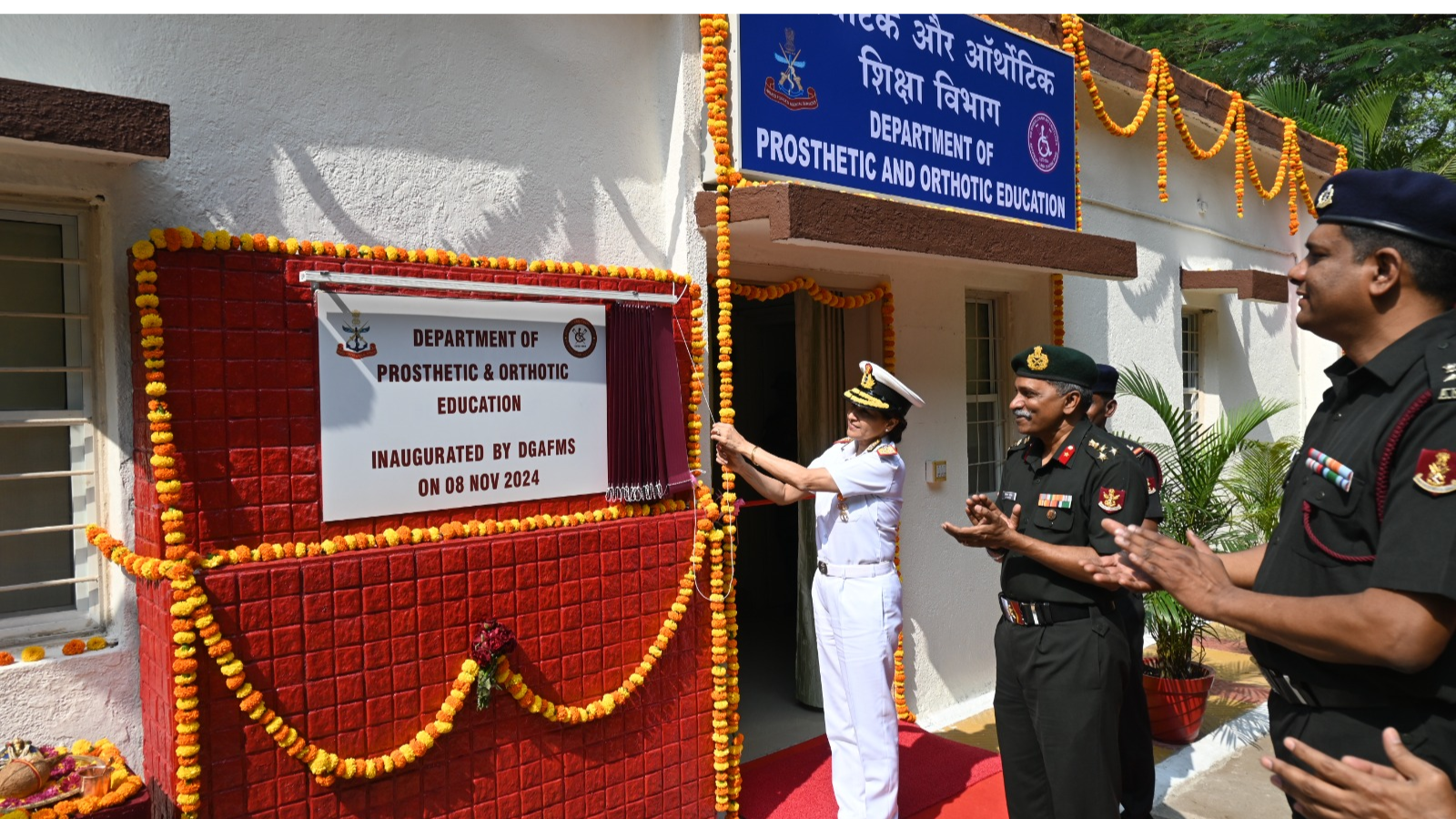
ALC Pune is also expanding its educational role through a Department of Prosthetics and Orthotics Education. This marks an important evolution from being primarily a provider of care to becoming a contributor to India’s professional training infrastructure.
The centre offers students an unusually rich learning environment. They can encounter complex cases, observe multidisciplinary care and understand the complete rehabilitation pathway from injury and surgery to prosthetic fitting, training and community reintegration.
Continuing Rehabilitation Education programmes also allow military and civilian professionals to exchange knowledge. The centre’s December 2025 programme focused on improving amputee rehabilitation outcomes, including upper-limb disability, immediate postoperative prosthetic fitting and emerging technologies.
An Institution Linking History and Innovation
More than eight decades after its establishment, the Artificial Limb Centre Pune remains closely connected to its original mission: helping people rebuild their lives following limb loss or disabling injury.
What has changed is the breadth of that mission. ALC Pune has progressed from wartime artificial-limb provision to comprehensive rehabilitation, para-sport support, professional education, advanced upper-limb training and digital manufacturing.
Its history is therefore more than the story of one military medical establishment. It is part of the history of prosthetics and orthotics in India—a history shaped by injured soldiers, skilled technicians, rehabilitation professionals, technological change and the determination of amputees to regain independence.
As ALC Pune enters its next chapter, its challenge will be to combine the discipline and experience built since 1944 with modern evidence, education and indigenous innovation. That combination could strengthen not only military rehabilitation, but the wider Indian P&O profession.
- Artificial Limb Centre – Indian Army
- Ministry of Defence: Artificial Limb Centre Pune
- Armed Forces Medical College
- History and Upper Limb Training Laboratory at ALC Pune
- Rehabilitation Council of India
- Department of Empowerment of Persons with Disabilities
- Bharat CPO