
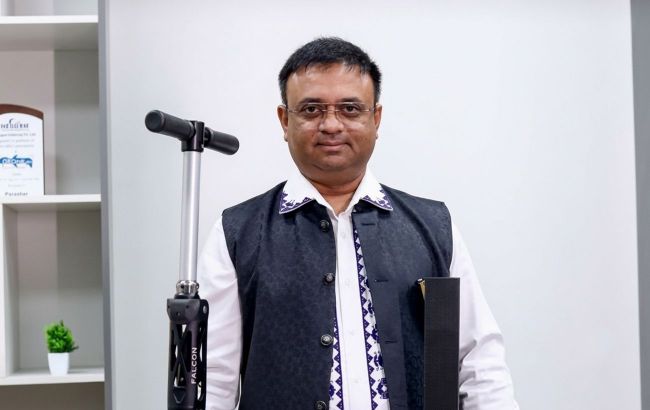
Indian-born entrepreneur and prosthetics innovator Nagender Parashar has spent more than three decades building a life and rehabilitation business in Ukraine, where his Bez Obmezhen—meaning “No Limits”—network now supports veterans and civilians living with limb loss.
Parashar moved from India to Kyiv in October 1991 at the age of 17, shortly after Ukraine declared independence. What began as a journey to obtain an education eventually developed into a lifelong commitment to the country and a personal mission to improve the quality of prosthetic care.
Today, his work spans prosthetic and orthotic centres, component manufacturing, rehabilitation services and the development of locally produced prosthetic technologies intended to improve mobility, balance and user safety.
From India to newly independent Ukraine
When Parashar arrived in Kyiv, Ukraine was largely unknown to many people in India. The former Soviet Union was commonly associated with Russia, and he had little understanding of the country in which he was about to study and live.
He enrolled at Kyiv’s Aviation University and spent his first year learning the language and adapting to an unfamiliar culture, climate and education system.
Over time, Ukraine became his permanent home. He started a family, established businesses and developed close personal and professional connections across the country.
Parashar has now lived in Ukraine for approximately 35 years. His daughter works within the Bez Obmezhen network, while his son is involved in the manufacturing side of the family business.
A personal connection to limb loss
Parashar’s decision to work in prosthetics was influenced by amputations within his own family.
Both of his grandfathers underwent amputations. His paternal grandfather died after a severe fracture and subsequent amputation, while his maternal grandfather later underwent an amputation associated with diabetes and also died in hospital.
These experiences shaped Parashar’s belief that an amputation should not mark the end of a person’s independence or participation in society.
His aim became to help people reach a stage where they could live confidently, contribute to their families and communities, and no longer feel defined by their prosthesis.
This patient-centred philosophy is reflected in the name Bez Obmezhen: “No Limits.”
Building a prosthetics network across Ukraine
Parashar initially worked with imported prosthetic components but became dissatisfied with the quality and reliability of some of the available products.
He began studying existing components, identifying design weaknesses and learning how mechanical and hydraulic prosthetic systems were manufactured. In 2014, his team started producing components in Ukraine, gradually developing its own engineering and production capabilities.
The Bez Obmezhen network now employs around 120 people and operates centres in cities including Lviv, Kovel, Vinnytsia, Chernihiv, Dnipro, Kryvyi Rih, Zaporizhzhia and Odesa.
Earlier reporting also identified Parashar Industries as a major domestic producer of prosthetic components in Ukraine, supporting the country’s efforts to reduce dependence on imported products.
The network provides more than prosthetic components. Its teams help patients select devices, complete fittings and access the rehabilitation support required to use a prosthesis effectively.
Supporting veterans and civilians during war
Demand for prosthetic rehabilitation in Ukraine has increased substantially as a result of the continuing war.
Military personnel and civilians may experience complex injuries involving traumatic amputations, multiple limb loss, nerve damage, burns or other conditions requiring prolonged rehabilitation.
Providing a prosthesis in these circumstances requires coordinated input from surgeons, rehabilitation physicians, prosthetists, orthotists, physiotherapists, psychologists and other specialists.
Parashar’s centres have continued operating during the conflict, with staff working to meet growing demand despite air-raid warnings, workforce pressures and disruption to normal business operations.
The organisation’s work has attracted international attention, particularly because an Indian entrepreneur has become closely involved in restoring mobility to Ukrainian service personnel and civilians.
Developing safer prosthetic knee technology
One of Parashar’s main engineering priorities has been improving safety for people using transfemoral prostheses.
Falls are a major concern for above-knee prosthesis users. Instability can occur when the prosthetic knee does not respond effectively to changes in walking speed, surface angle, obstacles or uneven ground.
Parashar said his team developed knee-joint technology intended to absorb shock, support balance and react quickly to changes in terrain. According to him, patients using the refined design have reported improved stability and an absence of falls.
The technology was completed after several stages of development and adjustment, informed by observations of patients who had experienced falls while using above-knee prostheses.
Parashar Industries has previously introduced locally produced lower-limb prosthetic components, including monocentric and polycentric knee systems designed for different mobility levels.
Continued clinical evaluation will be important to establish the performance of newer designs across different patient groups, body weights, activity levels and environmental conditions.
Combining imported expertise with local manufacturing
Although some elements of the company’s production take place in India, Parashar says its most advanced components have historically been manufactured in Ukraine.
This mixed manufacturing model reflects the increasingly international nature of the prosthetics industry. Components may be designed in one country, manufactured in another and fitted through clinical networks operating across several markets.
However, recent developments suggest that Parashar is now placing greater emphasis on Indian manufacturing.
Through Parashar Future Technologies, he has promoted the production of prosthetic knee joints, connectors and other precision components in India, drawing on experience developed in Ukraine.
This could create an important link between Ukraine’s urgent experience in trauma rehabilitation and India’s growing need for locally manufactured, affordable and serviceable prosthetic technology.
Potential benefits for India
India has a substantial population of people living with limb loss caused by road traffic injuries, diabetes, vascular disease, industrial accidents, cancer, congenital conditions and other causes.
Many patients remain dependent on imported high-performance prosthetic components, which can be expensive and difficult to maintain.
When an imported knee joint or other component needs specialist repair, it may have to be returned to the manufacturer or an overseas service centre. This can leave the user without a fully functioning prosthesis for weeks or months.
Local manufacturing could reduce these delays by making components, spare parts and technical expertise available closer to patients.
Parashar has previously outlined plans to manufacture advanced prosthetic products in India and train local teams to produce and maintain them. His stated objective is to offer Indian patients higher-quality devices at more accessible prices while reducing maintenance turnaround times.
For Indian prosthetic and orthotic providers, the availability of locally manufactured components could also offer:
- Faster access to replacement parts.
- Reduced exposure to international shipping delays.
- More affordable component options.
- Technical training from the manufacturer.
- Products designed for Indian lifestyles and environments.
- Greater opportunities for product customisation.
- Stronger domestic research and development capacity.
Supporting Make in India for prosthetics
Parashar’s journey demonstrates how knowledge gained internationally can be transferred back into India’s medical-device sector.
India has strong engineering, manufacturing and information-technology capabilities, but much of its advanced prosthetic component market continues to depend on overseas suppliers.
A successful domestic production ecosystem would require collaboration between component manufacturers, prosthetists, universities, testing laboratories, hospitals, rehabilitation centres and government agencies.
Products would also need to meet appropriate quality-management, safety, biocompatibility and mechanical-testing requirements.
The goal should not simply be to reproduce imported technology at a lower cost. Indian manufacturers have an opportunity to develop products specifically designed for local users, including people who walk on uneven roads, use public transport, work in agricultural or industrial environments, squat or sit cross-legged.
A bridge between India and Ukraine
Parashar has also become an advocate for stronger economic and technological ties between India and Ukraine.
He has participated in Ukrainian investment initiatives in India and encouraged Indian businesses to begin developing partnerships in Ukraine rather than waiting until the war has ended.
In October 2024, the Ukrainian Ambassador to India visited Parashar Industries and discussed the company’s work in innovative prosthetic components and rehabilitation technology.
This role positions Parashar as a bridge between two countries with different but complementary strengths.
Ukraine has acquired extensive experience in complex trauma care, veteran rehabilitation and high-volume prosthetic service delivery. India offers manufacturing scale, technical talent, a large domestic market and the potential to produce devices at more accessible costs.
Collaboration between the two countries could support joint manufacturing, component testing, professional education, digital prosthetic workflows and research into technologies for traumatic limb loss.
Life after amputation
The central message behind Parashar’s work is that life does not end after an amputation.
A successful outcome does not depend solely on delivering an artificial limb. It requires an appropriate socket, reliable components, physical rehabilitation, psychological support, follow-up care and opportunities to return to employment, education, sport and family life.
By combining clinical services with component manufacturing and product development, Bez Obmezhen is attempting to provide a more complete pathway for people with limb loss.
For India’s P&O sector, Parashar’s story is also an example of how personal experience, engineering and social purpose can develop into a scalable rehabilitation enterprise.
His experience in Ukraine could now help accelerate India’s transition towards more advanced domestic prosthetic manufacturing—bringing internationally tested knowledge closer to Indian patients and clinicians.
- RBC-Ukraine: Life doesn’t end after amputation
- Embassy of Ukraine in India: Ambassador visits Parashar Industries
- Reporters: Manufacturing in Two Shifts
- Times of India: Indian entrepreneur supporting Ukrainian amputees
- World Health Organization: Prosthetics and orthotics services
- World Health Organization standards for prosthetics and orthotics
- Rehabilitation Council of India
- Department of Empowerment of Persons with Disabilities