

Japanese logistics group Nippon Express Holdings has made an additional investment in 3D-printed prosthetics company Instalimb through its Series C funding round, accompanied by a new capital and business partnership between the two organisations.
The investment was made through the NX Global Innovation Investment Limited Partnership. Although the companies have not disclosed the amount raised, the agreement represents a significant expansion of their relationship and places India at the centre of Instalimb’s planned international growth.
According to the official NX Group announcement, Instalimb now regards India as its global central fabrication hub. The company operates Indian manufacturing facilities producing prosthetic and orthotic devices, specialised 3D printers and the filament used by those printers.
This means India is not being treated solely as a market for prosthetic services. It is becoming a production and supply-chain base from which digital O&P technology, materials and devices could be distributed to other emerging markets.
From investment to strategic partnership
NX Group first invested in Instalimb in February 2024. Since then, the logistics company has supported Instalimb by operating inventory warehouses in India and arranging international transport for 3D printers, filament and other supplies.
The latest agreement extends that relationship beyond conventional investment. NX and Instalimb will collaborate on:
- Global supply-chain planning
- Selection of manufacturing, inventory and distribution locations
- International transport and customs clearance
- Warehousing and inventory allocation
- Distribution systems for new overseas markets
- Coordination with NX subsidiaries in individual countries
- Potential new joint business opportunities
The partnership is intended to support Instalimb’s expansion into South America, Africa, South Asia and Southeast Asia.
Countries identified in the announcement include Chile, Brazil, Nigeria, Kenya, South Africa, Bangladesh, Nepal, Indonesia, Vietnam and Thailand.
Successfully entering these markets will require more than transporting completed prostheses. Instalimb’s model also depends on the reliable movement of printers, polymer filament, metal components, replacement parts and other production materials.
NX Group’s role is therefore to help build an international infrastructure around the clinical and manufacturing technology.
India becomes the central fabrication hub
Instalimb was established in Tokyo in 2017 and began operating in India in 2022. Its business combines digital scanning, computer-aided design, machine-learning technology and additive manufacturing to produce customised prosthetic and orthotic devices.
The company’s global website describes two principal activities: a clinic business serving patients and a manufacturing platform for organisations seeking to introduce digital P&O production.
In India, Instalimb offers prosthetic sockets as well as complete transtibial and transfemoral prosthetic solutions. The company says its prosthetists use clinical assessment and biomechanics alongside digital design, making millimetre-level adjustments to the socket model before manufacturing.
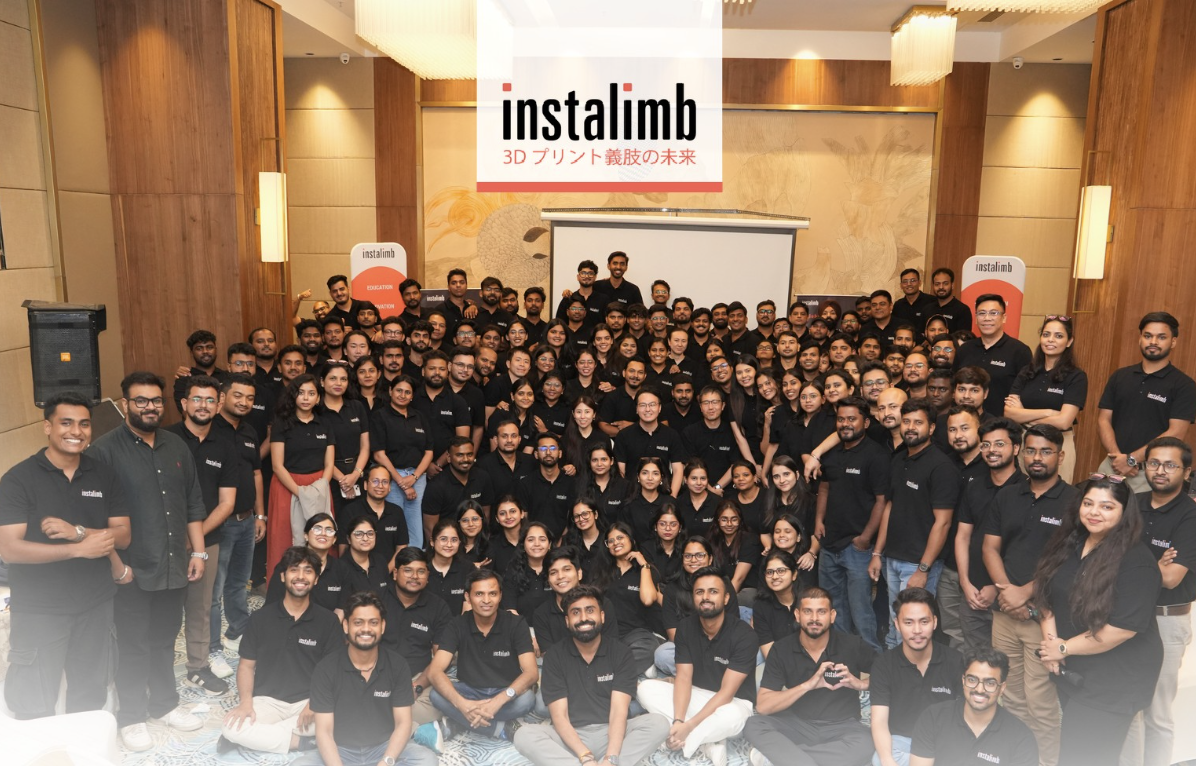
The new NX announcement shows how substantially the company’s Indian operations have expanded. As of August 2026, Instalimb employed 309 people globally:
- India: 170 employees
- Philippines: 82 employees
- Japan: 46 employees
- Ukraine and other locations: 11 employees
More than half of Instalimb’s global workforce is therefore based in India.
This concentration of manufacturing and technical capacity could have wider implications for India’s O&P sector. The country has the potential to support not only local patient care but also the design, production and export of complete digital fabrication systems.
Why logistics matters in prosthetic care
Prosthetic access is often discussed primarily in terms of clinical expertise, device price and manufacturing technology. However, supply-chain reliability can be equally important.
A digital production system may still fail to deliver timely care if clinics cannot obtain the correct filament, components or replacement parts. International expansion also creates challenges involving customs clearance, local inventories, machine servicing and the positioning of production capacity close enough to demand.
By working with NX Group, Instalimb is attempting to create a more coordinated system in which manufacturing, storage and distribution decisions are based on anticipated demand in each country.
Instalimb CEO Yutaka Tokushima said the ability to deliver printers and materials manufactured in India to other parts of the world would be critical to the company’s success.
For Indian manufacturers, CPOs and rehabilitation providers, this demonstrates that additive manufacturing should not be viewed only as a new fabrication technique. It requires an ecosystem encompassing clinical data capture, design software, validated production processes, materials management, quality assurance, logistics and local fitting support.
The clinical role remains essential
Automation and artificial intelligence may shorten parts of the design and fabrication process, but they do not remove the need for qualified prosthetic and orthotic professionals.
A prosthetic socket must respond to the condition of the residual limb, tissue tolerance, volume changes, muscle function, alignment requirements and the user’s functional goals. The completed device must then be fitted, evaluated and adjusted by appropriately trained professionals.
Digital tools can help standardise repetitive processes, preserve design information and allow manufacturing capacity to be shared across locations. However, their value ultimately depends on the quality of clinical assessment and follow-up.
Instalimb’s Indian patient service emphasises the role of its prosthetists in designing sockets according to residual-limb anatomy and biomechanics. This distinction is important as the company promotes AI-enabled design: the technology supports the workflow, but does not replace clinical responsibility.
Potential significance for Indian O&P
The Series C partnership creates opportunities beyond Instalimb’s immediate expansion.
India could increasingly become a regional and international base for:
- Digital prosthetic and orthotic design
- Central fabrication services
- Additive-manufacturing equipment
- Locally produced printing materials
- Technical training and implementation support
- Remote production for clinics with limited workshop capacity
- Export of patient-specific devices and manufacturing systems
A successful Indian hub could enable smaller clinics to access advanced production without investing immediately in industrial printers, extensive workshop infrastructure or specialist manufacturing personnel.
It could also create new roles for Indian CPOs in digital rectification, production supervision, quality management, clinical training and remote collaboration with partner clinics.
However, affordability claims must ultimately be assessed against complete delivered costs. These include scanning, clinical time, components, fitting, alignment, follow-up, repairs and replacement—not only the cost of printing the socket.
Independent evidence covering durability, first-fit success, patient outcomes, remake rates and long-term cost would help clinicians and institutional buyers evaluate the model more fully.
A broader model for assistive-technology manufacturing
NX Group’s original 2024 investment supported Instalimb’s international prosthetics business from a logistics perspective. The new agreement indicates that the relationship has progressed into a deeper operating partnership.
NX has also said it intends to explore employment opportunities for prosthetic users within warehouses and logistics operations. If implemented effectively, this would connect assistive-technology provision with economic participation and workplace inclusion.
For Bharat CPO, the most important aspect of the announcement is India’s emerging position within the global value chain.
India is no longer simply receiving technology developed elsewhere. Instalimb’s model places the country at the centre of device production, printer manufacturing, materials supply and international distribution.
The Series C investment will test whether an India-centred digital fabrication network can combine scale, affordability and reliable clinical delivery across highly varied healthcare markets. Its progress will be relevant not only to Instalimb, but to the future direction of prosthetic and orthotic manufacturing throughout India.
- NX Group: Additional investment and partnership with Instalimb
- Instalimb Global Website
- Instalimb India Prosthetic Services
- NX Group’s Initial 2024 Investment in Instalimb
- Dealroom: NX Group Backs Instalimb in Series C Round