
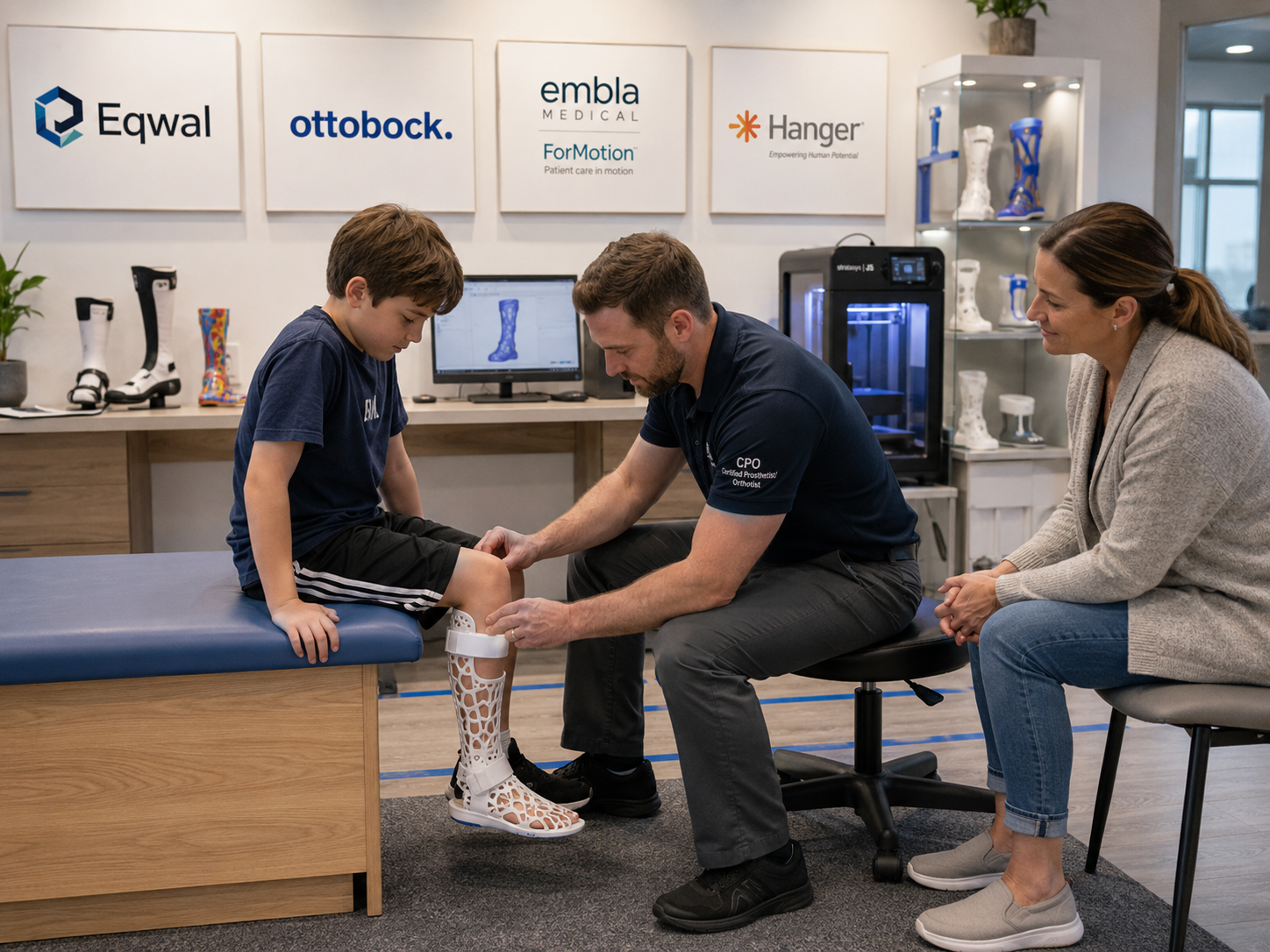
The global orthotics and prosthetics sector is undergoing a significant transformation.
Four organisations—Eqwal, Ottobock, Embla Medical through ForMotion, and Hanger—are building increasingly integrated platforms combining patient care, prosthetic and orthotic components, digital technology, manufacturing, distribution and purchasing power.
Their operating models are different. Hanger remains overwhelmingly focused on the United States, while Eqwal, Ottobock and Embla Medical have developed increasingly international clinical and commercial networks.
Together, however, they demonstrate where a substantial part of the O&P industry is heading: away from isolated clinics and towards large groups with hundreds of patient-care locations, common digital systems, centralised purchasing and access to institutional capital.
For India’s independent prosthetists, orthotists, clinics, rehabilitation centres and manufacturers, the central question is clear.
Will these organisations bring investment, technology and stronger clinical systems—or will their scale eventually make it harder for independent Indian providers to compete?
The answer is likely to be both.
The rise of a global O&P “big four”
Orthotics and prosthetics has traditionally been a fragmented sector.
Many clinics were established by individual prosthetists and orthotists who built local relationships with hospitals, doctors, physiotherapists, disability organisations and patients over many years.
Clinical services, component distribution and manufacturing were generally separate. A clinic assessed the patient, selected products from competing suppliers and either manufactured the device internally or worked with an outside fabrication centre.
That separation is gradually disappearing.
Large groups are increasingly seeking control or influence across the entire O&P pathway, including:
- Patient referrals
- Clinical assessment
- Device prescription
- Prosthetic and orthotic components
- Digital scanning
- Computer-aided design
- Central fabrication
- Software and patient records
- Procurement
- Repairs and maintenance
- Outcome measurement
- Professional education
For India, where independent businesses, charitable organisations, government institutions and local manufacturers all operate alongside multinational suppliers, this shift could reshape the competitive landscape.
Eqwal: private capital supporting rapid consolidation
Eqwal has become one of the fastest-growing international O&P groups.
The company presents itself as an integrated platform combining clinical patient care, specialised components and digital solutions. Naxicap Partners describes Eqwal as a global custom-made O&P business operating across patient care, digital technology and components.
According to figures released alongside its latest financing announcement, Eqwal expects turnover to increase from approximately €120 million in 2021 to €700 million by the end of 2026.
The group also reported nearly 400 branches, more than 3,500 employees, operations in 13 countries and around 350,000 patients supported annually. These are company-provided figures and projections rather than independently audited data.
Eqwal’s growth has been supported by repeated acquisitions of clinical providers, component businesses, orthopaedic footwear companies and digital technology specialists.
Its recent integrations have included businesses in Poland, Germany, the Netherlands, the United States and Dubai. The acquisition of OrthoMENA gave Eqwal direct patient-care and distribution operations in the UAE, showing that its international strategy is extending beyond Europe and North America.
Although Eqwal does not yet have a comparable clinical network in India, its model is highly relevant to the country.
A well-funded group could enter the Indian market through:
- Acquisition of established O&P clinic chains
- A joint venture with a local healthcare group
- Purchase of an Indian manufacturer
- Investment in digital scanning or fabrication software
- Centralised production partnerships
- Distribution of specialised components
- Hospital-based patient-care agreements
Eqwal’s latest financing provides further expansion capacity
Eqwal’s majority shareholder, Naxicap Partners, recently announced a new financing round involving existing and new financial partners.
The transaction includes a new unitranche facility from Ardian Private Credit and La Caisse, renewed mezzanine financing from CIC Private Debt, and participation from Crédit Agricole and several regional Caisse d’Epargne investment organisations.
The total value of the transaction was not disclosed.
The significance is not simply that Eqwal has received more money. It is that the group has access to financing structures commonly used to support acquisition-led international expansion.
This allows Eqwal to pursue suitable clinical, component or technology businesses without relying only on profits generated by its existing operations.
For independent Indian clinic owners, this creates both an opportunity and a potential threat.
A well-performing practice could become an attractive acquisition target, offering its owner an exit route and access to capital. However, Eqwal or a similar platform could also acquire a competitor, hospital contract or manufacturing partner and rapidly build local scale.
Ottobock already combines products and patient care in India
Ottobock operates one of the most vertically integrated models in global O&P.
The company develops and manufactures prosthetic, orthotic, mobility and neurorehabilitation technologies while also owning and operating patient-care clinics.
India is particularly important because Ottobock already maintains an established local presence.
Its Indian website lists patient-care clinics and services in cities including Delhi, Gurugram and Chennai, alongside its component, technical and after-sales operations.
This means Ottobock is not only a supplier to Indian prosthetists and orthotists. It is also a direct provider of clinical care.
An independent clinic may therefore purchase knees, feet, liners, orthotic joints, materials or workshop technology from Ottobock while competing with an Ottobock clinic for private patients and hospital referrals.
This dual role creates one of the most important strategic questions facing independent O&P providers.
Can a company remain a neutral supplier to the entire profession while also expanding its own clinical network?
Ottobock’s global scale strengthens its position
Ottobock says its Clinical Services Network operates according to common quality standards across more than 340 patient-care clinics worldwide. Other company reporting has placed its wider clinical footprint above 400 centres, depending on how locations and partnerships are classified.
The company’s integrated model creates several advantages.
Ottobock can use its clinics to:
- Build direct relationships with patients and hospitals
- Generate practical feedback on new products
- Collect clinical and outcome information
- Train clinicians in its technologies
- Test digital workflows
- Support advanced fittings
- Create demand for specialised components
It can also use its manufacturing, component and technical-service infrastructure to support its own clinics more efficiently than a smaller independent provider may be able to.
For India, where access to advanced components and reliable technical support can vary substantially between cities, this level of integration can be attractive to both patients and referral partners.
However, it can also place independent providers at a cost and resource disadvantage.
Ottobock’s public-market performance is more cautious than its operating results
Ottobock completed its Frankfurt Stock Exchange listing in October 2025.
The final offer price was €66 per share, and the shares opened at €72, giving the company an equity valuation of approximately €4.2 billion at the offer price.
By early August 2026, Ottobock shares were trading in the mid-€50 range, below both the offer price and the first-day opening level. Market data at the time placed the shares at approximately €55.
The decline does not necessarily indicate weakness in the underlying business.
Ottobock reported double-digit growth in its 2025 core business, alongside a substantial increase in adjusted earnings. Its first-quarter 2026 results also exceeded expectations, and the share price reacted positively on the announcement date.
The more cautious share-price performance suggests that investors are weighing strong operations against other issues, including valuation, acquisition returns, governance, margin expectations and the ability to maintain high growth after the IPO.
For Indian independent clinics, the key point is that Ottobock is now accountable to public shareholders.
That can increase pressure to generate continued revenue growth, expand profitable service lines and improve returns from patient-care operations.
India’s large population and growing private healthcare market may therefore become even more strategically important.
Embla Medical: products and patient care under ForMotion
Embla Medical, formerly known as Össur, has developed a similar combination of manufacturing and clinical provision.
Its portfolio includes:
- Össur
- College Park
- Fior & Gentz
- ForMotion
The company has also added other specialist technologies and brands through acquisition.
ForMotion is Embla Medical’s international network of orthotic and prosthetic patient-care facilities. The company states that it operates its own clinics under the ForMotion name in selected markets.
Embla Medical’s strategy creates a direct link between product development and clinical delivery.
The group can manufacture a prosthetic foot, orthotic joint or bracing product and then introduce that technology through clinics within its own patient-care network.
This may improve clinician education, product feedback and access to new technology.
It may also raise questions about whether a company-owned clinic remains equally open to competing products.
ForMotion could become relevant to India
ForMotion does not currently have the same visible Indian clinical footprint as Ottobock.
Nevertheless, India represents a logical long-term opportunity.
The country has:
- A substantial population requiring lifelong O&P care
- Growing demand for advanced prosthetic components
- A developing private rehabilitation market
- Increasing digital manufacturing capability
- Strong local engineering and software skills
- Major hospital groups seeking specialist partners
- A fragmented base of independent providers
Embla Medical could expand its Indian presence through acquisition, partnership or a centralised clinical and fabrication model.
Its component brands are already known within the Indian O&P sector, giving it a potential commercial foundation from which to build patient-care services.
Embla Medical’s Q2 results show strength—and difficulty in patient care
Embla Medical reported a strong second quarter in 2026, with group sales growth and improved profitability.
The company said Prosthetics and Neuro Orthotics performed strongly, while Patient Care declined during the quarter.
This contrast is important.
Manufacturing and selling components across international markets can be highly scalable. Running clinical facilities remains more labour-intensive and locally complex.
Patient-care businesses must manage:
- Clinician recruitment
- Appointment capacity
- Reimbursement
- Referral relationships
- Premises
- Clinical documentation
- Manufacturing turnaround
- Patient satisfaction
- Repairs and follow-up
Large corporate ownership does not remove these challenges.
It may provide better systems and investment, but every clinic still depends on local professionals, local healthcare relationships and patient trust.
Embla Medical’s public-market performance also reflects investor caution
Embla Medical is listed on Nasdaq Copenhagen.
During June 2026, the company bought back shares at an average price of DKK26.91, providing a useful public reference point for its recent market valuation.
The shares subsequently traded higher following stronger-than-expected second-quarter results, but remained below their previous 52-week peak.
Investor sentiment appears to recognise Embla Medical’s strong prosthetic-product portfolio and improving profitability while remaining cautious about patient-care growth, integration and the performance of acquired businesses.
The group has stated that 70% to 80% of patient-care revenue is recurring because prosthetic and orthotic users require lifelong service, maintenance and replacement.
This recurring revenue is one reason clinical networks are attractive to investors.
Once a provider establishes a long-term patient relationship, it may generate repeated revenue from sockets, orthoses, repairs, replacement components and follow-up care.
Hanger shows what a heavily consolidated market can become
Hanger remains the largest O&P patient-care organisation in the United States.
The company reports:
- 925 patient-care clinics
- 7,000 employees
- 1,800 certified clinical providers
- Approximately one million patients treated annually
Hanger also operates products, distribution and business-service activities that support the wider US O&P market.
It was taken private in 2022 and does not publish the same level of quarterly information as Ottobock or Embla Medical.
Hanger is not currently a major direct provider in India. However, it remains relevant because it shows what a mature consolidated national O&P market can look like.
One large group can develop:
- National hospital contracts
- Central purchasing agreements
- Standard clinical protocols
- Large training programmes
- Shared fabrication
- Strong insurer relationships
- Extensive outcome data
- Significant influence over suppliers
For India, Hanger is less an immediate competitor and more a possible indication of how the market could develop if local and international consolidators acquire enough clinics.
Why consolidation could be good for Indian O&P
India’s O&P sector faces several persistent challenges that larger organisations may be able to address.
Investment in technology
Many independent workshops cannot easily finance advanced scanners, CAD systems, milling machines, industrial 3D printers or automated fabrication equipment.
A large group can spread these investments across multiple clinics.
Standardised clinical systems
Corporate networks can introduce common documentation, quality-control processes, outcome measures and fitting protocols.
This may improve consistency across different locations.
Reliable access to components
Large networks can maintain central inventories and negotiate supply agreements, reducing delays caused by imported components or limited local stock.
Professional career pathways
Independent clinics often offer limited promotion opportunities.
A larger group can potentially provide structured clinical grades, management roles, training programmes and international mobility.
Succession for clinic owners
Many successful O&P businesses are closely dependent on their founders.
A corporate acquisition can provide an exit route when the owner wants to retire but has no family member or employee able to purchase the clinic.
Stronger hospital partnerships
Large healthcare groups may prefer to contract with providers that can cover several cities, supply different technologies and demonstrate formal governance.
Investment in evidence
Large organisations may be better able to fund clinical studies, patient registries and health-economic evidence needed to support reimbursement.
Why consolidation could be bad for independent Indian providers
The risks are equally significant.
Purchasing power
A group purchasing large volumes of feet, knees, liners, joints, resins, thermoplastics and workshop materials can negotiate prices unavailable to an independent clinic.
This creates a major advantage when bidding for hospital, insurer or government contracts.
Supplier and competitor under one owner
Ottobock and Embla Medical supply independent clinics while also owning patient-care businesses.
Eqwal combines patient care with component and digital activities.
Hanger operates both clinics and wider product and service businesses in the United States.
An independent provider may therefore be buying from a company that is also competing for the same patient population.
Product choice
Vertical integration creates a risk that clinics favour products owned by their parent group.
This does not automatically mean prescriptions will be inappropriate.
However, patients and referral partners may question whether the clinician is choosing freely from the entire market.
Independent clinics can use genuine product neutrality as an important point of differentiation.
Referral concentration
A large group may sign agreements with hospital chains, insurance providers, government programmes or rehabilitation networks.
These contracts can direct large patient volumes towards one provider and reduce the referrals available to smaller competitors.
Pressure on clinical fees
A multinational provider may use component purchasing discounts or central production to offer lower package prices.
Independent clinicians may then be expected to match those prices despite having higher unit costs.
Loss of Indian businesses and knowledge
If successful Indian clinics and manufacturers are progressively acquired by international groups, decision-making, intellectual property and profit may move outside the country.
Indian brands could gradually become regional production units or distribution channels within larger international organisations.
Reduced diversity
Independent providers often develop specialised techniques, local materials, lower-cost solutions and alternative service models.
Excessive consolidation could make the market more standardised and less innovative.
India is not a typical Western O&P market
Global groups cannot simply copy their European or US clinic models into India.
The Indian market includes several very different segments:
- Premium private prosthetic care
- Government hospitals
- Charitable organisations
- District disability programmes
- Artificial limb camps
- Insurance-supported care
- Workers’ compensation
- Local low-cost component manufacturing
- High-end imported technologies
- Digital start-ups
- Orthopaedic footwear and diabetic-foot services
Pricing differs enormously between these segments.
A premium microprocessor knee fitting in a major private hospital exists within the same wider market as a free camp supplying basic prosthetic hands or lower-limb devices.
This creates challenges for international consolidators but also protects some independent providers.
A large corporate clinic with high overheads may struggle to serve low-price rural or charitable markets profitably.
Local providers may retain major advantages in affordability, cultural understanding and the ability to adapt designs to available resources.
India’s manufacturing base could be the real target
The greatest opportunity for global groups may not initially be the acquisition of hundreds of clinics.
India’s manufacturing, technical and software capabilities could be equally attractive.
International groups may seek Indian partners for:
- Prosthetic and orthotic component production
- Central fabrication
- CAD and digital design
- Software development
- 3D printing
- Orthopaedic footwear
- Clinical data processing
- Technical customer support
- Regional distribution
This could create employment, exports and knowledge transfer.
However, Indian companies should consider whether they are building their own long-term brands or becoming low-cost production partners for foreign platforms.
The balance between international investment and domestic ownership will be important.
Independent Indian clinics still have powerful advantages
Large groups have capital and scale, but Indian independent providers retain strengths that are difficult to reproduce centrally.
Local referral relationships
Independent clinicians may have worked with the same surgeons, rehabilitation physicians, physiotherapists and hospitals for many years.
Lower operating costs
Smaller businesses can often operate efficiently without the management, branding and reporting costs of a multinational group.
Flexible pricing
Independent providers may offer different component levels, payment plans or locally manufactured options according to the patient’s budget.
Clinical agility
An owner-led practice can test a new technology or change a workflow without lengthy corporate approval.
Genuine product independence
An unaffiliated clinic can select from Ottobock, Össur, College Park, Streifeneder, Indian manufacturers and emerging suppliers according to the patient’s needs.
Specialist reputation
Independent providers can build leading practices in areas such as:
- Paediatric O&P
- Scoliosis bracing
- Upper-limb prosthetics
- Sports prosthetics
- Diabetic-foot care
- Cranial remoulding
- Neuro-orthotics
- Custom footwear
Personal continuity
Many patients value being treated by the same senior clinician over many years.
Local innovation
India’s independent providers frequently adapt materials, designs and manufacturing processes to local environments and affordability constraints.
Competing only on price will be dangerous
Independent clinics are unlikely to defeat large groups through component purchasing power alone.
They will need to compete through clinical value.
That may include:
- Senior-clinician involvement
- Faster appointments
- Better communication
- Independent product selection
- Responsive repairs
- Home and community visits
- Strong paediatric follow-up
- Clear outcome measurement
- Transparent pricing
- Specialist expertise
- Long-term relationships
Independent providers should also strengthen their business systems.
Clinical skill will remain central, but clinics increasingly need:
- Reliable accounting
- Inventory control
- Digital patient records
- Data protection
- Regulatory compliance
- Formal consent
- Outcome documentation
- Staff development
- Succession plans
- Stronger branding
A clinically excellent but poorly managed practice may become vulnerable to a better-organised corporate competitor.
Collaboration may provide a third route
Indian providers do not necessarily have to choose between remaining isolated and selling to a multinational group.
Independent clinics could form networks that share some benefits of scale while retaining ownership.
Possible areas of collaboration include:
- Joint component purchasing
- Shared digital fabrication
- Common quality-management systems
- Central CAD services
- Shared clinical education
- Specialist referral networks
- Tender partnerships
- Outcome-data platforms
- Regulatory support
- Shared marketing
A group of independent clinics purchasing together may negotiate better terms without becoming a single corporate chain.
Central fabrication can also allow smaller clinics to access advanced manufacturing without purchasing every machine themselves.
Indian manufacturers and distributors must choose their position
Manufacturers and distributors may face an especially difficult strategic decision.
Should they continue supplying independent providers, align with a global network or develop their own patient-care operations?
A manufacturer that opens clinics may create the same supplier–competitor concern now associated with international groups.
A distributor acquired by a multinational platform may gain capital and market access but lose flexibility to represent competing brands.
Indian businesses should consider:
- Whether exclusivity restricts future growth
- Ownership of customer and clinical data
- Protection of local intellectual property
- Long-term control of distribution
- Non-compete clauses
- Product-selection independence
- Future acquisition rights
- Whether the Indian brand will remain visible
Regulators and hospitals should monitor vertical integration
Competition should not be measured only by the number of clinics owned by each group.
Authorities and healthcare buyers should also examine ownership across components, software, fabrication, distribution and patient care.
Important questions include:
- Can clinicians prescribe competing manufacturers’ products?
- Are ownership relationships disclosed to patients?
- Do independent clinics receive fair access to components?
- Are tenders designed around one company’s technology?
- Is patient data separated from commercial supplier information?
- Are hospitals preserving genuine provider choice?
- Does consolidation improve clinical outcomes?
- Are Indian clinicians and manufacturers being developed or displaced?
The objective should not be to prevent international investment.
It should be to ensure that investment strengthens Indian O&P rather than simply transferring control of the market.
Is consolidation good or bad for India?
It can be good when capital improves clinical facilities, supports education, introduces technology and expands access.
It can be good when a retiring clinic owner finds a responsible buyer that protects staff and patients.
It can be good when global groups manufacture in India, develop local professionals and improve supply chains.
It becomes harmful when scale removes competition, limits product choice or directs patients towards corporate clinics regardless of clinical suitability.
It becomes harmful when Indian providers are reduced to low-cost subcontractors while higher-value decisions and profits remain abroad.
It also becomes harmful when clinical activity is driven mainly by acquisition targets, product sales or investor expectations rather than patient needs.
Independence must become a deliberate strategy
Eqwal’s new financing, Ottobock’s public listing and Embla Medical’s continuing integration of products and patient care demonstrate that O&P is now attracting serious institutional capital.
Patient care is increasingly seen as a recurring-revenue business with long-term relationships, replacement cycles and predictable demand.
The major groups are not yet taking over the entire Indian O&P sector.
India remains too diverse, price-sensitive and locally fragmented for one or two international companies to dominate every segment.
Nevertheless, independent ownership can no longer be treated as automatically secure.
Clinic owners must decide whether they intend to sell, expand, specialise, collaborate or remain independent.
Those choosing independence will need to become clinically distinctive, operationally efficient and commercially organised.
India’s strongest future O&P market may be one where responsible global investment coexists with strong Indian manufacturers, specialist independent clinics, charitable services and public-sector rehabilitation.
Maintaining that balance will require conscious decisions from clinicians, business owners, hospitals, professional associations, patients and regulators.
- Eqwal Group
- Eqwal news and acquisitions
- Eqwal’s Dubai expansion through OrthoMENA
- Naxicap Partners’ Eqwal portfolio profile
- Ottobock India
- Ottobock India clinic locations
- Ottobock investor relations
- Ottobock results and reports
- Embla Medical investor relations
- Embla Medical business model
- ForMotion patient-care network
- Hanger corporate information
- Hanger Clinic
- Rehabilitation Council of India
- International Society for Prosthetics and Orthotics