
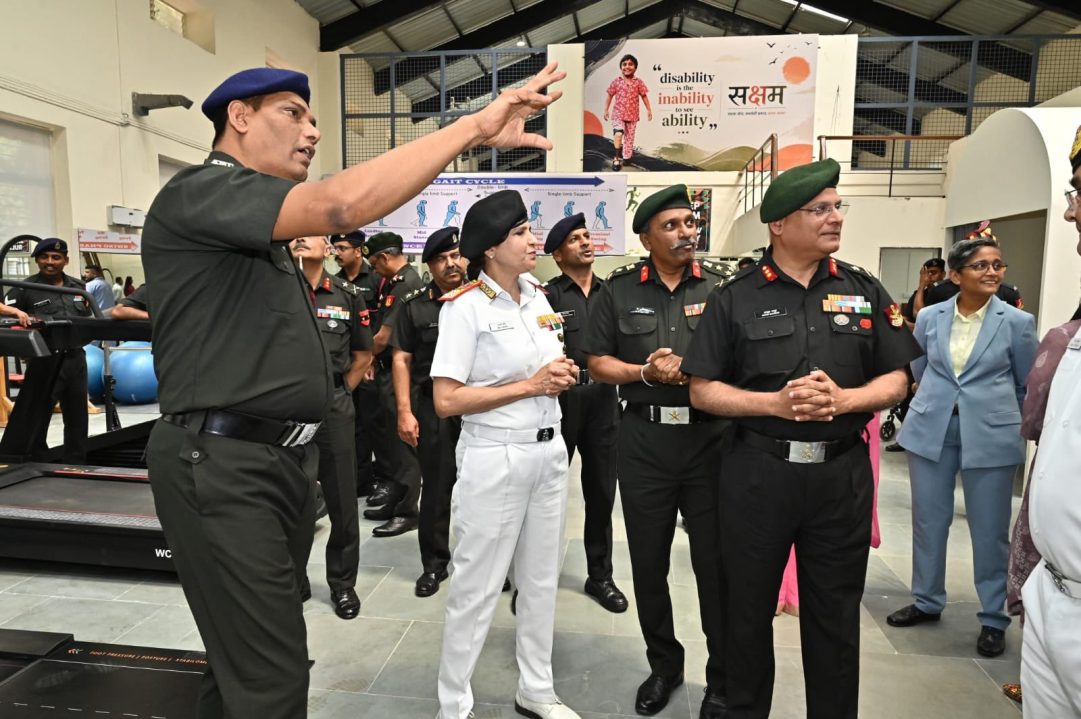
The Artificial Limb Centre (ALC) in Pune has unveiled an indigenously developed prosthetic foot designed to improve mobility across different terrains while potentially shortening the rehabilitation period for lower-limb amputees.
The new foot was presented during a visit by Surgeon Vice Admiral Arti Sarin, Director General of the Armed Forces Medical Services (AFMS), who reviewed rehabilitation and assistive-technology initiatives at the centre and toured its Saksham mobility clinic.
According to the Artificial Limb Centre, the prosthetic incorporates adjustable ankle movement, intended to allow the user to adapt more naturally to changing surfaces and improve stability while walking.
If the technology performs as expected during trials, ALC believes it could reduce rehabilitation time from approximately six weeks to four weeks.
For India’s prosthetics and orthotics sector, the project is another significant example of indigenous development moving beyond basic prosthetic manufacture towards more functional, terrain-adaptive and patient-specific technologies.
Designed for India’s varied terrain
Mobility outside the clinic can present very different demands from walking on a flat rehabilitation floor.
Users may encounter slopes, uneven roads, gravel, grass, rural pathways and changes in ground level throughout a normal day. A prosthetic foot that provides some degree of ankle adaptation can potentially make negotiating those surfaces easier and more stable.
The new ALC design is intended specifically to address this challenge.
The adjustable ankle movement is being developed to allow the foot to respond more effectively to different terrain conditions rather than requiring the user to compensate entirely through the knee, hip or trunk.
This is particularly relevant in India, where the environments encountered by prosthetic users can vary substantially between major cities, villages, agricultural areas and military settings.
Controlled patient trials planned
The new foot has not yet moved into routine or mass production.
According to the Times of India report, ALC plans to conduct controlled trials with trained prosthetic users to assess how the foot performs during real-world activities and whether the adjustable ankle actually translates into improved mobility across different surfaces.
Mechanical testing will also be required.
The prosthesis uses materials selected to provide strength and durability, with structural performance expected to undergo testing on specialist equipment before the technology progresses towards wider manufacturing.
Standardising the components and refining the foot’s form factor will be another important step before larger-scale production can be considered.
For CPOs, this validation process is critical.
A promising mechanical concept must ultimately demonstrate not just that it works technically, but that it delivers meaningful benefits to users in areas such as stability, comfort, gait efficiency, durability and confidence.
Faster rehabilitation could be an important advantage
One of the most interesting claims surrounding the new technology is its potential impact on rehabilitation time.
ALC expects the design could help reduce the typical rehabilitation period from around six weeks to four weeks.
That will need to be demonstrated through the planned trials, but if achieved consistently it could have important implications.
Faster adaptation can help amputees return more quickly to daily activities, work and independent mobility.
Within a military rehabilitation environment, where some patients may also be working towards a return to highly active lifestyles or service-related functions, reducing the time needed to achieve safe and confident mobility could be particularly valuable.
For civilian rehabilitation programmes, shorter treatment pathways could also help clinics increase capacity and reduce the burden on patients who must travel repeatedly for therapy.
ALC combines rehabilitation and product development
The project reflects the unusual role of Pune’s Artificial Limb Centre.
Rather than functioning only as a clinical fitting facility, ALC integrates rehabilitation, prosthetic development and 3D printing within the same organisation.
Officials told the Times of India that the approach is intended to reduce dependence on imported assistive technologies while allowing products to be customised according to individual patient requirements.
This integration has particular advantages for prosthetic innovation.
Engineers and technicians developing a new foot can potentially receive feedback directly from prosthetists, rehabilitation professionals and users. Designs can then be modified according to practical clinical requirements rather than being developed entirely separately from patient care.
That type of collaboration is increasingly important as prosthetic products become more sophisticated.
Building on previous prosthetic-foot development
The latest design is not ALC’s first effort in prosthetic-foot technology.
The centre says its previous work included a foot design that contributed to the performance of Indian para-athletes.
The new all-terrain project represents a further step towards developing devices intended not simply to restore basic walking ability, but to support higher levels of function.
That distinction is becoming increasingly important within Indian prosthetics.
As access to prosthetic care expands, expectations are also changing. Many users want devices that enable them to work, participate in sport, travel independently and negotiate demanding environments—not merely walk short distances indoors.
For the Indian O&P profession, this means prosthetic prescription will increasingly need to consider activity level, terrain, occupation and lifestyle alongside basic clinical requirements.
Indigenous development has wider significance
ALC officials have positioned the programme as part of a wider effort to develop indigenous, affordable and customised assistive technologies for service personnel and other amputees.
That ambition is particularly relevant for India.
Advanced imported prosthetic feet can be expensive, while replacement components and technical support can add further long-term cost.
Locally developed technologies capable of delivering useful functional improvements at a more accessible price could therefore address an important gap between basic low-cost prostheses and premium imported systems.
But affordability alone will not determine success.
For a new Indian prosthetic foot to achieve widespread adoption, it will need to demonstrate durability, repeatable manufacturing quality, appropriate weight limits, dependable performance and ease of servicing.
It will also need to be supported by appropriate prescription criteria and training for prosthetists and rehabilitation professionals.
Another step forward for Indian prosthetic innovation
The unveiling of ALC’s all-terrain foot illustrates how India’s prosthetic technology ecosystem is evolving.
Domestic innovation is increasingly covering the complete pathway from clinical rehabilitation and component design to materials testing, 3D printing and potential mass production.
For Bharat CPO readers, the most important phase will now be the clinical and mechanical testing.
If the adjustable-ankle design proves capable of delivering better real-world mobility while remaining durable and affordable, it could become an important Indian-developed option for active lower-limb amputees.
More broadly, the programme demonstrates the value of keeping product development close to the clinicians and patients who will ultimately use the technology.
India has a substantial requirement for affordable prosthetic care, but the future of the sector cannot be based on affordability alone.
The next generation of Indian prosthetics will also need to offer function, adaptability, durability and the ability to support users in the environments in which they actually live.
The Artificial Limb Centre’s new all-terrain foot is a promising example of that direction.
- Times of India – Army’s ALC unveils prosthetic for all-terrain mobility and speedy recovery
- Armed Forces Medical Services
- Ministry of Defence, Government of India
- Bharat CPO