
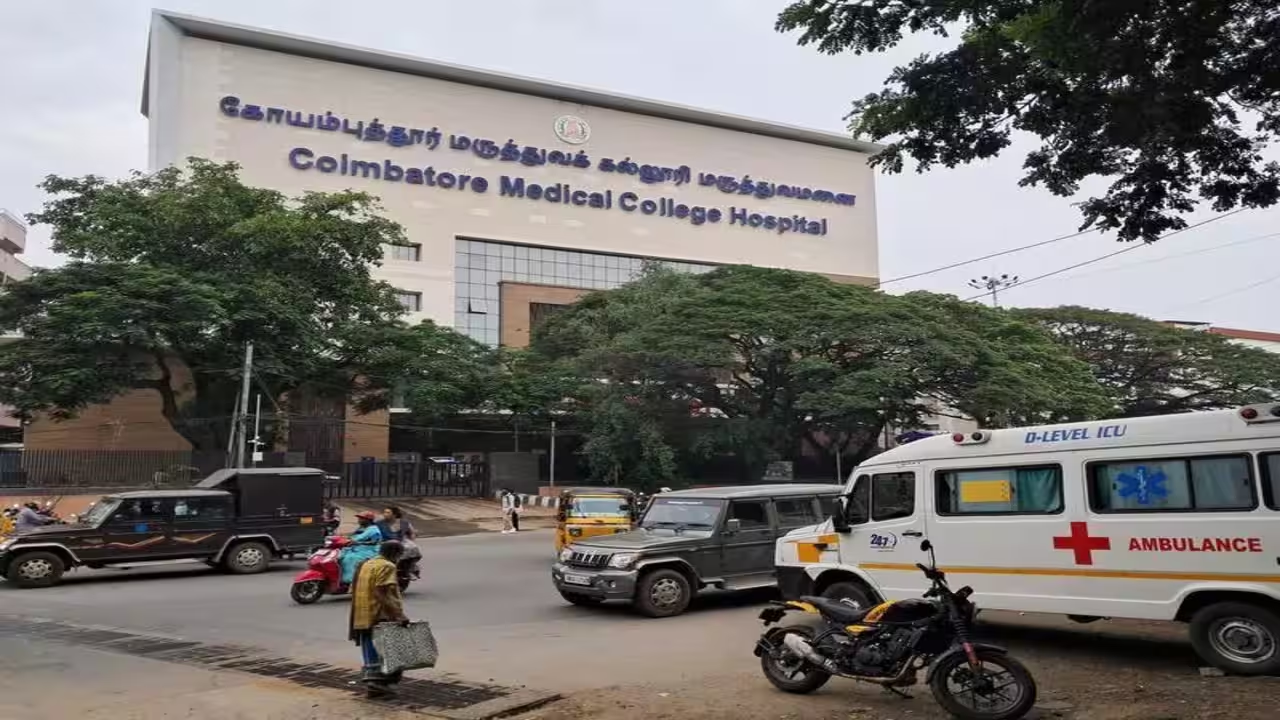
A pioneering prosthetic limb service at Coimbatore Medical College Hospital (CMCH) has received the Tamil Nadu Chief Minister’s Best Practices Award, recognising a model that has brought free, locally manufactured lightweight prostheses to hundreds of amputees while operating without a separate government capital allocation.
The lightweight artificial limb production centre, operated by the hospital’s Institute of Orthopaedics and Traumatology, was one of three initiatives selected for the 2026 award. CMCH Dean Dr M. Geethanjali received the honour during Tamil Nadu’s Independence Day celebrations.
For India’s prosthetics and orthotics community, the recognition is particularly notable because the programme demonstrates how a government hospital can integrate prosthetic fabrication, rehabilitation and multidisciplinary follow-up within the same public healthcare pathway.
Born during the Covid-19 pandemic
The CMCH artificial limb centre was established on 14 August 2020, during the Covid-19 pandemic. The initiative was developed by former Institute of Orthopaedics and Traumatology director Dr S. Vetrivel Chezian, who retired in July 2026.
Its purpose was straightforward: patients from Coimbatore and surrounding districts should not have to travel to Chennai simply to obtain an artificial limb.
Before the unit was established, many amputees in western Tamil Nadu faced either long journeys to specialist centres or the expense of seeking prosthetic care privately. The in-house centre created a district-level alternative within an existing tertiary government hospital.
That decentralisation is one of the most important aspects of the initiative.
For an amputee, obtaining a prosthesis can involve several visits for assessment, measurement, fabrication, fitting, alignment and gait training. Moving those services closer to the patient can reduce both travel costs and the risk that individuals simply drop out of the rehabilitation pathway.
More than 300 people have now received prostheses
CMCH says more than 300 people from 22 districts across Tamil Nadu have now benefited from prosthetic limbs manufactured through the centre.
Earlier figures published in 2025 showed that 213 patients had already received devices, including 102 people with trauma-related amputations, 74 associated with diabetic foot complications and 32 linked to peripheral vascular disease.
Those figures illustrate the changing nature of amputation care in India.
Trauma remains an important cause of limb loss, but diabetes and vascular disease are also major contributors to the prosthetic caseload. This means prosthetic services increasingly need to sit within broader pathways involving diabetes management, vascular care, wound management and long-term rehabilitation.
CMCH has even treated paediatric cases. In 2025, the hospital reported supplying a customised prosthetic leg to a three-year-old child following an above-knee amputation related to a congenital condition.
A multidisciplinary model
One of the strongest features of the CMCH programme is that it does not stop at fabrication.
Patients requiring prosthetic rehabilitation are admitted under the orthopaedic team, with around 10 beds specifically used for people with limb loss. Prosthetists manufacture the artificial limbs, physiotherapists provide gait training, occupational therapists deliver occupational counselling and psychiatric support is available to address mental wellbeing.
That approach reflects what high-quality prosthetic rehabilitation should look like.
A prosthesis is only one element of the process.
A new amputee may need strengthening, balance training, gait re-education, residual-limb care, confidence building and assistance returning to work or other daily activities.
By placing these services within one hospital-based pathway, CMCH has created a model in which the device and rehabilitation programme are delivered together.
Funding without a separate government allocation
The financial structure behind the centre was one of the factors highlighted in the Best Practices Award.
CMCH says approximately ₹20 lakh was required for the infrastructure and accessories needed to establish the service, but no additional government allocation was requested. Instead, the department used funds generated through the Tamil Nadu Chief Minister’s Comprehensive Health Insurance Scheme and related orthopaedic reimbursement.
The centre reports that, after accounting for expenditure and insurance claims, the programme has generated a surplus of approximately ₹82.20 lakh, which has been reinvested into recurring expenses and further infrastructure development.
This aspect makes the programme particularly interesting for other government hospitals.
Rather than viewing an in-house P&O workshop solely as a cost centre, the CMCH experience suggests that appropriately structured reimbursement can potentially allow prosthetic services to become financially sustainable while still providing devices free of charge to eligible patients.
A model that could be replicated elsewhere
The Chief Minister’s Best Practices Award is intended to recognise government initiatives that are innovative, effective and capable of improving public service delivery. In 2026, CMCH’s prosthetic programme was selected in the government-body category.
For Bharat CPO, the most important question is whether the model could be replicated elsewhere.
India has government medical colleges across almost every state, many with orthopaedic departments, physiotherapy services and access to public insurance programmes.
Adding appropriately staffed P&O units to selected regional hospitals could potentially reduce the dependency on a relatively small number of specialist rehabilitation centres.
But successful replication would require more than purchasing workshop equipment.
It would require qualified prosthetists and orthotists, reliable component supply chains, clinical protocols, gait rehabilitation, follow-up services and a reimbursement mechanism that recognises the full cost of prosthetic care.
Recognition for the CPO role
The award also provides valuable visibility for the role of the prosthetist within a large public hospital.
In many discussions around amputation care, attention understandably focuses on the surgeon and the surgical procedure.
Yet the patient’s long-term mobility is often determined by what happens afterwards.
The quality of socket fit, alignment, component selection and follow-up can have a major impact on comfort, walking ability and whether a prosthesis is ultimately used successfully.
The CMCH model places the prosthetist within the wider rehabilitation team rather than treating prosthetic fabrication as a separate technical service.
That is an important distinction for the development of the profession in India.
From local initiative to recognised best practice
What began in 2020 as a relatively small attempt to prevent patients travelling hundreds of kilometres for prosthetic care has now developed into an award-winning service used by patients from 22 districts of Tamil Nadu.
Its achievement is not based on an expensive new building or a major standalone government programme.
Instead, the centre has combined existing hospital infrastructure, professional expertise and insurance funding to create a functioning prosthetic rehabilitation pathway.
For India’s P&O sector, that may be the most important lesson from Coimbatore.
Expanding access to prosthetic care does not always require building entirely new rehabilitation institutions.
Sometimes it requires giving an existing hospital the people, workshop capacity and financial mechanism to provide the service locally — and integrating the CPO properly into the clinical team.
CMCH’s Chief Minister’s Best Practices Award suggests that Tamil Nadu now sees that approach not only as a successful prosthetic programme, but as a public healthcare model worth recognising.
- The Hindu – Coimbatore Medical College Hospital’s prosthetic limb initiative wins CM’s Best Practices Award
- The New Indian Express – Artificial limb production centre at CMCH receives CM’s Best Practices Award
- Coimbatore Medical College
- Tamil Nadu Health & Family Welfare Department
- Chief Minister’s Comprehensive Health Insurance Scheme
- Bharat CPO