
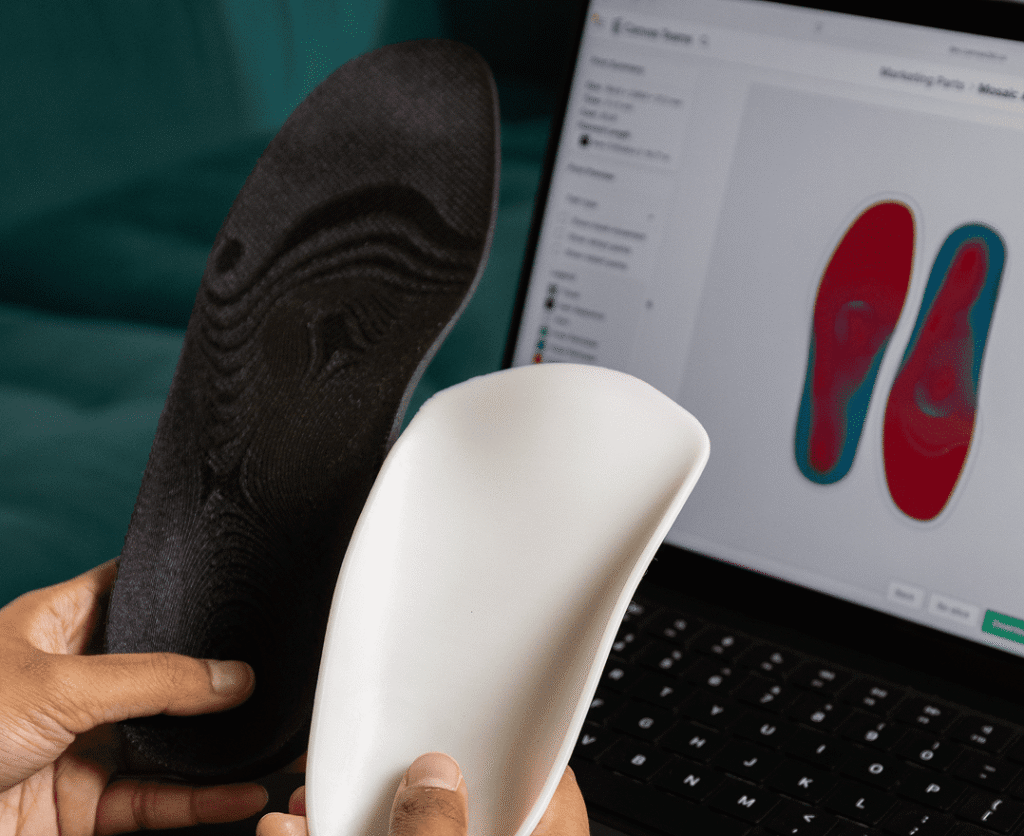
3D foot scanning is becoming one of the most visible signs of digital transformation in orthotics.
For many clinics, replacing foam impression boxes or plaster casting with a scanner feels like a major technological leap. Patient intake becomes cleaner, measurements can be stored digitally and scans can be transferred without physically shipping casts.
But according to a recent article from Mosaic Manufacturing, clinics and laboratories may be focusing on the wrong part of the problem.
The company argues that 3D scanning on its own does not automatically increase production capacity. The scanner digitises the foot, but the real operational advantage emerges only when that data flows through a standardised digital design and manufacturing system.
For India’s rapidly developing orthotics sector, that distinction deserves attention.
Buying a scanner does not make a laboratory digital
A clinic can capture an excellent 3D representation of a patient’s foot and still operate a largely manual production process afterwards.
Mosaic points out that small and medium-sized orthotics laboratories can continue experiencing bottlenecks caused by technician-dependent interpretation, manual grinding, variable wall thickness and production pressure during busy periods. These inconsistencies can contribute to adjustments, remakes and delays.
That is an important lesson for Indian orthotists, podiatrists and foot-orthotics businesses considering investment in digital technology.
The scanner should not be viewed as the digital workflow.
It is simply the entry point.
A complete system potentially involves:
Patient assessment → 3D scan → digital prescription → CAD design → production management → 3D printing or milling → finishing → fitting → digital patient record
If several stages remain heavily dependent on manual interpretation, much of the potential efficiency gained during scanning can disappear further down the production chain.
Standardisation may be more important than speed
One of the strongest arguments for digital orthotics is not necessarily that a computer can produce an orthosis faster.
It is that a properly designed digital workflow can make the process more repeatable.
Mosaic describes a connected workflow in which scans captured through its Stryde Scan system move into digital design, production management and ultimately manufacturing. The company argues that this approach can help preserve characteristics such as arch geometry, heel containment and device stiffness between repeated builds.
This could be particularly relevant in India.
A growing orthotics business may begin with one experienced technician who understands exactly how a clinician wants an orthosis manufactured.
But what happens when the business expands to five technicians?
Or five clinics?
Or prescriptions start arriving from clinicians hundreds of kilometres away?
The challenge quickly changes from “Can we manufacture this orthosis?” to “Can we manufacture it the same way every time?”
Digital systems can potentially capture some of that production knowledge within software rather than leaving it entirely with an individual technician.
India could benefit from distributed digital orthotics
India’s geography creates an especially interesting opportunity.
The clinician who assesses the patient does not necessarily need to be located beside the laboratory manufacturing the device.
A digital foot scan can potentially be captured in one city, designed elsewhere and manufactured at a central production facility.
That creates the possibility of a hub-and-spoke model.
A podiatrist, physiotherapist, orthotist or diabetic-foot clinic could become the clinical assessment and scanning point, while specialist orthotics laboratories handle design and production centrally.
For smaller clinics, this could lower the barrier to providing custom foot orthotics because they would not necessarily need their own complete manufacturing workshop.
For larger laboratories, it creates the potential to serve a much wider network of clinicians.
The commercial opportunity is therefore not simply selling more 3D scanners.
It is building connected digital orthotics networks.
Labour dependence is another important consideration
Traditional custom orthotics manufacturing frequently involves skilled manual processes.
These skills remain valuable, but scaling a production business around them can be difficult.
Mosaic identifies labour dependency as one of the constraints facing small and mid-sized orthotics laboratories. Its argument is that automated digital manufacturing can reduce the degree to which production capacity depends on individual technicians and physically intensive production steps.
That does not mean removing the orthotist or technician from the process.
Clinical reasoning still determines what the patient requires.
The opportunity is instead to allow skilled professionals to spend more time on tasks where their expertise has the greatest value, rather than repeating manufacturing steps that can potentially be standardised or automated.
Materials remain central to clinical outcomes
Another important point raised by Mosaic is that the move to 3D printing cannot be separated from materials.
Traditional orthotics laboratories understand materials such as EVA and polypropylene extremely well. Clinicians know approximately how different thicknesses and densities behave under load.
Printed materials need to provide similarly predictable performance.
Mosaic has developed materials including Aero, which it positions for EVA-style accommodative applications, and Form, which is intended to provide controlled stiffness for functional orthotics.
But the wider lesson is more important than any single material.
Digital manufacturing must reproduce clinical intent, not simply anatomical shape.
An orthosis may look perfect on a computer screen but still fail clinically if cushioning, stiffness, flexibility or load distribution are inappropriate.
3D printing changes the economics of customisation
Automated additive manufacturing also offers a different production model.
Traditional fabrication often involves producing one device through a sequence of labour-intensive steps.
Digital manufacturing makes it possible for a production system to manufacture multiple patient-specific devices from digital files with less intervention between each pair.
Mosaic says its orthotics-focused production systems are designed around predictable, repeatable production and reduced labour per pair, with its Orion platform positioned for approximately 300 pairs per month under specified conditions.
Those figures are manufacturer claims and will naturally vary according to prescription, material, device design and actual laboratory utilisation.
But the direction of travel is significant.
Custom manufacturing is increasingly adopting techniques historically associated with mass production.
Each patient’s orthosis can remain unique while the manufacturing process itself becomes standardised.
A major opportunity for India’s O&P profession
India has the potential to become an important market for digitally manufactured foot orthotics.
The opportunity includes far more than orthopaedic workshops.
Diabetic-foot clinics, podiatrists, physiotherapists, sports medicine centres, footwear businesses and rehabilitation providers can potentially participate in a digital prescription network.
For CPOs, that creates both opportunity and competition.
The clinical expertise of the orthotist becomes even more important when manufacturing itself becomes easier to distribute.
The differentiator will increasingly be the ability to assess the patient correctly, translate biomechanics into an appropriate prescription and determine whether the manufactured device actually achieves the intended clinical outcome.
Technology can automate production.
It cannot automatically decide what the patient needs.
The scanner is the front door, not the factory
Perhaps the most useful takeaway from Mosaic’s article is that clinics should avoid evaluating a 3D scanner in isolation.
Mosaic argues that organisations should instead ask whether the broader system can reliably transform the captured anatomy into repeatable physical devices.
That is an especially relevant question for Indian clinics currently planning digital investments.
The first wave of digital orthotics was largely about replacing plaster and foam impressions with scanners.
The next wave is likely to be about connecting those scanners to CAD, automated manufacturing, validated materials and scalable production infrastructure.
India does not simply need more digital scans.
It needs systems capable of turning those scans into consistently good orthoses.
And that is where the real digital transformation of foot orthotics begins.
- Mosaic Manufacturing – 3D Scanning for Foot Orthotics
- Mosaic Manufacturing – Traditional vs 3D Printed Orthotics
- Mosaic Manufacturing – Orthotics
- International Society for Prosthetics and Orthotics
- Bharat CPO