
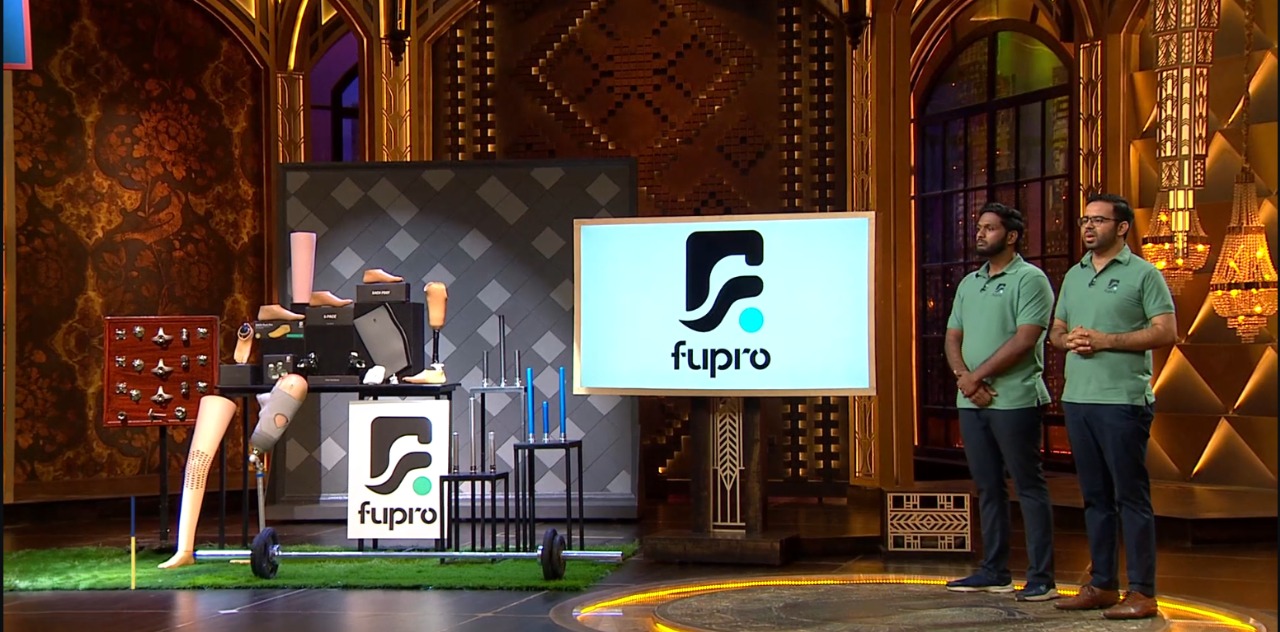
For decades, one of the central challenges facing Indian prosthetics has been a difficult compromise between access and technology.
At one end of the market are low-cost and charitable prosthetic solutions designed primarily to make basic mobility available to as many people as possible. At the other are sophisticated international prosthetic components offering higher levels of performance, but frequently at prices that put them beyond the reach of many Indian patients.
Indian prosthetic manufacturer FUPRO believes there should be a third option: locally engineered components that combine international-level manufacturing standards with pricing designed around the realities of the Indian healthcare market.
Operating from its facility in Mohali, Punjab, the company is building a growing range of prosthetic components around a straightforward objective — making better prosthetic technology available to many more amputees.
Its stated vision is ambitious: quality prosthetic components should become a standard rather than something determined by a patient’s income or location.
The access gap remains enormous
FUPRO estimates that India has more than four million people living with limb loss, while fewer than one in ten have access to what the company describes as quality prosthetic care.
Whatever methodology is used to estimate India’s total amputee population, the wider access challenge is familiar to virtually every CPO working in the country.
India has excellent specialist rehabilitation centres and increasingly advanced private P&O practices, but access remains highly uneven.
A patient treated in Mumbai, Delhi, Bengaluru or another large city may have access to a wide choice of components and technologies.
Someone living in a smaller district may instead depend on whatever products are available locally, a government programme or an occasional charitable camp.
FUPRO’s proposition is that improving this situation requires more than simply producing additional prostheses.
The components inside those prostheses also need to improve.
Between basic and unaffordable
The company describes the historic prosthetic market in India as being dominated by two broad choices: free but basic, or world-class but unaffordable.
That description simplifies a much more diverse sector, but it captures an important commercial and clinical problem.
Imported high-performance components can become expensive once international pricing, freight, distribution margins and currency movements are taken into account.
At the other end of the spectrum, affordability programmes frequently need to prioritise cost and volume.
The result can leave a substantial group of amputees somewhere in between.
These are patients who may be working, raising families and travelling independently, and who require durable, functional prosthetic systems — but cannot necessarily justify or afford premium imported technology.
FUPRO is positioning itself directly within that middle ground.
Engineering around Indian conditions
The company says its development philosophy begins with the environment in which its components will actually be used.
That means considering Indian anatomy, terrain, climate and everyday mobility requirements during the engineering process.
This is an important point.
A prosthetic component does not operate in a laboratory.
It may be used on uneven roads, stairs, agricultural land or crowded public transport. It may be exposed to dust, heat, humidity and intensive daily use.
For many users, reliability and repairability can be more important than an extensive list of advanced features.
FUPRO’s challenge is therefore to engineer products that achieve an appropriate balance between performance, durability and price.
More than 35 prosthetic products
According to FUPRO’s latest company information, its portfolio now contains more than 35 prosthetic products.
The company also reports five patented innovations, suggesting that its strategy extends beyond manufacturing conventional components at a lower cost and into developing its own intellectual property.
That evolution is important for India’s wider P&O industry.
For many years, the country has had substantial capability in fabrication and low-cost prosthetic provision.
The next phase is increasingly about developing Indian-owned product technology, with local companies designing and engineering components rather than simply reproducing existing concepts or distributing imports.
A stronger domestic component industry could also make CPOs less dependent on long international supply chains.
FUPRO reaches more than 50,000 lives
The company states that its products have now helped restore mobility for more than 50,000 people.
FUPRO products are being exported to more than nine countries, indicating that the company is increasingly looking beyond the domestic Indian market.
That export ambition is significant.
India is not the only country facing the affordability-versus-technology dilemma.
Across South Asia, Africa and parts of the Middle East, CPOs frequently work with patients who need robust and clinically appropriate prosthetic technology but cannot afford products developed primarily for high-income reimbursement systems.
If Indian manufacturers can achieve consistent quality at significantly lower price points, the potential market is much larger than India alone.
Standards become essential as Indian manufacturing grows
FUPRO highlights a number of manufacturing and quality credentials, including:
- ISO 9001
- ISO 13485
- WHO GMP
- CE
For CPOs evaluating new manufacturers, quality systems are becoming increasingly important.
Price alone should not determine component selection.
Prosthetic products are subjected to repeated mechanical loading and are relied upon by users every day. Failure can result not simply in inconvenience but in falls and injury.
As more Indian companies enter advanced prosthetic manufacturing, demonstrating repeatable production, testing, traceability and quality control will therefore become crucial to earning clinician confidence.
FUPRO says rigorous testing is incorporated throughout its manufacturing process at Mohali.
Why domestic manufacturing matters to CPOs
A larger Indian prosthetic manufacturing base can create several advantages for clinicians.
Products manufactured domestically can potentially offer:
- Shorter delivery times
- Reduced exposure to currency fluctuations
- Easier access to spare parts
- Faster warranty support
- Closer communication with product engineers
- Lower inventory costs
- Technology designed around local clinical requirements
That last point may become particularly important.
Indian CPOs treat an enormous range of patient profiles, from highly active urban professionals to elderly dysvascular amputees and people receiving services through rural camps.
A domestic manufacturer able to obtain direct feedback from those clinicians has an opportunity to develop products around real local requirements.
India’s CPOs will ultimately decide whether the model works
Manufacturing claims and certifications are important, but widespread clinical adoption ultimately depends on prosthetists.
CPOs need components that are predictable, easy to align, durable and supported after the sale.
They also need confidence that a product specified today will remain available when that patient returns several years later.
This is particularly important as Indian manufacturers attempt to move from competing primarily on price towards competing on clinical value.
If a domestic component provides appropriate functionality while substantially lowering the total cost of a prosthesis, it potentially allows the clinician to provide better technology to a wider group of patients.
That is where locally engineered products could have their greatest impact.
Could India become a global prosthetic manufacturing hub?
FUPRO’s expansion also reflects a larger opportunity for India’s medical-device industry.
India has already established enormous capabilities in pharmaceuticals, engineering, software and manufacturing.
Prosthetics represents a much smaller sector, but the underlying opportunity is similar.
The country has:
- A large domestic patient population
- A growing CPO workforce
- Strong engineering capabilities
- Lower manufacturing costs than many Western markets
- Access to rapidly expanding rehabilitation markets across Asia, Africa and the Middle East
This creates the foundations for India to become not simply a consumer of international prosthetic technology but a major developer and exporter of it.
Companies such as FUPRO will be part of determining whether that potential is realised.
Quality cannot remain a privilege
Perhaps the most important statement in FUPRO’s positioning is its aspiration for every prosthetic limb built in India — whether in a large hospital, district clinic or rural camp — to contain high-quality components.
That will not happen through one manufacturer alone.
It will require better reimbursement, stronger P&O services, professional education, appropriate product regulation and competition between multiple Indian manufacturers.
But lowering the cost of quality components is clearly part of the solution.
The next stage of India’s prosthetic development may therefore not be defined by choosing between basic affordability and advanced technology.
It may increasingly be about eliminating that choice.
If companies such as FUPRO can demonstrate that well-engineered, internationally compliant prosthetic components can be manufactured in India at prices suited to Indian healthcare, they could help create a much larger middle market — one where better prosthetic performance is available to ordinary patients rather than only those able to afford premium imports.
For India’s amputees, that is the third path FUPRO says it wants to build.
- FUPRO – Official Website
- Bureau of Indian Standards
- Central Drugs Standard Control Organisation
- Department of Empowerment of Persons with Disabilities
- Rehabilitation Council of India
- International Society for Prosthetics and Orthotics
- Bharat CPO