
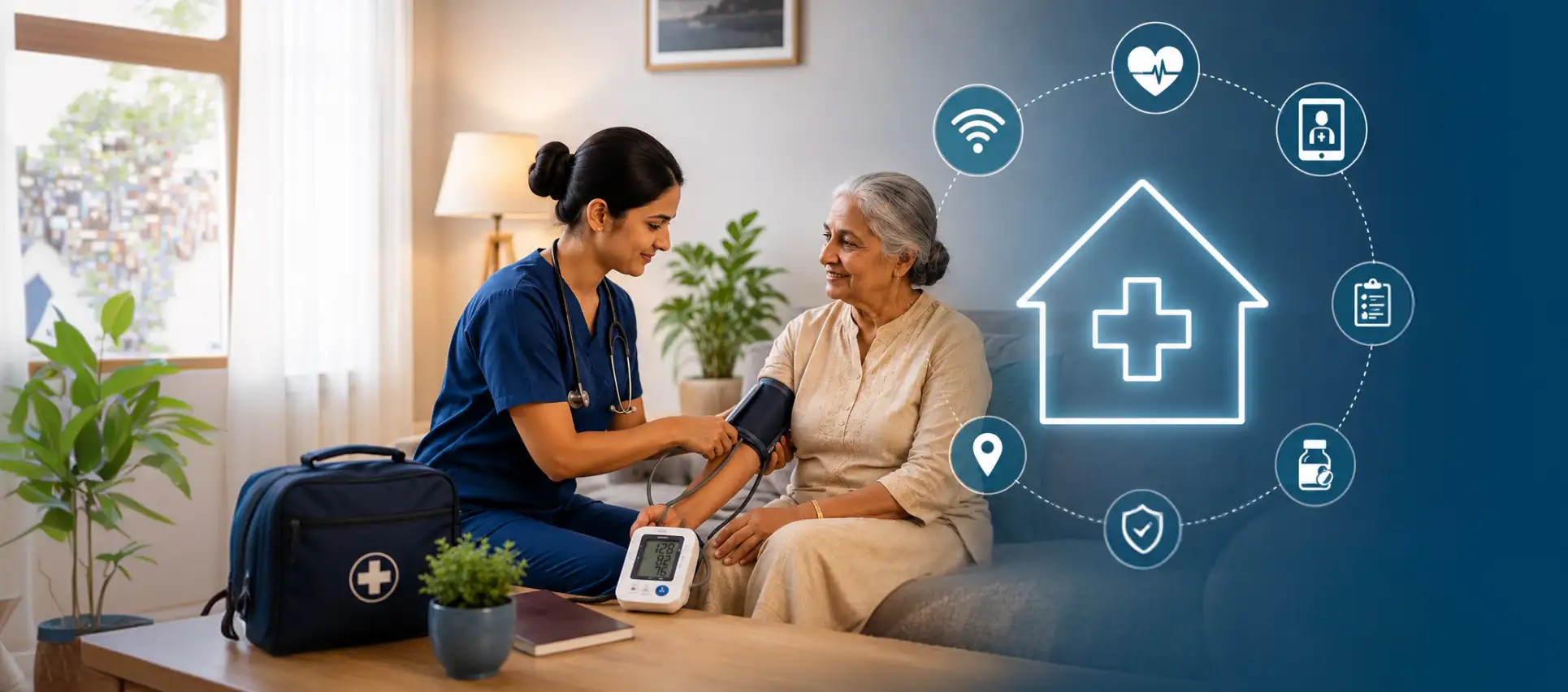
Home healthcare in India is rapidly moving beyond traditional post-discharge support and elderly care, becoming a broader extension of the hospital itself.
A recent Digital Health News feature argues that connected medical devices, remote patient monitoring, artificial intelligence and digital health platforms are beginning to make it possible for clinically meaningful care to continue in patients’ homes rather than ending at the hospital door.
For India’s prosthetics and orthotics community, this shift could be particularly significant.
P&O care has always depended on repeated interaction with the patient. A prosthesis may require alignment changes, socket modifications and gait review. An orthosis may need adjustment as a child grows or a neurological condition changes. A person with diabetes may require regular monitoring long before a wound develops.
The growth of connected home healthcare could therefore allow CPOs to remain involved with patients between clinic visits and potentially identify problems earlier.
Hospitals are becoming one part of a larger care network
Digital Health News describes home healthcare as evolving into a strategic extension of hospitals, driven by an ageing population, rising chronic disease, increasing healthcare costs and demand for continuous care outside traditional facilities.
The wider implication is that the future healthcare system may become less dependent on a patient repeatedly travelling to a hospital.
Instead, hospitals could operate as one node within a wider connected network involving the home, community clinics, diagnostic services and remote specialists.
That model has obvious relevance to rehabilitation.
A patient may still need to visit a P&O clinic for casting, scanning, fitting or major adjustments, but much of the follow-up surrounding those appointments could potentially take place remotely.
Prosthetic follow-up could become more continuous
A prosthetic user often leaves the clinic at the point when the most important real-world testing is about to begin.
Walking for ten minutes in a rehabilitation room does not necessarily reproduce what happens during a full day at work, climbing stairs at home or walking outdoors in heat.
Remote follow-up could help bridge that gap.
Future connected prosthetic care could allow CPOs to review:
- Daily step counts and activity levels
- Changes in gait pattern
- Device usage time
- Patient-reported comfort
- Socket-related skin problems
- Falls or instability
- Changes in mobility over time
- Rehabilitation progress
Some prosthetic systems and wearable activity monitors already make parts of this possible.
The next step is integrating those data into a structured care pathway rather than treating them as isolated information.
Not every problem requires a physical clinic visit
Prosthetic and orthotic practice will always remain highly physical.
A clinician cannot replace a detailed residual-limb assessment, socket modification or hands-on orthotic fitting entirely through video.
But many follow-up questions do not necessarily require the patient to travel several hours to a specialist centre.
A video consultation may be sufficient to determine whether a problem requires immediate in-person assessment.
A CPO might remotely review gait, check whether a strap is being applied correctly, examine visible skin irritation or guide a patient through simple troubleshooting.
For someone living in a rural district, that can mean the difference between receiving advice quickly and postponing care for weeks.
India’s geography makes the home-care model particularly relevant
India has specialist rehabilitation expertise, but it is not distributed evenly.
Many advanced prosthetic and orthotic centres remain concentrated in larger cities.
Patients living in rural areas can face significant travel costs and may need family members to accompany them.
That becomes especially challenging when care requires multiple appointments.
Connected home healthcare could help create a hub-and-spoke model in which specialist CPOs based in regional centres support patients and local healthcare workers remotely.
The specialist clinic would continue to perform high-level assessment and fabrication, while community professionals could assist with routine monitoring and basic follow-up closer to the patient.
Orthotics may be particularly suited to hybrid care
Orthotic patients can require frequent review because their clinical condition or body dimensions may change over time.
This is especially true in paediatrics.
A child using an AFO for cerebral palsy may grow rapidly, while changes in gait or muscle tone can alter the effectiveness of the device.
Remote follow-up could allow parents to show the CPO:
- Redness or pressure areas
- Changes in gait
- Strap positioning
- Heel seating
- Shoe compatibility
- Apparent growth-related fit problems
The clinician could then decide whether the issue can be managed with advice or whether the child needs to return for modification or replacement.
This could reduce unnecessary travel while also preventing families from continuing to use an orthosis that no longer fits.
Diabetic foot care could move much closer to the home
One of the largest opportunities may be diabetic-foot management.
A high-risk diabetic patient does not necessarily need to wait for an ulcer before entering specialist care.
Connected home systems could potentially incorporate temperature monitoring, photographs, pressure information and patient-reported symptoms.
Patients could be prompted to inspect their feet regularly and submit information to a clinical team when concerns appear.
CPOs and podiatrists could then become part of a preventive network involving diabetologists, nurses and wound-care specialists.
For India, where diabetic-foot complications contribute substantially to lower-limb morbidity and amputation, moving monitoring closer to the patient could have significant value.
Remote patient monitoring is becoming part of mainstream digital health
Remote patient monitoring is one of the technologies helping drive the wider home-healthcare movement described by Digital Health News.
Connected medical devices can transmit clinical information directly to healthcare teams, potentially allowing changes to be identified without waiting for the next appointment.
In rehabilitation, that concept can extend beyond conventional vital signs.
Wearable sensors could monitor movement.
Pressure sensors could identify loading patterns.
Smart orthoses and prostheses could track how frequently a device is used.
Activity monitors could show whether a patient is becoming more active after receiving a new prosthesis.
For CPOs, this would introduce a new type of outcome measurement: what happens to the patient after they leave the clinic.
AI could help identify which patients need attention
Artificial intelligence is another technology cited as supporting the growth of connected home care in India.
Its most useful role in P&O may not initially be designing the device.
It could instead help clinicians manage large numbers of patients.
If a clinic had hundreds of patients sending activity or follow-up data, AI systems might help identify unusual changes:
- A sudden reduction in prosthesis use
- Increasing falls
- Reduced walking activity
- Repeated reports of discomfort
- Persistent skin problems
- Declining orthotic compliance
The system could then flag those patients for clinician review.
That would allow specialist time to be focused on cases most likely to require intervention.
Home healthcare could also change business models
The shift towards connected care may eventually affect how rehabilitation services are funded.
Traditional P&O reimbursement often focuses heavily on the device itself.
But ongoing remote monitoring, digital follow-up and rehabilitation support represent services rather than products.
If home healthcare becomes more integrated into hospital systems, insurers and public healthcare programmes may increasingly need to recognise the value of these ongoing services.
For Indian CPO clinics, that could create a move away from a purely transactional model in which revenue is generated primarily when a new prosthesis or orthosis is supplied.
A connected-care model could instead place more emphasis on long-term patient management.
Technology cannot replace access to a qualified CPO
There is also a risk that home healthcare becomes interpreted simply as another technology market.
A connected device is only useful if someone is responsible for interpreting the information and acting on it.
For prosthetics and orthotics, the clinical role remains central.
A sensor can report pressure.
An activity monitor can record steps.
A camera can show redness.
But a qualified professional still needs to determine what the information means and whether the intervention should be adjusted.
The future is therefore unlikely to be remote care instead of CPO care.
It is more likely to be CPO care delivered across a wider combination of clinic, home and digital environments.
A new definition of the P&O clinic
India’s healthcare system is moving towards a model in which care no longer has to remain within the walls of a hospital. Digital Health News argues that hospitals themselves could become just one part of a broader digitally connected care ecosystem over the coming decade.
The same principle could apply to prosthetics and orthotics.
The future P&O clinic may still contain plaster rooms, scanners, alignment equipment and workshops.
But it may also include remote patient dashboards, video consultations, wearable sensor data and digital outcome monitoring.
For Bharat CPO, that evolution could be particularly important.
India does not simply need more rehabilitation centres.
It needs ways of allowing the expertise within those centres to reach patients much further away.
Home healthcare, if integrated properly with qualified clinical care, could become one of the tools that makes that possible.
- Digital Health News – Home Healthcare in India: The Next Frontier of Connected Care
- Digital Health News
- Ayushman Bharat Digital Mission
- Department of Empowerment of Persons with Disabilities
- Rehabilitation Council of India
- Bharat CPO