
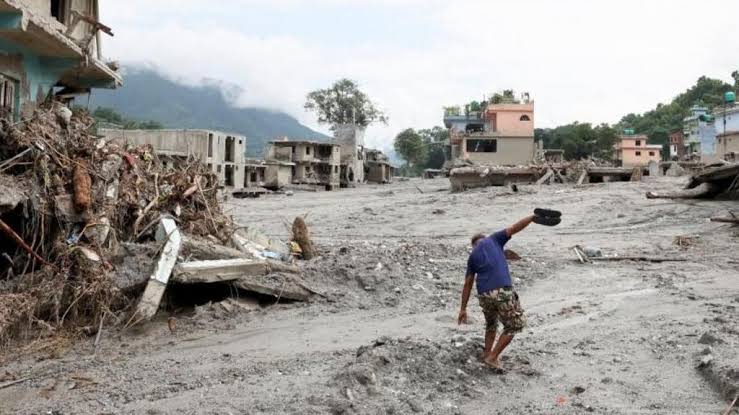
The catastrophic flash floods that struck Nepal’s Bhotekoshi River corridor on 26 August 2026 have created an urgent need for rehabilitation services to be integrated into the country’s emergency response.
A powerful surge of water, mud and debris swept through communities in northern and central Nepal, causing extensive loss of life and destroying homes, roads, bridges, schools, hydropower facilities and essential public infrastructure.
According to an update from Nepal’s National Disaster Risk Reduction and Management Authority reported on 29 August, 626 people had been confirmed dead, 2,426 remained missing or unaccounted for, and 4,451 had been rescued. At least 101 injured people were receiving hospital treatment. Authorities warned that these figures were preliminary and likely to change as rescue teams reached previously inaccessible areas.
The International Society of Physical and Rehabilitation Medicine and its international network have expressed solidarity with the people of Nepal and with the country’s rehabilitation professionals, including the Nepalese Society of Physical Medicine and Rehabilitation.
Their central message is clear: rehabilitation cannot wait until search-and-rescue operations end or reconstruction begins.
Rehabilitation must start during the emergency
Survivors of floods, landslides and structural collapse may sustain crush injuries, fractures, peripheral nerve injuries, spinal cord injuries, traumatic brain injuries and limb loss. Others may develop respiratory complications, pressure injuries, contractures or loss of mobility following prolonged immobilisation.
Older people, children and people with pre-existing disabilities are particularly vulnerable when wheelchairs, orthoses, prostheses, walking aids or communication devices are lost or damaged. Destruction of roads and health facilities can also separate patients from the services and medication they previously depended upon.
Early rehabilitation in this environment does not mean beginning a conventional outpatient programme while the emergency continues. It means bringing functional assessment, safe positioning, mobility, respiratory care, pressure management and discharge planning into acute medical treatment from the beginning.
“Rehabilitation is not only a component of recovery. It is an essential part of saving function, preventing disability, and restoring lives,” said Dr Raju Dhakal, president of the Nepalese Society of Physical Medicine and Rehabilitation.
Immediate priorities for affected communities
The rehabilitation response must begin with early assessment of injured survivors in hospitals, emergency treatment centres and temporary shelters. This allows teams to identify people at risk of avoidable complications and plan appropriate referral or follow-up.
Immediate priorities include:
- Emergency medical treatment accompanied by early functional assessment
- Safe positioning, mobilisation and prevention of secondary complications
- Provision and repair of wheelchairs, crutches, walking frames, splints and other assistive products
- Psychological first aid, trauma counselling and longer-term mental health support
- Clear referral pathways between acute hospitals and specialist rehabilitation services
- Identification and continued support of people with pre-existing disabilities
- Community-based rehabilitation for survivors returning to remote or inaccessible areas
Prosthetists and orthotists have an important role within this response, although many interventions in the first days will involve temporary rather than definitive devices. Orthotic management may be required for fractures, neurological injuries, spinal trauma and soft-tissue protection. People who have lost an existing prosthesis or orthosis may need urgent repair, replacement or an interim mobility solution.
Where amputation is unavoidable, coordinated residual-limb management, positioning, wound care and patient education can prepare the individual for later prosthetic rehabilitation. Premature provision of a definitive prosthesis, before wounds and limb volume have stabilised, should be avoided.
India can support Nepal—but coordination is essential
Nepal’s geographic proximity and close relationship with India create a clear opportunity for Indian rehabilitation institutions, professional associations, hospitals and manufacturers to offer support. India has significant capacity in trauma care, prosthetics, orthotics, spinal injury management, assistive technology and community-based rehabilitation.
However, outside organisations must work through Nepalese authorities and established local rehabilitation services. Uncoordinated donations can leave affected communities with unsuitable devices, missing components and products that cannot be repaired locally.
International guidance consistently emphasises that wheelchairs and other assistive products must be selected and fitted according to the individual user, their environment and their functional requirements. Sending large quantities of unidentified braces, used prostheses or incorrectly sized mobility devices can create logistical burdens without improving outcomes.
Indian organisations seeking to assist should therefore ask Nepalese partners what is actually needed. Useful contributions may include technical personnel requested by local authorities, standardised emergency mobility products, repair materials, orthotic components, clinical training, accessible transport, funding and support for local procurement.
The objective must be to strengthen Nepal’s response—not establish a parallel system that disappears when the initial emergency attention fades.
Continuity will be one of the greatest challenges
The destruction of roads and bridges means that some survivors may be discharged to communities with limited access to rehabilitation follow-up. A patient who receives emergency surgery may still face permanent functional loss if rehabilitation ends at hospital discharge.
Every person leaving acute care with a serious injury should therefore have an understandable plan covering mobility, skin and wound monitoring, precautions, required assistive products, follow-up appointments and a named referral service.
Where travel is impossible, rehabilitation teams may need to combine outreach visits, telephone follow-up, tele-rehabilitation and community health-worker support. Patient records should also accompany people who are transferred between emergency facilities, district hospitals and specialist centres.
Long-term needs are likely to include prosthetic fitting, orthotic management, spinal cord injury rehabilitation, vocational rehabilitation, home modification, return-to-school programmes and psychosocial support. These requirements will continue long after international attention moves elsewhere.
Rebuilding for accessibility and resilience
Reconstruction offers Nepal an opportunity to replace damaged infrastructure with schools, clinics, shelters, transport systems and public buildings that are accessible to people with disabilities.
Accessibility should be included during planning rather than added after construction. Step-free entrances, usable sanitation facilities, accessible evacuation routes, clear signage and safe community shelters can benefit injured survivors, older people, children and those living with disabilities.
The Bhotekoshi disaster is still an active emergency. Yet decisions made now will influence whether survivors retain function, return to their families and communities, and rebuild independent lives.
For India’s rehabilitation and O&P community, the most valuable response will combine urgency with humility: listen to Nepalese professionals, respond to verified needs, support local capacity and remain engaged throughout the long recovery ahead.
- National Disaster Risk Reduction and Management Authority, Nepal
- Nepal Health Emergency Operation Center
- International Society of Physical and Rehabilitation Medicine
- ISPRM Emergency Rehabilitation Committee
- Bhotekoshi flood update – The Kathmandu Post
- WHO rehabilitation in emergencies
- WHO emergency funding for Nepal’s flood response