
India has already demonstrated that it can manufacture footwear at an internationally competitive scale. Its next opportunity may lie in exporting fewer—but considerably more valuable—pairs built around design, craftsmanship, digital fitting and individual customer requirements.
That is the proposition advanced by footwear industry leader Basanta Parida, who argues that India should look beyond production capacity and the number of pairs shipped when considering the future of its footwear exports.
Bespoke footwear could offer a pathway from contract manufacturing towards higher-value products and direct relationships with international customers. For India’s orthotics, prosthetics and rehabilitation community, the same opportunity extends beyond luxury footwear into custom orthopaedic shoes, diabetic footwear and digitally manufactured foot orthoses.
India may be able to export not only a shoe, but an integrated foot assessment, design and personalised manufacturing service.
Moving beyond competition on volume
India is the world’s second-largest producer and consumer of footwear, according to Invest India. The country’s leather and footwear sector employs more than 4.4 million people and includes established manufacturing clusters, skilled craftspeople, tanneries, component suppliers and training institutions.
This gives India a substantial industrial base, but much of the country’s export activity remains connected to contract production, private-label manufacturing and price-sensitive international orders. In these models, much of the brand value, customer data and retail margin may remain outside India.
Parida’s proposal is to move further up the value chain by bringing together:
- Indian shoemaking and leatherworking skills
- Internationally relevant design
- Digital foot scanning and fit technology
- Made-to-measure construction
- Small-batch, flexible manufacturing
- Global e-commerce and fulfilment
- Direct after-sales relationships with customers
A made-to-order model can also reduce inventory exposure. Instead of manufacturing large numbers of standard sizes and predicting which colours or designs will sell, production begins after the customer’s order and measurements have been received.
This could allow Indian companies to achieve a higher value per pair while reducing discounting, unsold inventory and dependence on wholesale intermediaries.
Bespoke requires more than craftsmanship
India’s history of shoemaking and leather craftsmanship provides a strong foundation, but craftsmanship alone will not create a globally recognised category.
An international customer ordering made-to-measure footwear expects consistent sizing, premium materials, accurate delivery times, transparent communication and an effective system for resolving fit problems. A beautifully constructed shoe that does not fit correctly will still be considered a failed product.
Bespoke footwear therefore requires an ecosystem connecting foot measurement, last design, material selection, pattern engineering, production control, quality assurance, packaging, export logistics and customer service.
It also requires a clear digital method for converting measurements or scans taken in London, Dubai, Riyadh or Singapore into a reliable shoe produced in Agra, Chennai, Kanpur or another Indian manufacturing centre.
India does not necessarily need to reproduce Italy’s luxury heritage or compete directly with China’s manufacturing scale. Its alternative proposition could be a distinctive combination of Indian craftsmanship, digital technology, customisation and greater global accessibility.
The connection with orthopaedic footwear
The opportunity becomes particularly relevant to Bharat CPO when bespoke manufacturing is extended into therapeutic and orthopaedic footwear.
A luxury bespoke shoe is made to satisfy an individual customer’s fit, comfort and aesthetic preferences. Custom orthopaedic footwear must additionally accommodate or manage a clinical condition. It may need to redistribute plantar pressure, accommodate a deformity, stabilise the foot and ankle, compensate for a leg-length discrepancy or protect tissue at risk of ulceration.
The CSIR–Central Leather Research Institute already operates a customised-footwear pathway involving physical assessment, gait analysis, plantar-pressure assessment and the collection of foot anthropometric data.
CLRI identifies potential users as including people with:
- Diabetic neuropathy and increased ulceration risk
- Hallux valgus, claw toes or hammer toes
- Flat, supinated or otherwise structurally atypical feet
- Leg-length discrepancy
- Heel or general foot pain
- Foot dimensions that do not correspond to standard shoe sizes
This is not a marginal clinical requirement. India’s large population of people living with diabetes creates substantial demand for footwear that reduces harmful plantar pressure and safely accommodates deformity. At the same time, international markets are seeking better solutions for ageing populations, diabetic-foot prevention, rheumatoid deformity and complex paediatric or neurological conditions.
India could develop export expertise in both premium bespoke shoes and clinically prescribed custom footwear, although the two categories must retain different assessment, documentation and quality-control requirements.
Digital scanning can connect assessment and production
Digital foot scanning could become the bridge between international customers and Indian manufacturing.
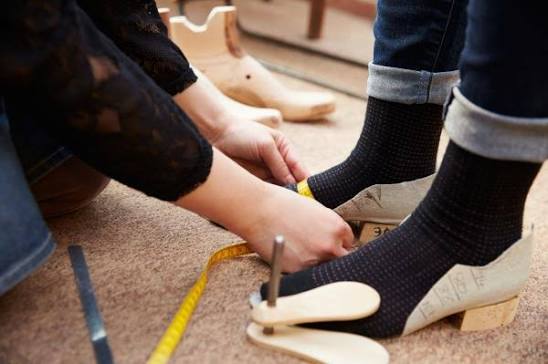
A scan can capture foot length, width, girth, arch profile and surface geometry more comprehensively than a single shoe-size number. When combined with photographs, plantar-pressure measurements, gait information and a clinical prescription, it can support the production of an individual last, foot orthosis or customised shoe.
The resulting workflow could allow a trained clinician or retail partner in another country to assess and scan the customer locally, transmit the data securely to India, and receive a completed product for fitting and verification.
For clinical footwear, however, scanning must not be mistaken for a complete assessment. A geometric model cannot independently identify neuropathy, vascular compromise, joint range, tissue vulnerability or the functional cause of abnormal loading. Orthotists, prosthetists, podiatrists, physiotherapists and footwear technologists remain essential to interpreting the data and translating it into an appropriate prescription.
Building a credible export ecosystem
India already has many of the required elements, including institutions such as CSIR-CLRI and the Central Footwear Training Institute in Agra, which provides education in footwear manufacture, design, CAD and product development.
The remaining challenge is to connect these capabilities into commercially reliable export pathways.
Success will require:
- Interoperable scanning and CAD systems
- Digitally designed individual lasts
- Standardised clinical and non-clinical order forms
- Traceable materials and manufacturing records
- Repeatable quality-control procedures
- Secure management of customer and health data
- Clear remake, adjustment and warranty policies
- International regulatory and product-compliance expertise
- Local fitting and follow-up partners in destination markets
- Training that connects traditional shoemakers with digital designers and clinicians
Clinical products also require appropriate evidence. Manufacturers must demonstrate not only that footwear is made to the requested dimensions, but that it achieves its intended accommodation, pressure redistribution or functional objective.
From “Made in India” to “Made for Me in India”
The strongest idea within Parida’s proposal is that India should export an experience rather than a commodity.
For premium customers, that experience could include remote consultation, digital scanning, personalised design, material selection, updates during production and long-term retention of the individual last for repeat orders.
For clinical customers, it could combine professional assessment, a digital prescription, custom footwear or orthoses, fit verification and measurable outcome monitoring.
This changes the value proposition from “Made in India” to “Made for Me in India.”
India’s next footwear export category may therefore sit at the intersection of two traditionally separate worlds: the creativity and desirability of bespoke shoemaking, and the measurement, biomechanics and clinical accountability of orthopaedic footwear.
If India can bring those capabilities together while maintaining consistent fit, quality and international service, made-to-measure footwear could become both a premium export opportunity and an important new area of growth for the country’s O&P sector.
- Basanta Parida on LinkedIn
- Invest India: India’s leather and footwear opportunity
- Council for Leather Exports
- CSIR–Central Leather Research Institute
- CLRI customised-footwear fabrication pathway
- Central Footwear Training Institute, Agra
- Bureau of Indian Standards