
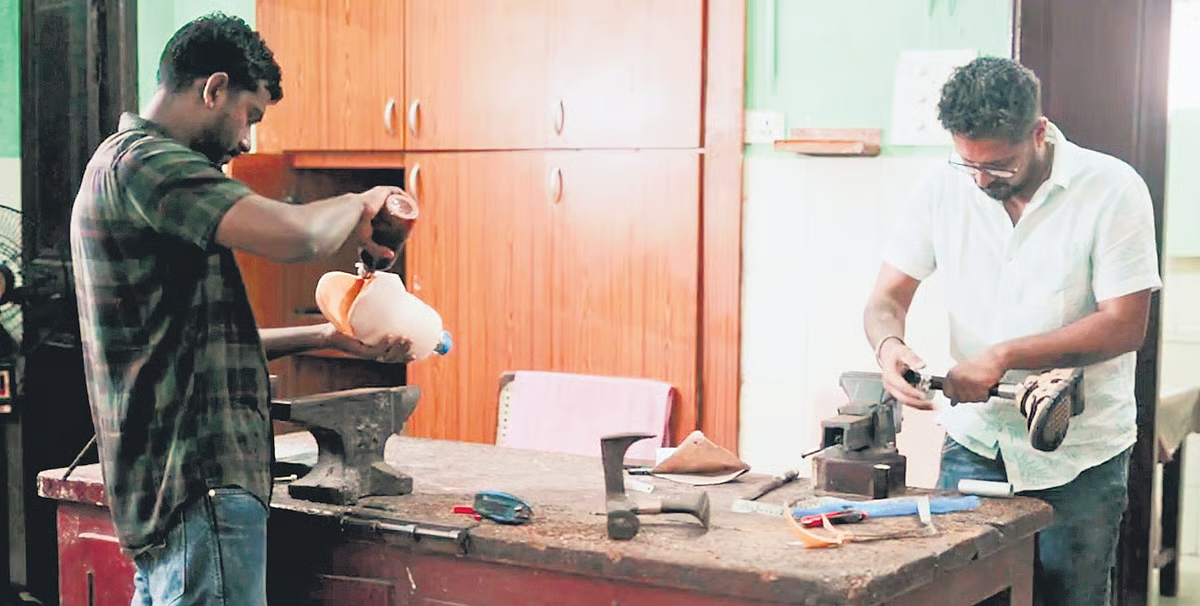
For almost four decades, the District Limb Fitting Centre at General Hospital Ernakulam has provided an important route to affordable prosthetic, orthotic and therapeutic-footwear services for people across Kerala.
Established in 1987, the centre combines outpatient assessment with an in-house production facility. Its team evaluates individual requirements before directing patients to rehabilitation technicians and specialist footwear workers for fabrication, fitting and follow-up.
The centre has reportedly helped thousands of people regain mobility through artificial limbs, custom orthoses, corrective footwear and related rehabilitation support. Its longevity demonstrates the important role district-level facilities can play in bringing O&P services closer to communities.
Assessment and fabrication under one roof
The Ernakulam centre operates as part of the hospital’s Physical Medicine and Rehabilitation Department. This provides a pathway through which patients can be clinically assessed and referred directly for an appropriate device.
Depending on the person’s condition, the centre may provide:
- Below-knee and above-knee prostheses
- Custom-made orthoses
- Corrective and therapeutic footwear
- Microcellular rubber, or MCR, footwear
- Appliances supporting people with spinal and musculoskeletal conditions
- Repairs and adjustments to existing devices
- Training in the safe use of a prosthesis or orthosis
General Hospital Ernakulam confirms that rehabilitation technicians and footwear workers are attached to the centre and that custom prostheses, orthoses and MCR footwear are manufactured there.
Keeping consultation, fabrication and rehabilitation within the same hospital can improve communication between the prescribing clinician, technical team and patient. It also makes it easier to review fit, make adjustments and provide continuing support after delivery.
Affordable devices for patients with limited resources
Affordability is one of the centre’s most important contributions.
According to The New Indian Express, a prosthetic leg that may cost more than ₹1 lakh through some private providers can be supplied at a substantially subsidised price through the centre.
The reported prices include:
- Below-knee prosthesis: ₹7,160
- Above-knee prosthesis: ₹24,250
- MCR footwear: ₹660
The hospital states that rehabilitation services are free for patients below the poverty line, while other patients pay charges determined by the government.
Price alone, however, does not define access. Patients must also be able to reach the service, receive an appropriate assessment, attend fittings and obtain repairs when the device no longer fits or performs correctly.
The centre’s presence within a major district hospital helps address several of these barriers through an established public-health pathway.
Supporting a growing diabetes-related caseload
The centre is also seeing the consequences of diabetes and diabetic foot complications.
Dr Sindhu M, senior consultant in the hospital’s Physical Medicine and Rehabilitation Department, said that increasing numbers of patients are approaching the service following amputations associated with diabetes. These cases can involve the loss of a leg, foot segment or toe.
This reinforces the need to connect district O&P services with diabetic-foot screening, vascular care, wound management, podiatry, physiotherapy and long-term footwear provision.
For a person with diabetes, delivery of a prosthesis should not mark the end of care. Continued inspection of the contralateral foot, pressure management, appropriate footwear and regular follow-up remain essential to reducing the risk of further ulceration or amputation.
Hundreds of appliances supplied each year
The centre reportedly provides approximately:
- 330 orthotic appliances annually
- 30 prostheses annually
- 420 leather and footwear products annually
- Additional repairs to existing appliances
These figures show that footwear and orthotic work represent a substantial part of the centre’s activity, alongside lower-limb prosthetic care.
Repair services are particularly important in publicly funded rehabilitation. A worn strap, damaged joint, broken component or deteriorated shoe modification can make an otherwise functional device unusable. Local repair capacity can extend product life and prevent patients from waiting for complete replacements.
Upper-limb prosthetics remain a service gap
Despite the centre’s achievements, it does not yet routinely provide prosthetic hands.
Hospital superintendent Dr Prebhudas R said that the centre receives enquiries for upper-limb prostheses and cosmetic solutions. Access through private providers can be financially difficult for many families, creating a strong case for developing the service within the public system.
The hospital’s own information indicates that preparations are being made to introduce upper-limb prosthetic fabrication. At present, such provision remains concentrated in a limited number of government and specialist institutions, including Government Medical College Thiruvananthapuram, the National Institute of Physical Medicine and Rehabilitation and the Composite Regional Centre in Kozhikode.
Expanding into upper-limb care would require more than purchasing components. It would need appropriately qualified prosthetists, assessment and casting or scanning systems, fabrication facilities, functional training, occupational therapy and reliable access to repairs and replacement parts.
A model worth strengthening
The Ernakulam centre illustrates the value of placing O&P capacity within district healthcare.
India does not only need a small number of advanced national institutions. It also needs accessible regional services capable of providing routine assessment, fabrication, fitting, repair and follow-up close to where patients live.
Future development could include:
- Recruitment and retention of qualified prosthetists and orthotists
- Introduction of upper-limb prosthetic services
- Digital scanning and CAD/CAM where clinically and economically appropriate
- Stronger diabetic-foot and limb-preservation pathways
- Formal outcome and patient-satisfaction measurement
- Outreach clinics for people unable to travel
- Improved referral links with surgeons, physiotherapists and community health teams
- Structured maintenance and replacement programmes
Technology can strengthen these services, but experienced professionals and dependable follow-up remain their foundation.
After nearly four decades, the District Limb Fitting Centre at General Hospital Ernakulam demonstrates how affordable, locally available O&P care can restore more than movement. It can support independence, participation and dignity for people who might otherwise be unable to obtain the devices they need.
- The New Indian Express: Four Decades of Support at Ernakulam’s District Limb Fitting Centre
- General Hospital Ernakulam: Physical Medicine and Rehabilitation
- General Hospital Ernakulam
- Kerala Health Department