
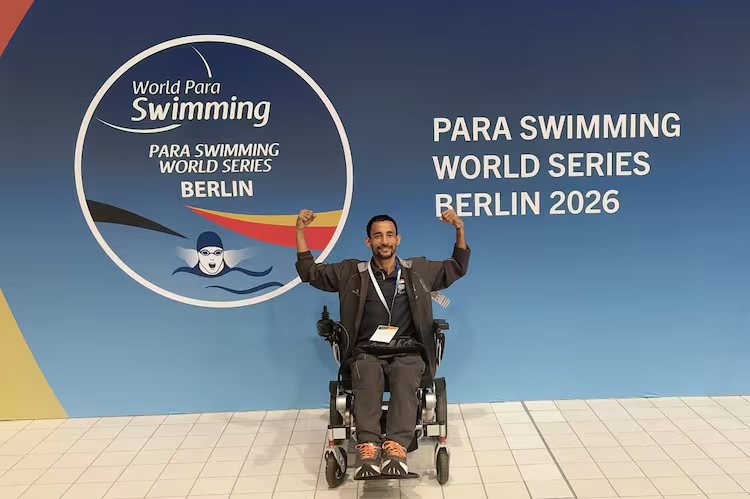
IIT Roorkee graduate Saurav Kumar is bringing together three perspectives rarely found in one person: prosthetic user, engineer and international para athlete.
The 24-year-old Engineering Physics graduate has developed a working lower-limb prosthetic, represented India in international para-sport competitions and set his sights on competing for gold at the Los Angeles 2028 Paralympic Games.
His journey demonstrates the potential of user-led innovation, but it also highlights the importance of connecting engineers and prosthetic users with qualified prosthetists, rehabilitation professionals and structured clinical-development pathways.
From Engineering Physics to prosthetic development
Kumar entered IIT Roorkee after securing a Persons with Disabilities rank of 165 in JEE Advanced 2021. Although initially interested in aerospace engineering, he selected Engineering Physics because it matched his curiosity about electronics, mechanical systems and the science governing how devices work.
That multidisciplinary background eventually led him towards a practical assistive-technology project.
Kumar began designing and developing a lower-limb prosthetic, working independently on its mechanical design and potential automation. His supervisor specialised in photonic physics rather than prosthetics but agreed to support the project as Kumar worked through its engineering challenges.
According to India Today, he developed a functioning device without accepting project funding. The completed prototype reportedly impressed his supervisor and the academic evaluation panel.
Kumar now hopes to take the project beyond a laboratory demonstration and develop automated solutions capable of benefiting other people with lower-limb disabilities.
The importance of innovation led by lived experience
Kumar’s work belongs to a growing international movement in which people with disabilities are not merely recipients of assistive technology. They are increasingly becoming designers, researchers, entrepreneurs and decision-makers.
A prosthetic user can bring insights that may be less obvious to someone approaching a device purely as an engineering problem. These may include:
- The effort required to put on and remove a prosthesis
- Comfort during prolonged daily use
- The practical consequences of heat and perspiration
- Difficulty accessing repairs and replacement components
- The importance of weight and appearance
- Challenges encountered at school, work and during travel
- The difference between laboratory performance and daily usefulness
Lived experience does not replace clinical or engineering expertise. It adds another essential source of knowledge to the development process.
The strongest model is therefore co-design: prosthetic users, CPOs, physiotherapists, engineers, material specialists and manufacturers working together from the earliest stages.
Building an international sporting career
Kumar has pursued his engineering work while developing a career in para swimming and competitive snooker.
In May 2026, he reportedly finished ninth at an international para-swimming competition in Berlin involving competitors from more than 60 countries. The following month, he achieved fifth place at the World Disability Snooker Championship in Thailand and later secured fourth position in snooker at the World Abilitysport Games in Finland.
His path into competitive swimming began after he organised an awareness event for students with disabilities at IIT Roorkee in 2024. The event brought him into contact with para athletes Mohammad Shams Aalam Shaikh and Pramod Bhagat.
Meeting Aalam, an international para swimmer with a spinal cord injury, encouraged Kumar to reconsider what he might achieve through sport. He subsequently committed himself to swimming, combining early-morning training with classes, laboratory work and evening snooker practice.
Kumar also supports more than 150 students with disabilities at the institute, offering guidance on their social and physical development.
Aiming for Los Angeles 2028
Kumar’s immediate ambition is to represent India at the 2028 Paralympic Games and compete for a gold medal.
IIT Roorkee continued supporting him for a year after his 2025 graduation and still permits him to use its swimming pool, gym and other sporting facilities. However, sustaining an international sporting campaign requires considerably more than access to training infrastructure.
Equipment, coaching, medicines, accommodation, nutrition, travel and everyday living expenses must all be funded. Kumar is seeking further support that would allow him to continue training while developing his technology projects.
His situation reflects a broader challenge facing Indian para athletes. Talent and determination can establish international potential, but consistent performance also depends on long-term financial, clinical, technical and coaching support.
Clinical development must accompany engineering
The available report establishes that Kumar has built a working prosthetic project, but it does not provide detailed information about its intended amputation level, socket design, components, materials, control system, structural testing or clinical evaluation.
The prototype should therefore not yet be interpreted as a clinically validated or commercially available prosthesis.
Before any lower-limb prosthetic innovation is used more widely, development should address:
- Clinical assessment and patient selection
- Socket comfort, suspension and pressure distribution
- Alignment and gait biomechanics
- Component strength and fatigue testing
- Weight limits and intended activities
- Material consistency and traceability
- Risk management and failure modes
- User training and rehabilitation
- Maintenance and repair requirements
- Regulatory and quality-management obligations
- Structured testing involving multiple prosthetic users
This is where collaboration with Indian CPOs becomes critical. An engineer may optimise mechanisms, electronics and automation, while a prosthetist translates the user’s anatomy, tissue tolerance, functional ability and rehabilitation objectives into a safe prosthetic prescription.
An opportunity for India’s innovation ecosystem
India possesses leading engineering institutions, a growing medical-technology sector and a substantial network of prosthetic and rehabilitation professionals. However, these communities do not always work together systematically.
Kumar’s story shows why universities and technology incubators should create formal assistive-technology partnerships involving:
- Engineering and design departments
- Prosthetics and orthotics institutions
- Rehabilitation hospitals
- Disability organisations
- Prosthetic users and para athletes
- Testing laboratories
- Manufacturers and investors
Such collaboration could help promising student prototypes progress through clinical review, testing, design refinement, regulatory planning and responsible commercialisation.
It could also prevent teams from spending time developing solutions without sufficiently understanding socket fit, alignment, rehabilitation or the practical realities of prosthetic service delivery.
More than a university project
Kumar has also co-founded an early-stage waste-management startup incubated through IIT Roorkee’s Technology Incubation and Entrepreneurship Development Society. His work reflects a consistent objective: applying engineering to practical social problems.
The next chapter will require the right partners. His prosthetic project needs clinical and technical development, while his Paralympic ambition requires sustained financial and sporting support.
For India’s O&P community, Kumar’s story is a reminder that people with disabilities must be central to innovation—not only as participants in final product testing, but as inventors, researchers and leaders.
When lived experience is combined with engineering expertise and qualified clinical input, assistive technology has a far better chance of progressing from an impressive prototype to a safe, useful and scalable solution.
- India Today: IIT Roorkee Graduate Builds a Prosthetic and Represents India in Sport
- IIT Roorkee
- IIT Roorkee Technology Incubation and Entrepreneurship Development Society
- IIT Roorkee Diversity and Inclusion Committee