
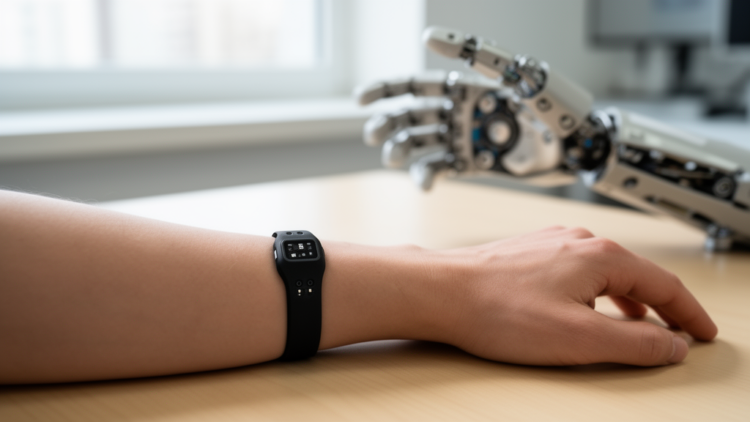
Researchers at the National Institute of Technology Rourkela have developed a low-cost wearable armband that detects changes in forearm muscle shape and translates them into commands for robotic and assistive devices.
The prototype uses force myography, or FMG, rather than conventional surface electromyography. Four pressure-sensitive sensors detect the mechanical deformation created when different forearm muscles contract. A machine-learning model then classifies these patterns as intended hand gestures.
In laboratory testing, the system recognised five gestures and was used to control an indigenously developed robotic arm during a pick-and-place demonstration.
The research was conducted by Laxmi Gupta, Naveeta Kharendra and Alok Prakash from NIT Rourkela’s Department of Electronics and Communication Engineering and published in Frontiers in Medical Engineering.
How force myography works
Most externally powered upper-limb prostheses use surface electromyography, or sEMG, to detect the electrical signals generated when muscles contract.
These signals can provide an intuitive connection between the user and a motorised terminal device. However, their performance may be affected by perspiration, electrode movement, electrical interference, changes in skin condition and inconsistent electrode placement.
FMG takes a different approach. Rather than reading electrical signals, it measures the physical expansion and deformation of muscles beneath the skin.
The NIT Rourkela armband contains four piezoresistive force-sensing resistors positioned over selected forearm muscle groups, including the flexor carpi, extensor digitorum and extensor carpi.
Each sensor is housed within a specially designed 3D-printed casing. A small coupler transfers the contracting muscle’s force to the active area of the sensor. The four housings are mounted on an adjustable Velcro band, allowing their positions to be changed according to the wearer’s anatomy.
Five gestures recognised
The researchers collected data from ten healthy participants—six men and four women—while they performed five gestures:
- Fist
- Fist flexion
- Open hand
- Wrist flexion
- Wrist extension
Each gesture produced a distinctive combination of pressure readings across the four sensors.
The recorded signals were processed to reduce noise before relevant features were extracted. The researchers compared five machine-learning classifiers: Random Forest, Support Vector Machine, K-Nearest Neighbours, XGBoost and Multi-Layer Perceptron.
Random Forest produced the strongest offline result, achieving an accuracy of 91.81%. The other four approaches returned offline accuracies of approximately 89% to 90%.
Moving from a computer to real-time control
High laboratory accuracy is only part of the challenge. An assistive device must interpret the user’s intention quickly and reliably during actual operation.
The researchers converted the trained Random Forest model into code that could run on an inexpensive ESP32 microcontroller. This allowed signal processing and gesture classification to take place through compact embedded hardware rather than a powerful external computer.
Real-time evaluation involved five participants completing 250 trials. A trial was counted as successful when the intended gesture was identified and the corresponding command activated within three seconds.
The system correctly completed 200 trials, producing a real-time success rate of 80%. It was then connected to a four-degree-of-freedom robotic arm, with the five gestures assigned to movements required for a pick-and-place task.
The decline from almost 92% offline accuracy to 80% in real-time operation is clinically important. It demonstrates why performance reported from stored datasets should not be assumed to represent everyday prosthetic control.
Why the research could matter for India
Complex multi-channel control systems can require expensive sensors, specialised electronics and considerable computing power. This can make them difficult to translate into affordable assistive products.
The NIT Rourkela concept uses:
- Four commercially available force sensors
- Simple adjustable positioning
- 3D-printed sensor housings
- A low-cost ESP32 microcontroller
- A comparatively lightweight machine-learning model
This combination could support further Indian research into affordable upper-limb prostheses, rehabilitation interfaces, wheelchair controls and other human–machine systems.
FMG may also offer practical advantages where heat and perspiration affect electrical skin-contact systems. However, this potential must be evaluated through proper comparative testing rather than assumed from laboratory findings.
Not yet a prosthetic-hand control system
Despite the promising results, the armband has not yet been clinically validated as a prosthetic-control interface.
The study involved healthy participants who performed movements using intact hands and forearms. It did not evaluate people with upper-limb amputations, whose remaining muscles, anatomy, surgical history and movement strategies may be substantially different.
The robotic-arm demonstration was a proof of concept. It does not establish that the system can safely and reliably control a wearable prosthetic hand during daily activities.
Further development would need to examine:
- Performance with people at different upper-limb amputation levels
- Whether sufficient muscle deformation remains within shorter residual limbs
- Sensor stability during repeated arm movement
- Changes caused by perspiration, fatigue and residual-limb volume
- The effect of socket pressure on sensor readings
- Donning repeatability and sensor-location accuracy
- Recognition of additional functional grips
- Response speed and unintended commands
- Long-term comfort and skin safety
- Battery life, durability and repairability
The researchers themselves identified sensor positioning, consistent contact pressure, variations between users and limited microcontroller capacity as practical challenges.
The CPO’s role in translation
Integrating this technology into a prosthesis would require close collaboration between engineers, prosthetists, occupational therapists and prosthetic users.
A CPO would need to determine where the armband or individual sensors should sit relative to the socket, whether the residual limb produces usable mechanical signals and how the interface affects suspension, comfort and pressure distribution.
Occupational therapists would help establish whether the available commands correspond to meaningful daily activities and whether the user can operate them without excessive concentration or fatigue.
The final objective should not simply be a higher gesture-classification score. It should be more dependable performance in activities that matter to the user.
A strong foundation for Indian development
The NIT Rourkela project does not yet provide a finished prosthetic product, but it demonstrates that meaningful real-time control may be possible using relatively simple and accessible hardware.
Its greatest contribution may be showing how sensor design, embedded electronics and machine learning can be combined without relying on an excessively complex or expensive system.
The next decisive step will be testing the technology with prosthetic users under real clinical and everyday conditions. If those studies demonstrate dependable control, FMG could become a valuable part of India’s effort to develop affordable, locally supported upper-limb prosthetic technologies.
- Bioengineer.org: Cheap Armband Reads Forearm Muscle Forces to Drive Robots and Prosthetics
- Frontiers: Classification of Forearm Muscle Forces for Controlling Assistive Devices
- Research Paper DOI
- National Institute of Technology Rourkela