
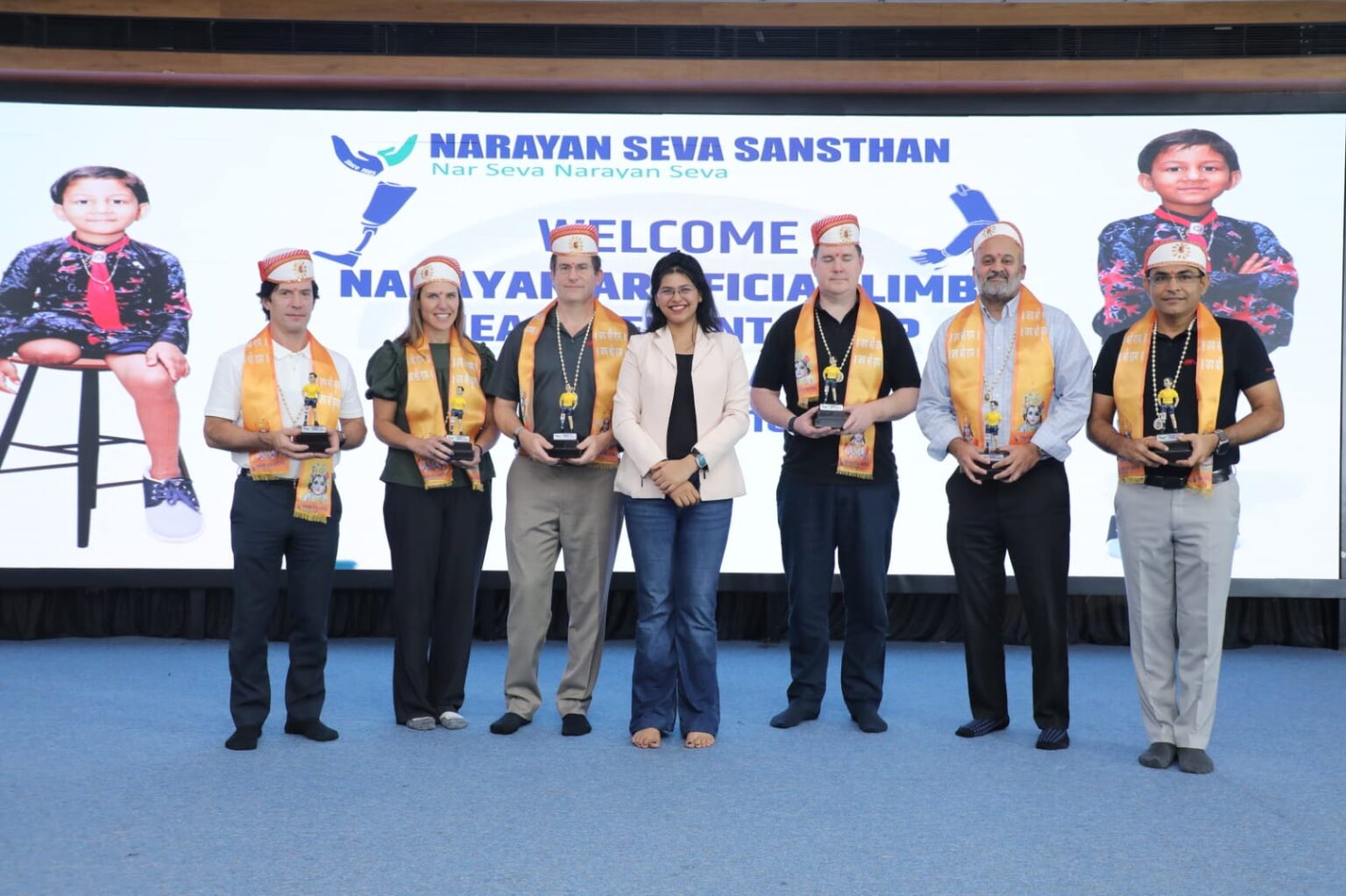
More than 128 persons with disabilities attended a free assessment and measurement camp organised by Narayan Seva Sansthan with corporate social responsibility support from Ingersoll Rand.
Held at the Atal Kalam Campus of Gujarat University in Navrangpura, Ahmedabad, the programme combined clinical assessments, measurements for prosthetic and orthotic devices, selection for corrective surgery and recognition of donors supporting the initiative.
Following assessment by specialist doctors and the organisation’s prosthetics and orthotics team:
- 73 beneficiaries were measured for Narayan Modular Artificial Limbs
- 14 beneficiaries were measured for calipers
- Seven people were selected for free corrective surgery
Ten prosthetic users also demonstrated walking with their artificial limbs during the programme’s inauguration.
Assessment begins the rehabilitation pathway
The October programme was primarily a screening and measurement camp rather than a same-day mass distribution event.
This distinction is important because prosthetic provision should begin with an assessment of the individual rather than the selection of a standard product.
Before prescribing a prosthesis, the clinical team may need to consider:
- Amputation level and residual-limb length
- Skin integrity, scarring and wound status
- Joint range of movement
- Muscle strength and balance
- Residual-limb volume and maturity
- Pain and sensation
- Home and working environment
- Previous prosthetic experience
- Functional goals and activity level
- Need for physiotherapy or further surgery
Where a person is not ready for fitting, referral for medical treatment, wound management, physiotherapy or corrective surgery may be more appropriate than proceeding immediately with a device.
Narayan Seva Sansthan stated that beneficiaries measured during the camp would return to a future Ahmedabad programme for fitting, expected approximately two months later. A team of around 25 medical and technical professionals supported the assessments.
CSR supporting a structured service pathway
The camp was inaugurated by Vincent Reynal, Chairman, President and CEO of Ingersoll Rand. Vikram Kini, the company’s Senior Vice President and Chief Financial Officer, presided over the programme.
Other representatives from Ingersoll Rand and its Indian operations attended alongside social workers and members of Narayan Seva Sansthan.
Reynal described free services for persons with disabilities as an important act of humanity and recognised the organisation’s focus on both treatment and self-reliance. Kini highlighted the potential of modern prosthetic technology to support mobility and independence.
The initiative illustrates how corporate social responsibility funding can support a defined rehabilitation pathway rather than an isolated donation of equipment.
Funding can contribute to:
- Community outreach and beneficiary identification
- Clinical and technical assessment
- Prosthetic and orthotic fabrication
- Corrective surgery
- Travel and accommodation support
- Training in device use
- Repairs and replacement components
- Follow-up and outcome monitoring
For sponsors, the strongest measure of impact is not simply the number of devices funded. It is whether beneficiaries can use those devices safely, consistently and productively.
Part of an ongoing Ahmedabad programme
The latest camp follows earlier Narayan Seva Sansthan activity in Ahmedabad during 2026.
In July, more than 450 people attended a screening and measurement programme at Gujarat University. Measurements were taken for 327 beneficiaries requiring modular artificial limbs, while 33 people were selected for corrective surgery.
A subsequent fitment camp in September supplied 291 artificial limbs to 271 beneficiaries. A further 87 calipers and assistive devices were provided to 64 people.
A 40-member specialist team reportedly carried out the September fittings and trained beneficiaries in balance, walking techniques, device use and limb care.
Together, the July, September and October events demonstrate a repeating service cycle:
- Community registration and screening
- Clinical assessment and measurement
- Device design and fabrication
- Fitment and user training
- Continuing adjustment, repair and review
This staged approach is more clinically appropriate than attempting to assess, fabricate and permanently fit every beneficiary during a single visit.
The CPO team remains central
Although charitable organisations and sponsors make the programme possible, qualified prosthetists and orthotists remain essential to the clinical process.
A modular component system can simplify fabrication and improve consistency, but the socket or orthosis still has to be adapted to the individual.
During fitting, the CPO must evaluate:
- Socket comfort and suspension
- Pressure distribution
- Prosthetic alignment
- Stability during standing and walking
- Appropriate caliper control
- Ease of donning and removal
- Skin response after use
- The need for modifications or additional therapy
Users should also understand that discomfort, redness, looseness or instability must be reported rather than accepted as unavoidable.
Follow-up determines long-term value
The period after delivery is particularly important.
A new prosthetic user may need repeated alignment adjustments and gait training. Residual-limb volume can change, especially during the early stages following amputation. Children require regular review and replacement as they grow.
Calipers may also require alterations to straps, joints, padding or footwear as the user’s condition changes.
A strong continuing-care programme should therefore provide:
- Scheduled clinical reviews
- Access to socket and alignment adjustments
- Repair and replacement services
- Physiotherapy or occupational-therapy referral
- Education on skin inspection and device care
- Monitoring of comfort and daily use
- A named contact for technical problems
Documenting outcomes would allow future CSR programmes to report not only how many devices were delivered, but also how many remained in use after three, six and twelve months.
From mobility to participation
Narayan Seva Sansthan describes its broader objective as helping persons with disabilities become more independent and self-reliant.
That requires looking beyond the device. Mobility can support education, employment, family responsibilities and community participation, but environmental and social barriers may remain.
The Ahmedabad camp shows how specialist assessment, O&P provision, surgery and CSR funding can be brought together within one organised programme.
Its lasting impact will depend on completing the pathway for each beneficiary—from measurement and fabrication to fitting, training, maintenance and long-term follow-up.
- Bilkul Online: Narayan Seva Sansthan Organises a Large Free Divyang Camp in Ahmedabad
- Narayan Seva Sansthan
- Narayan Seva Sansthan Patient Registration
- Request an Artificial-Limb Camp