
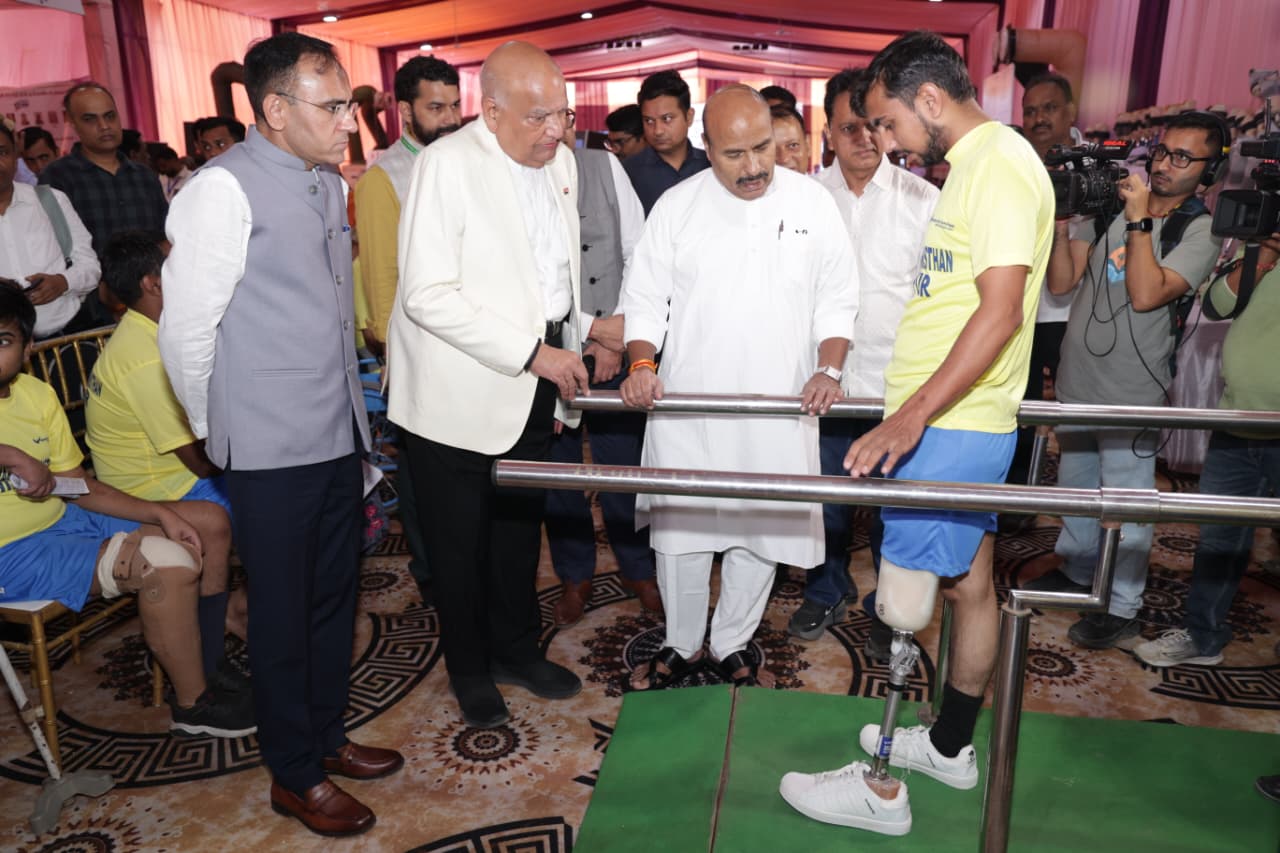
Narayan Seva Sansthan has fitted 77 people with modular upper- and lower-limb prostheses during a camp held at the Red Fort Ground in New Delhi.
The Modular Artificial Limb Fitting Camp took place on September 17, coinciding with celebrations marking Prime Minister Narendra Modi’s birthday. According to India CSR, the beneficiaries received devices described by the organisers as German-Japanese technology-based modular artificial limbs.
The programme went beyond the physical delivery of prostheses. Participants also received physiotherapy, instruction on using their devices and training intended to support walking, movement and everyday activities.
A 15-member specialist team from Narayan Seva Sansthan was responsible for fitting the devices and explaining their use. The report said team members sought to adjust each prosthesis according to the individual requirements of its user.
Government and disability-sector representatives attend
The event’s chief guest was Union Minister for Social Justice and Empowerment Dr Virendra Kumar Khatik.
Other attendees included Chandni Chowk Member of Parliament Praveen Khandelwal, National Commission for Scheduled Tribes Chairman Kishor Makwana, Artificial Limbs Manufacturing Corporation of India Managing Director Praveen Kumar and Lav-Kush Committee Chairman Arun Goyal.
Narayan Seva Sansthan trustee Devendra Choubisa welcomed the guests, while social worker Satyabhushan Jain presented an overview of the fitting and rehabilitation work being undertaken at the camp.
Dr Khatik praised Narayan Seva Sansthan’s work and said that access to modern prosthetic devices could improve mobility, day-to-day function and opportunities for people with disabilities.
Narayan Seva Sansthan President Prashant Agrawal said the organisation intends to make advanced prosthetic technology available to a growing number of people with limb absence. He emphasised the role that appropriate prostheses can play in building confidence, independence and social participation.
Modular construction supports adjustment
Modular prosthetic systems commonly use separately manufactured components that can be assembled and aligned according to the user’s amputation level, physical condition and functional needs.
For lower-limb users, these components may include a socket, structural adaptors, pylons, knee joints and prosthetic feet. Upper-limb systems can incorporate sockets, terminal devices, wrist units and elbow components depending on the individual prescription.
One benefit of modular construction is the ability to adjust alignment during fitting and rehabilitation. Components can also be replaced or upgraded without necessarily remanufacturing the entire device.
However, the description of a prosthesis as “advanced” does not by itself establish whether it is suitable for a particular user. The outcome depends on clinical assessment, socket comfort, alignment, component selection, training and access to subsequent adjustment and repair.
The inclusion of physiotherapy and user training at the Delhi camp was therefore an important part of the service. New prosthetic users may need to learn how to put on and remove the device, manage residual-limb volume, inspect their skin and gradually increase wearing time.
Lower-limb users may also require gait training to improve balance, weight transfer and control of the prosthesis. Upper-limb users need task-specific training to integrate the device into daily activities.
Fitting camps can extend access
Artificial-limb camps can bring assessment and fitting services closer to people who may otherwise struggle to reach a specialist centre. They can also identify individuals who need more complex intervention, physiotherapy or referral to another clinical service.
Their long-term impact, however, depends on what happens after the event. Prosthetic users may require socket adjustments as their residual-limb volume changes, particularly when receiving a first device. Worn components, alignment problems, skin irritation or changes in mobility can also require review.
Clear arrangements for follow-up, maintenance and replacement are therefore essential if a prosthesis supplied at a camp is to remain comfortable and functional.
Narayan Seva Sansthan’s wider programme includes free artificial-limb provision, corrective surgery, physiotherapy and vocational support. On its official website, the Udaipur-based organisation reports that it has distributed more than 40,000 artificial limbs.
Part of India’s broader assistive-device landscape
The Delhi event took place within a wider Indian system of government, charitable and corporate-supported assistive-device provision.
The Government of India’s Assistance to Persons with Disabilities for Purchase and Fitting of Aids and Appliances scheme—known as ADIP—supports eligible people in obtaining devices including prostheses and orthoses. The scheme works through implementing agencies such as ALIMCO, national institutes, hospitals, district disability rehabilitation centres and eligible non-governmental organisations.
Charitable fitting camps can complement these national programmes by increasing awareness and reaching people who face financial, geographic or administrative barriers to accessing prosthetic care.
For the 77 beneficiaries fitted in Delhi, the next measure of success will be whether the devices continue to support comfortable mobility and participation after the camp. That will require accessible clinical review, repairs and rehabilitation alongside the initial provision of the prostheses.
- India CSR: Narayan Seva Sansthan Fits 77 People in Delhi
- Narayan Seva Sansthan
- Department of Empowerment of Persons with Disabilities: ADIP Scheme
- Artificial Limbs Manufacturing Corporation of India
- ARJUN Portal for ADIP Assistive-Device Applications