
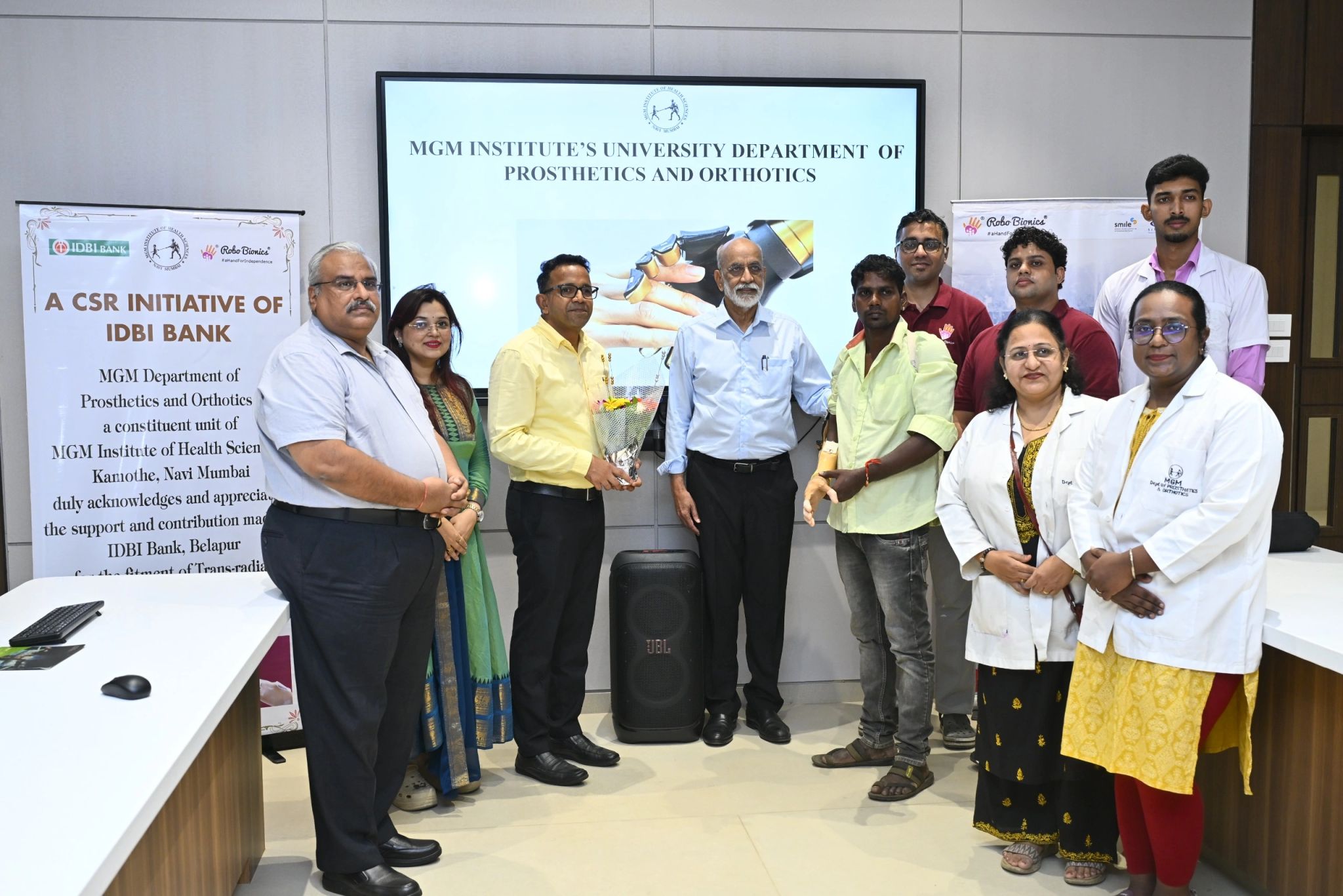
A 36-year-old man from Asangaon has received a Grippy Bionic Prosthesis following a fitting and delivery by the Department of Prosthetics & Orthotics at MGM Institute of Health Sciences. The fitting took place on 21 October 2026 and marks the second bionic prosthesis delivered through an IDBI Bank corporate social responsibility initiative, according to Associate Professor and Vice Principal Uttara Deshmukh’s announcement.
Mr. Kailash lost his right hand in an accident while operating a chainsaw. The prosthesis is intended to help him regain functional independence and approach daily activities with greater confidence. The announcement describes the delivery as the result of a partnership involving IDBI Bank, MGM Institute of Health Sciences and Bionic Hope Pvt. Ltd., the company behind the Grippy device.
The story is a reminder that access to a prosthesis depends on more than the device itself. Clinical assessment, skilled fitting, training and follow-up all contribute to whether a person can use a prosthesis in daily life.
A second device through a continuing initiative
The delivery is the second bionic prosthesis provided through the CSR initiative. That makes this fitting part of an ongoing effort, rather than a one-off intervention. Continued partnerships can help more people access devices that may otherwise be beyond their means.
IDBI Bank’s CSR programme includes support for healthcare access and assistance for people with disabilities. In this instance, the bank’s support has come together with MGM’s institutional and clinical role and Robo Bionics’ technical contribution. The arrangement connects funding, specialist service delivery and assistive technology around an individual’s needs.
MGM Institute’s University Department of Prosthetics & Orthotics is based at the Kamothe campus in Navi Mumbai. The university lists the department among its constituent institutions, and its official materials describe prosthetics and orthotics education and clinical facilities at the campus.
The role of fitting and rehabilitation
A bionic hand can offer potential functional options, but the device alone does not determine the outcome. Prosthetic care involves understanding the individual’s goals, evaluating their needs, fitting the device and supporting them as they learn how to use it. The person’s comfort, control, daily routine and access to ongoing support all matter.
The World Health Organization’s guidance on prosthetics and orthotics services emphasises the need for qualified teams and regular access to services. It identifies devices, personnel and service provision as parts of a wider system for delivering quality, affordable prosthetic and orthotic care.
The manufacturer describes Grippy as a bionic hand developed by Robo Bionics. The specific configuration and expected use for Mr. Kailash are not detailed in the announcement, so the practical benefits will depend on his individual fitting, training and experience with the device.
Partnerships that expand access
For people who have lost a limb, access to suitable prosthetic care can support participation in everyday life. Yet affordability and the availability of specialist services remain important barriers. WHO notes that assistive products, including prostheses, can support functioning and independence, while access is often limited by cost and gaps in service provision.
CSR-supported programmes can help address the cost barrier for individual recipients. Their longer-term value depends on connecting device provision with clinical expertise and the support needed after delivery. The second fitting under the IDBI Bank initiative shows how a bank, a university department and a technology company can contribute different parts of that process.
For MGM’s Department of Prosthetics & Orthotics, the delivery also demonstrates the role of specialist teams in translating an assistive technology into a patient-specific service. For the next recipient, the continuation of the initiative could mean another opportunity to access a bionic prosthesis and the professional support needed to use it.
Bharat CPO perspective
The delivery to Mr. Kailash is a meaningful example of partnership in upper-limb prosthetic care in India. Its impact will be shaped by how well the device serves his goals over time, and by the training and follow-up available to him.
The announcement’s central message is one of access: technology can create new possibilities when it reaches a person through coordinated support. Sustained collaboration between CSR funders, clinical institutions and prosthetic technology providers can help extend those opportunities to more people living with limb loss.
Suggested hyperlinks
- Uttara Deshmukh’s announcement
- MGM Institute’s University Department of Prosthetics & Orthotics
- MGM Institute of Health Sciences: constituent institutions
- IDBI Bank: Corporate Social Responsibility
- Robo Bionics: Grippy bionic hand
- WHO: Strengthening prosthetics and orthotics services
- WHO: Assistive technology