
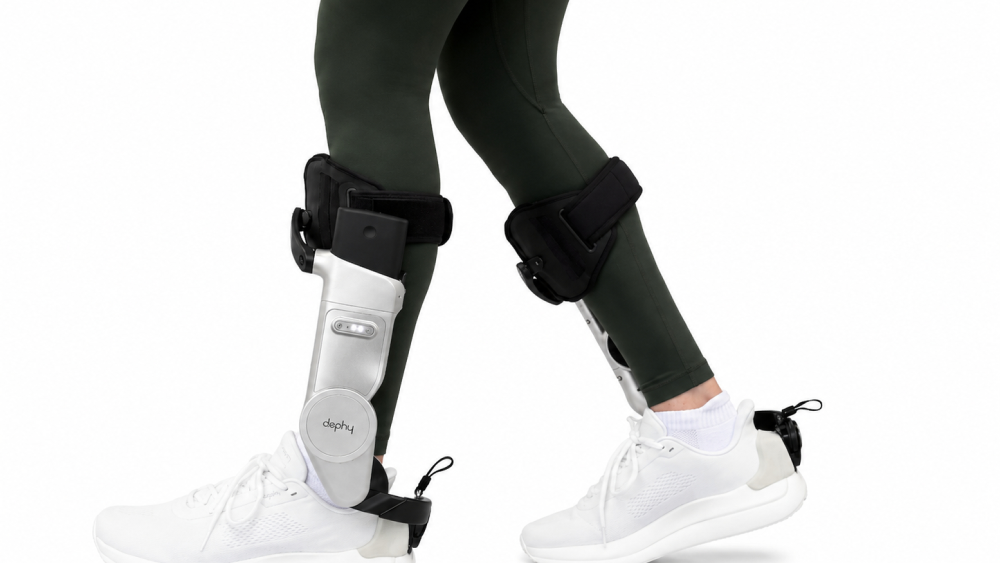
Wearable robotics company Dephy has expanded its Sidekick footwear range with a new shoe intended to accommodate people with standard-to-wide feet.
Sidekick is a bilateral powered system worn around the lower leg and connected to specially designed footwear. It delivers motorised assistance during ankle push-off, aiming to reduce the effort required for everyday walking.
The expanded footwear range now gives users two choices developed around different foot shapes, cushioning preferences and levels of arch support. Dephy says the change responds to feedback from early customers who found that the original shoe was too narrow.
The development was reported by Footwear News and announced in an official Dephy product release.
For Indian prosthetists, orthotists and rehabilitation professionals, the product offers an interesting example of how wearable robotics, footwear design and adaptive gait control are beginning to converge. However, Dephy explicitly markets Sidekick as a consumer wellness product rather than a medical device.
Two shoes for different foot profiles
The Sidekick range now includes Dephy Active and Dephy Comfort footwear.
Dephy Active is the original design and is intended for narrow-to-standard feet. It uses firmer EVA cushioning and provides greater arch support, giving it the feel of a performance-oriented athletic shoe.
The new Dephy Comfort model is built on a wider last for standard-to-wide feet. It uses softer supercritical foam, reduced arch support and a lace-loop arrangement designed to make the shoe easier to put on and remove.
Both models incorporate a full-length composite carbon plate and a CNC-machined aluminium quick-attachment interface for the powered ankle unit.
Unlike the plate in a conventional carbon running shoe, which flexes and returns stored energy, Dephy says its plate is designed to transfer torque from the Sidekick’s motorised system through the foot and into the ground.
This makes footwear fit and structural integrity central to the system’s performance. The shoe is not simply an interchangeable fashion component; it forms part of the powered mechanical pathway.
Assistance during ankle push-off
The technology behind Sidekick emerged from biomechatronics research associated with the Massachusetts Institute of Technology.
Dephy’s system targets the ankle because the plantarflexors and Achilles tendon make a major contribution to forward progression during walking. Reduced ankle power can affect step length, walking speed and the amount of compensatory work required at the knee and hip.
After the user puts on the shoes and attaches the devices, Sidekick observes the person’s movement for approximately 20 strides. It then provides adaptive assistance during push-off while responding to the individual’s walking rhythm.
The company describes the experience as comparable to an electric bicycle: the user continues producing and controlling the movement, while the motor adds assistance at the appropriate point in the gait cycle.
Dephy says the system is designed for adults who find that fatigue, stiffness or discomfort limits the distance they can comfortably walk. Suggested uses include daily walking, travel, outings and extended periods spent standing.
Technical specifications
The Sidekick Starter Pack currently has a listed US price of $4,500 and includes:
- A pair of Sidekick powered ankle units
- Custom-sized shin attachments and calf straps
- Two rechargeable batteries
- A dual-bay charger
- One pair of compatible shoes
- A carrying case and fit-adjustment tool
Each powered unit weighs approximately 1.4kg, including its battery. Battery charging takes around 1.5 hours, while the manufacturer claims a walking range of up to five miles at its second power setting. Higher assistance settings may reduce the available distance.
Dephy states that the system has been durability-tested beyond one million steps. It is intended primarily for forward walking on flat or moderately rough surfaces, stairs and inclines or declines of approximately 20% or less.
The Sidekick is independently certified to ISO 13482, the safety standard covering personal-care robots that operate in physical contact with people.
This certification should not be confused with medical-device approval. Dephy repeatedly states that Sidekick is a lifestyle and wellness product, not a medical device intended to diagnose, treat or rehabilitate a specific condition.
Important considerations for CPOs
The Sidekick’s design overlaps visually and mechanically with powered ankle-foot orthoses and lower-limb exoskeleton technology, but its consumer positioning creates a clear distinction.
A prescribed orthosis is selected to address an assessed impairment, control joint motion, redistribute load or support a defined rehabilitation objective. Sidekick instead provides general walking assistance through proprietary footwear without making a medical treatment claim.
Clinicians should therefore avoid assuming that it is appropriate for people with neurological weakness, joint instability, severe balance impairment, deformity or other complex conditions without individual assessment.
Its weight is also clinically relevant. Adding 1.4kg to each lower limb may be acceptable when the motor provides effective assistance, but the trade-off may differ according to strength, balance, sensation and walking pattern.
The present product information is largely manufacturer-reported. Published independent research involving specific patient groups, Indian users and real-world clinical outcomes would help CPOs understand which people may benefit and where the system’s limitations lie.
Relevance for India
India has a large and diverse population of people experiencing mobility limitations associated with ageing, arthritis, neurological conditions and other causes. Powered walking technology could eventually create a new category between conventional footwear, orthotic treatment and full rehabilitation exoskeletons.
However, affordability will be a major challenge. At $4,500 before international shipping, customs, servicing and replacement costs, Sidekick would remain beyond the reach of most Indian consumers unless local distribution, financing or institutional access models emerge.
There is also no confirmed information in the reviewed sources about an Indian launch, local service support or regulatory pathway.
The wider-fit shoe nevertheless represents an important design lesson. A powered device can perform technically as intended and still remain inaccessible if the footwear does not accommodate the user’s foot shape. As wearable robotics moves towards everyday use, fit, donning, comfort and footwear choice will be as important as motors, sensors and software.
- Footwear News: Dephy Expands the Sidekick Footwear Line
- Dephy Sidekick Official Website
- Dephy Sidekick Product Announcement
- Dephy Sidekick Starter Pack and Specifications
- ISO 13482: Safety Requirements for Personal Care Robots