
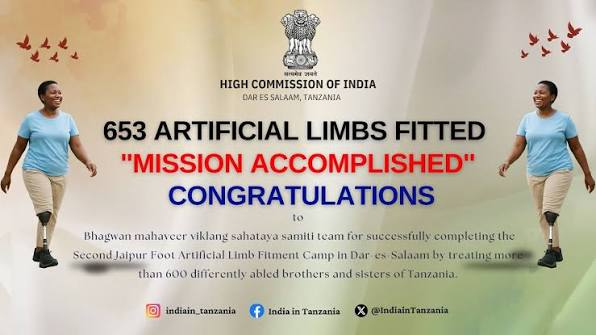
More than 620 Tanzanians have received free prosthetic limbs through a series of fitment camps supported by the High Commission of India in Tanzania.
The programme has delivered 653 Jaipur Foot prostheses to 622 men, women and young people from different parts of the country, according to figures announced by Indian High Commissioner Bishwadip Dey and reported by Tanzania’s Daily News.
The difference between the numbers of beneficiaries and devices indicates that some recipients required more than one prosthesis, although the published report does not provide a breakdown by amputation level or device type.
Technical fitment was delivered by teams from Bhagwan Mahaveer Viklang Sahayata Samiti, the Jaipur-based organisation commonly known as BMVSS or Jaipur Foot.
The initiative is part of the Indian High Commission’s humanitarian outreach ahead of India’s 80th anniversary of independence in August 2027.
Reaching patients through temporary fitment camps
The camps brought prosthetic services closer to Tanzanians who might otherwise face considerable financial and geographical barriers to accessing care.
People requiring a prosthesis may need to travel long distances to reach a specialist centre. Costs associated with transport, accommodation, clinical appointments and the device itself can place treatment beyond the reach of lower-income households.
Temporary fitment camps can address part of this access gap by bringing clinical and technical teams, components and workshop capability to a selected location for a concentrated period.
BMVSS reports that it has organised more than 100 international fitment camps across over 40 countries. Its previous work in Africa includes programmes in Ethiopia, Kenya, Malawi, Nigeria, Rwanda, Senegal, Sierra Leone, Somalia, Sudan, Tanzania, Uganda and Zambia.
Many overseas camps have received funding and logistical support from the Indian government through its India for Humanity programme.
A design developed around local activities
The Jaipur Foot system is known for its relatively low manufacturing cost and design characteristics intended to support activities common in many low- and middle-income settings.
According to BMVSS, the Jaipur limb commonly uses a customised high-density polyethylene socket connected to the Jaipur Foot. The design is intended to accommodate activities such as walking on uneven ground, squatting and sitting cross-legged.
These functional requirements can be particularly relevant where people work in agriculture, use floor-level seating or regularly travel across surfaces that differ significantly from controlled urban environments.
However, the suitability of any prosthesis must be assessed individually. Amputation level, residual-limb condition, body weight, activity, occupation, home environment and access to maintenance all influence component selection and clinical outcomes.
The published Tanzania figures do not include information on gait training, rehabilitation sessions or follow-up arrangements. These services are important in helping recipients use their prostheses safely and effectively after fitment.
South–South cooperation with a measurable outcome
The prosthetic camps form part of a wider relationship between India and Tanzania that includes trade, investment, technical training and higher-education scholarships.
High Commissioner Dey announced the prosthetic figures during the annual Kalakendra Night in Arusha. He said bilateral trade had reached US$9.02 billion in 2025–26, following growth of more than 300% over five years.
Within this broader relationship, the fitment programme offers a tangible example of South–South healthcare cooperation. Indian technology, technical personnel and humanitarian funding have been combined with local coordination to deliver mobility devices directly to Tanzanian beneficiaries.
The model may be particularly valuable for identifying people who have remained outside established rehabilitation pathways. Camps can also raise awareness of available services and demonstrate that mobility can be restored after limb loss.
Follow-up remains essential
The immediate delivery of 653 prosthetic limbs represents a substantial achievement, but long-term impact will depend on continuing access to professional support.
Socket fit can change over time, particularly for new amputees or people whose residual limbs are still changing. Prosthetic feet, knees, suspension systems and other components will eventually require inspection, repair or replacement.
Recipients may also require physiotherapy, gait training and clinical review to address pain, skin problems, balance or changes in functional ability.
International camps are most sustainable when they are connected to Tanzanian rehabilitation centres and local prosthetic professionals who can provide this continuing care. Sharing technical knowledge, maintaining patient records and ensuring access to compatible replacement materials can extend the useful life of the devices fitted during the programme.
Future reporting could also document functional outcomes, return to education or employment, user satisfaction and the number of recipients continuing to use their prostheses after six or twelve months.
For now, the headline result is significant: 622 Tanzanians have received 653 prostheses without charge. The programme demonstrates how international cooperation and cost-conscious prosthetic technology can rapidly expand mobility access—while also underlining the importance of converting short-term fitment into sustained rehabilitation.
- Streamline: India Fits 653 Free Limbs for 622 Tanzanians
- Daily News Tanzania: India Provides Artificial Limbs to 622 Tanzanians
- BMVSS – Jaipur Foot
- High Commission of India in Tanzania
- WHO Standards for Prosthetics and Orthotics