
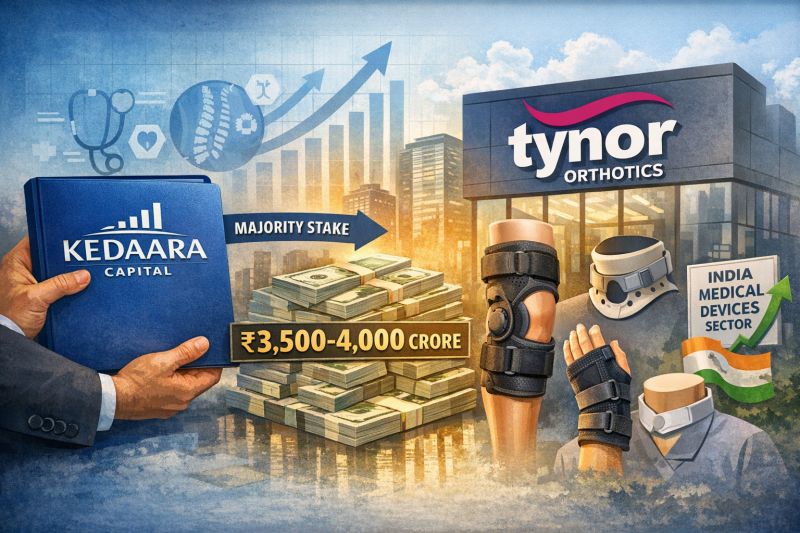
Indian private equity firm Kedaara Capital has announced a strategic investment of approximately $200 million in Tynor Orthotics, one of India’s most prominent manufacturers and brands of orthopaedic supports, mobility aids and rehabilitation products.
The transaction will reportedly give Kedaara a majority stake of approximately 51% in the Mohali-based company. It represents one of the most significant investments to date in an Indian business focused specifically on orthopaedic supports and rehabilitation products.
According to the original report from Moneycontrol, investment bank o3 Capital acted as the exclusive financial adviser for the transaction.
The investment is expected to support Tynor’s next phase of development, including greater penetration across India, expansion in international markets and continued investment in manufacturing capacity, product development and operational efficiency.
Building an Indian orthopaedic products platform
Founded in 1993, Tynor has developed a portfolio covering orthopaedic braces and supports, mobility aids, rehabilitation products and sports-performance solutions. The company says its distribution network now reaches more than 300,000 retail outlets and 8,000 hospitals across 60 countries, with its products having served more than 100 million people.
Tynor operates three manufacturing facilities covering approximately 650,000 square feet. Its scale, distribution network and established relationships with doctors, hospitals, pharmacies, physiotherapists and rehabilitation providers have helped it create a distinctive position between medical technology and consumer healthcare.
Kedaara is expected to work alongside Tynor’s promoters, Dr P.J. Singh and A.J. Singh, its professional management team and French orthopaedic company Thuasne, which has been a strategic partner of Tynor since 2010.
The partnership will seek to build a broader orthopaedic and wellness platform while strengthening Tynor’s position as an Indian manufacturer capable of serving both domestic and international markets.
What the investment means for India’s orthotics sector
For India’s orthotic and prosthetic community, the size of the transaction is significant. It demonstrates that orthopaedic supports, rehabilitation products and related medical devices are increasingly being viewed as scalable healthcare categories rather than small, fragmented product segments.
Private equity investment at this level can accelerate several areas of development:
- Expansion of manufacturing capacity and automation
- Development of new orthopaedic and rehabilitation products
- Stronger quality systems and international certifications
- Wider access through hospitals, pharmacies and digital channels
- Greater investment in clinical education and professional engagement
- Expansion into underserved Indian cities and international markets
Tynor’s combination of Indian manufacturing, established distribution and accessible pricing gives the company a strong platform for further growth. Kedaara’s operational resources and experience scaling Indian businesses could also help Tynor develop new product categories or pursue complementary acquisitions.
Kedaara describes itself as an operationally focused private equity investor. The firm manages more than $6 billion and invests across healthcare, pharmaceuticals, financial services, consumer businesses and technology-enabled services.
Opportunities for CPOs and rehabilitation professionals
The transaction may create new opportunities for certified prosthetists and orthotists, physiotherapists, rehabilitation physicians and other clinical professionals.
A larger and better-funded orthopaedic supports company will require deeper engagement with healthcare professionals to ensure that products respond to clinical requirements. Growth may therefore support expanded professional education, product training, clinical evaluation and collaboration between manufacturers and practitioners.
At the same time, commercial expansion should not reduce orthotic care to the retail sale of braces. Many patients require assessment, product selection, fitting, adjustment and follow-up from appropriately trained professionals. The growth of branded and ready-to-fit supports should complement, rather than replace, custom orthotic services delivered by CPOs.
There is also potential for closer cooperation between large manufacturers and India’s orthotics education and research institutions. Industry-supported testing, materials research, outcome studies and structured feedback from clinicians could help ensure that product innovation is driven by patient and practitioner needs.
A vote of confidence in Indian medical-device manufacturing
The investment is also a vote of confidence in India’s ability to develop globally competitive rehabilitation and medical-device businesses.
Tynor’s promoters have said that the partnership will support their ambition to become a leading supplier across the Global South while also strengthening the company’s role in supply chains serving developed markets.
For the broader Indian orthotics industry, the deal raises expectations around manufacturing quality, product design, evidence generation and export competitiveness. Smaller manufacturers may face stronger competition, but they may also benefit from increased investor awareness of the sector and greater recognition of India as a source of high-quality, affordable rehabilitation products.
The arrival of Kedaara marks a new chapter for Tynor following eight years of investment from Lighthouse Funds. With the promoters and Thuasne continuing as strategic partners, the company now combines Indian manufacturing experience, international orthopaedic expertise and substantial growth capital.
For Bharat’s CPO community, this is more than a private equity transaction. It is evidence that orthotics and rehabilitation products are becoming a strategically important part of India’s expanding medical-device economy.
- Moneycontrol – Kedaara Capital to invest $200 million in Tynor Orthotics
- Tynor Orthotics
- Kedaara Capital
- Thuasne Group
- Department of Pharmaceuticals – Medical Devices