
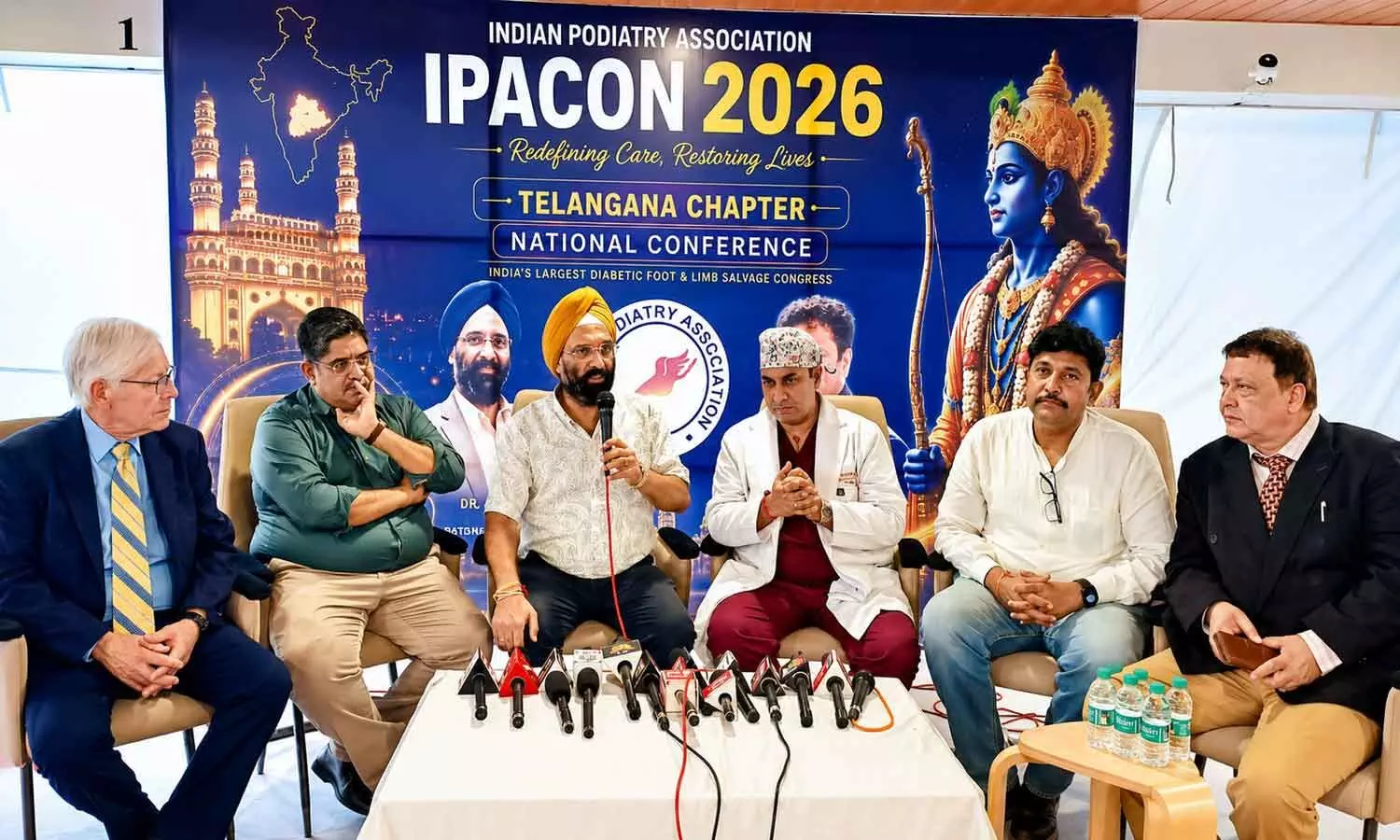
More than 400 healthcare professionals have gathered near Hyderabad for IPACON 2026, a two-day national congress focused on preventing diabetic foot complications and avoidable lower-limb amputations.
Hosted by the Indian Podiatry Association in association with its Telangana Chapter, the congress is being held on 29 and 30 August at Firefox Sports and Resorts in Moinabad.
The event’s theme, “Redefining Diabetic Foot Care Through Prevention, Preservation and Regeneration,” reflects a programme spanning early risk identification, wound treatment, vascular intervention, pressure offloading, reconstruction, rehabilitation and prosthetic care.
The conference was previewed by The Hans India, while its programme and delegate information are available through the official IPACON Telangana website.
More than 30 scientific sessions
IPACON 2026 features more than 50 faculty members participating in approximately 30 scientific sessions.
The delegate group includes diabetologists, endocrinologists, vascular surgeons, orthopaedic surgeons, plastic and reconstructive surgeons, infectious-disease specialists, podiatrists, wound-care professionals, rehabilitation clinicians, researchers, students and allied health professionals.
The scientific programme covers:
- Diabetic foot screening and risk assessment
- Infection and osteomyelitis
- Antibiotic stewardship
- Vascular assessment and revascularisation
- Diabetic foot reconstruction
- Limb-salvage algorithms and protocols
- Advanced wound-care products and dressings
- Regenerative and biological therapies
- Hyperbaric oxygen and other adjunctive treatments
- Offloading and gait management
- Preventive podiatry
- Amputation prevention
- Rehabilitation and prosthetic care
- Functional restoration and quality of life
The congress was inaugurated by retired senior IAS officer P. V. Ramesh, former Special Chief Secretary to the Government of Andhra Pradesh.
Speaking at the event, he called for podiatry to be recognised as an independent medical discipline in India and for specialised educational programmes to be introduced within medical colleges.
Call for an “Amputation-Free India”
Dr A. P. S. Suri, Founder and National President of the Indian Podiatry Association, used the congress to call for an “Amputation-Free India by 2047.”
He identified three priorities: expanding early screening, improving public awareness and strengthening multidisciplinary diabetic foot services.
Diabetes-related neuropathy can reduce protective sensation, meaning that a wound, pressure point or footwear injury may progress without causing the level of pain normally expected. When combined with impaired circulation, infection or delayed access to specialist treatment, a small lesion can become a serious threat to the limb.
Routine foot inspection and structured risk assessment can help identify patients who require closer monitoring, footwear intervention, offloading or referral to vascular and wound-care services.
Dr David B. Alper, a member of the American Podiatric Medical Association’s Board of Trustees, stressed the value of incorporating regular foot checks into diabetes care. He called for collaboration between podiatrists, diabetologists, vascular surgeons, primary-care doctors, physiotherapists, nutritionists and patients.
Hands-on training in total contact casting
Practical workshops are a central feature of IPACON 2026.
The programme includes international product demonstrations, advanced wound-healing techniques, debridement training, vascular workshops, a wound-care masterclass and total contact casting.
Total contact casting is an established offloading method used in selected patients with neuropathic plantar wounds. A carefully applied cast redistributes pressure away from the ulcerated area and limits activity that may repeatedly load the wound.
Its inclusion is particularly relevant to orthotists because safe application requires knowledge of anatomy, pressure distribution, padding, cast construction and patient selection.
Total contact casting is not appropriate for every diabetic foot presentation. The decision must consider infection, vascular status, balance, skin condition, swelling, the patient’s ability to follow instructions and access to timely cast review.
Training should therefore cover assessment, contraindications, warning signs and follow-up—not only the technical casting procedure.
The role of CPOs begins before amputation
For prosthetists and orthotists, diabetic foot care is sometimes associated primarily with prosthetic rehabilitation after an amputation. IPACON’s limb-preservation focus highlights the profession’s earlier role.
CPOs can contribute to multidisciplinary diabetic foot services through:
- Footwear and gait assessment
- Plantar-pressure redistribution
- Custom insoles and accommodative foot orthoses
- Charcot foot management
- Removable and non-removable offloading devices
- Custom therapeutic footwear
- Ankle-foot orthoses and other protective devices
- Monitoring the effectiveness and condition of offloading products
- Education on footwear, skin inspection and device use
An offloading prescription must be translated into a device the patient can use safely in everyday life. Fit, adherence, footwear compatibility, ease of donning and the person’s home and working environment all influence the result.
Orthotists should therefore be included in treatment planning alongside medical, surgical and wound-care professionals—not contacted only after other interventions have failed.
Rehabilitation after limb salvage or amputation
Preserving the limb is not the final outcome if the patient remains unable to stand, walk or participate in daily life.
After wound closure or reconstructive surgery, patients may require progressive loading, gait retraining, strength and balance work, footwear modification and continued surveillance to reduce the risk of recurrence.
When amputation cannot be avoided, early rehabilitation planning remains essential. Decisions about amputation level, residual-limb management and future prosthetic potential benefit from input before surgery wherever possible.
The conference programme’s inclusion of rehabilitation, prosthetics and functional restoration reflects this full pathway from prevention through limb salvage to post-amputation care.
Strengthening multidisciplinary diabetic foot services
Dr K. V. N. N. Santosh Murthy, President of the IPA Telangana Chapter, described IPACON as a platform covering the complete diabetic foot pathway, including prevention, vascular care, wound healing, reconstruction, rehabilitation and quality of life.
This integrated approach is necessary because no single professional can address every factor contributing to diabetic foot complications.
For India’s CPO community, IPACON 2026 provides an opportunity to strengthen the place of biomechanics, orthotic offloading and therapeutic footwear within mainstream diabetic care.
The congress also reinforces an important principle: successful limb salvage is not defined only by avoiding surgery. It should preserve a foot that is stable, protected and capable of supporting meaningful mobility.
- The Hans India: IPACON 2026 to Put Diabetic Foot Care and Limb Salvage in Focus
- IPACON Telangana Summit 2026 Official Website
- IPACON 2026 Scientific Programme
- Indian Podiatry Association Official Website
- Telangana Today: IPACON 2026 in Hyderabad