
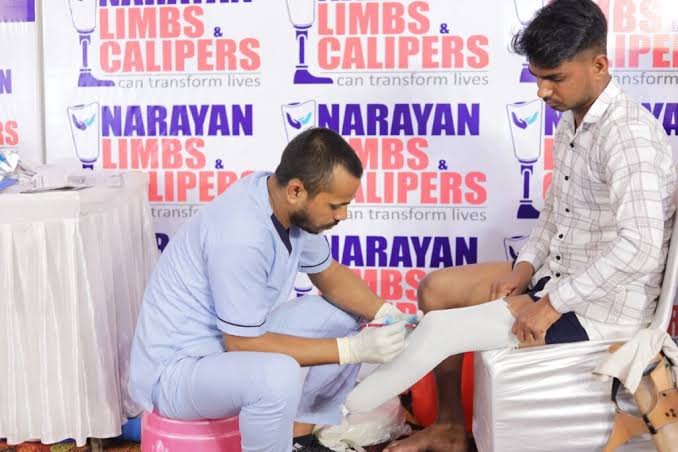
Narayan Seva Sansthan organised a free Narayan Limb and Caliper Fitment Camp in Agra on 31 May 2026, providing prosthetic and orthotic support to persons with disabilities from different regions.
According to the organisation, 325 differently abled individuals were fitted with 3D-printed Narayan Modular Artificial Limbs and Calipers, developed using Japanese and German technology. The camp aimed to help beneficiaries regain mobility, improve independence and move toward a more self-reliant life.
For India’s prosthetics and orthotics community, the camp reflects the continuing role of large-scale charitable, NGO-led and community outreach programmes in expanding access to mobility devices for persons with disabilities, particularly those who may face financial, geographic or service-access barriers.
3D-Printed Modular Limbs and Calipers
The use of 3D-printed Narayan Modular Artificial Limbs is significant in the Indian rehabilitation context. Digital manufacturing and modular prosthetic systems are increasingly being explored as ways to reduce production time, improve repeatability and support wider access to prosthetic care.
Narayan Seva Sansthan has publicly highlighted its use of advanced 3D technology in artificial limb provision and presents the Narayan Limb process as a pathway from measurement to fitment and mobility restoration. The organisation’s work also includes calipers, assistive devices, physiotherapy, corrective surgery and broader rehabilitation support.
While 3D printing can offer important advantages in design flexibility and faster production, clinical fitment remains essential. Prosthetic and orthotic outcomes depend not only on fabrication technology, but also on assessment, socket comfort, alignment, gait training, follow-up and long-term service support.
Camp-Based Rehabilitation and Access in India
India has a long history of artificial limb and caliper camps, particularly through NGOs, charitable hospitals, public-sector initiatives and rehabilitation organisations. These camps are often vital for people who cannot easily access city-based O&P clinics or pay for private treatment.
The Agra camp demonstrates how outreach models can bring services closer to beneficiaries. For many persons with limb loss, polio-related disability, lower-limb deformity or mobility limitation, receiving a prosthetic limb or caliper can directly affect education, employment, family participation and daily independence.
However, the scale of camp activity also highlights the need for strong professional systems. Effective limb and caliper provision requires:
- Proper clinical assessment before fitment
- Accurate measurement and device selection
- Safe fitting and pressure checks
- Gait training and functional education
- Review and adjustment after use
- Repair, replacement and follow-up pathways
- Referral to physiotherapy, surgery or medical care when required
For CPOs and technicians, these elements remain central to quality care, whether the device is made through traditional methods, modular assembly or 3D printing.
Four Decades of Disability Rehabilitation Work
Narayan Seva Sansthan has been working in disability rehabilitation and empowerment for around four decades. The organisation, headquartered in Udaipur, Rajasthan, describes its mission as providing comprehensive rehabilitation support to persons with disabilities.
Its activities include artificial limb provision, caliper distribution, corrective surgery, physiotherapy, vocational training, education, mass marriage programmes, para-sports promotion and social empowerment initiatives. The organisation’s model reflects a broad interpretation of rehabilitation, where mobility restoration is connected with education, livelihood, dignity and community participation.
For India’s O&P sector, this integrated approach is important. A prosthetic limb or caliper is not simply a product. It is part of a wider rehabilitation pathway that may include physical training, counselling, vocational opportunity, family support and social inclusion.
Why This Matters for BharatCPO Readers
The Agra camp is relevant to orthotists, prosthetists, technicians, educators, rehabilitation providers and policy stakeholders for several reasons.
First, it shows that demand for limb and caliper services remains high across India. Even with expanding hospital, NGO and government programmes, many persons with disabilities still rely on outreach camps to access mobility devices.
Second, it demonstrates the growing role of digital fabrication and modular prosthetic technologies in Indian service models. As more organisations adopt 3D printing and advanced production methods, professional training and quality control will become even more important.
Third, it underlines the value of partnerships between charitable organisations, clinical teams, donors, technologists and local communities. Sustainable mobility access in India will require both innovation and strong service-delivery systems.
Finally, it reinforces the importance of follow-up. A successful fitment camp should not end when a beneficiary receives a limb or caliper. Long-term outcomes depend on comfort, use, repairs, rehabilitation, function and the ability to return for adjustments when needed.
A Step Toward Independent Living
For the 325 beneficiaries fitted in Agra, the camp represents more than device distribution. It offers a practical step toward walking, working, studying, travelling and participating more fully in family and community life.
As India continues to expand assistive technology and rehabilitation access, organisations such as Narayan Seva Sansthan will remain important contributors to the national disability-support ecosystem. The challenge for the wider O&P profession is to ensure that innovation, scale and charitable reach are matched by clinical quality, technical skill and long-term care.
- Narayan Seva Sansthan official website
- Narayan Seva Sansthan About Us
- Narayan Artificial Limb information
- Narayan Seva Sansthan events
- Department of Empowerment of Persons with Disabilities, Government of India
- ALIMCO
- World Health Organization: Assistive technology
- International Society for Prosthetics and Orthotics