
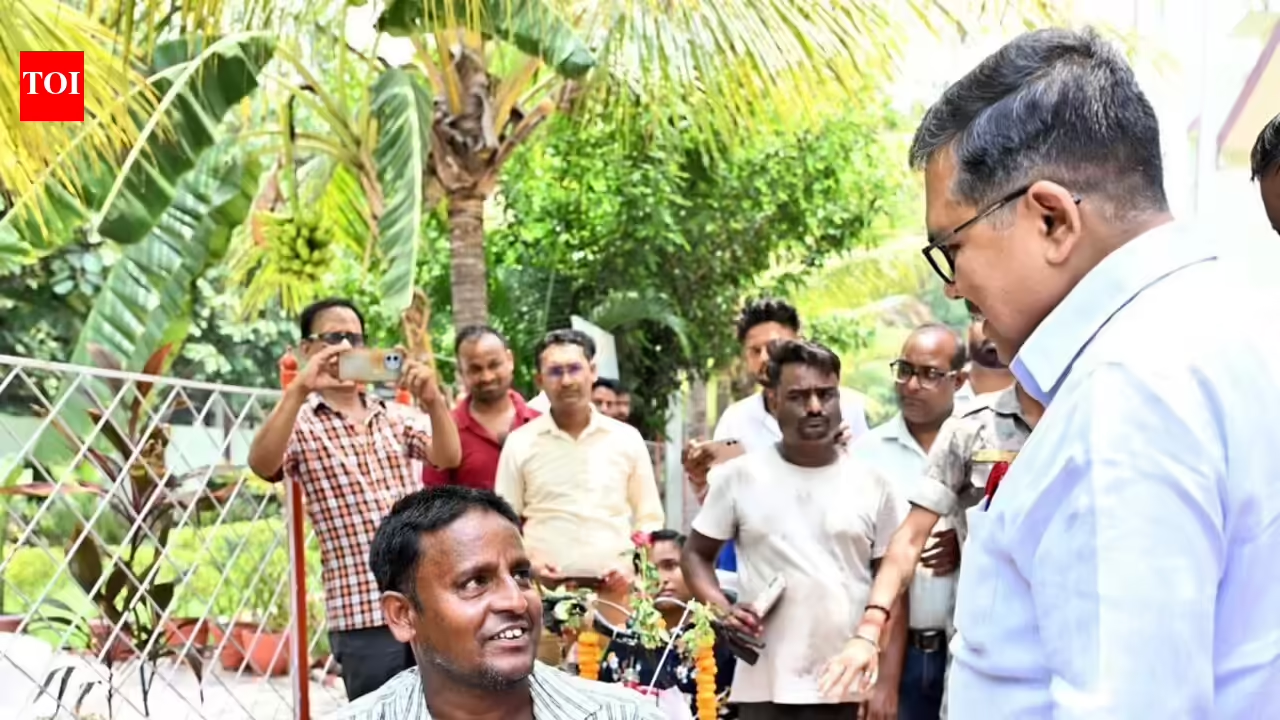
A district-led mobility initiative in Bokaro, Jharkhand, has distributed 112 assistive devices to persons with disabilities through a special support pool funded by local industries.
According to a report in The Times of India, the Bokaro administration has brought together companies from the steel, coal, power, petroleum, gas and cement sectors to support mobility access for people who face daily barriers due to disability.
The initiative has so far distributed 62 battery-operated tricycles, 49 Divyang scooties and one artificial limb, with around Rs 91 lakh spent by participating industries. More vehicles are reportedly in the pipeline.
For Bharat CPO readers, the Bokaro model is important because it shows how district administration, industry CSR and practical assistive technology provision can work together to support independence and self-reliance.
From One Application to a District-Level Mobility Pool
The initiative began on July 11, 2025, when 32-year-old Suresh Pandey, described as orthopedically challenged, approached Deputy Commissioner Ajay Nath Jha during the Janta Darbar seeking a battery-operated tricycle. According to the report, his case was taken up quickly and he received the tricycle within 48 hours.
As more people came forward with similar mobility needs, the administration recognised that accessible mobility was a wider district-level issue. Many potential beneficiaries were not even able to reach the collectorate because of physical constraints, prompting officials to step outside and receive applications directly.
This is a critical lesson for disability services. Access problems are often invisible to systems that require people to physically attend offices, hospitals or camps before support can begin. For many persons with disabilities, the first barrier is not paperwork. It is transport, distance and mobility itself.
Mobility Devices Can Transform Daily Life
The Times of India report describes the impact as life-changing for beneficiaries. One recipient from a poor family said that receiving a tricycle enabled him to start home tuition classes and earn independently, restoring confidence and self-respect. In another case, Chas resident Raghunath Gorai, who lost both legs in an accident, received both a tricycle and disability pension within hours of appealing at the Janta Darbar.
These examples show why assistive devices must be understood as more than welfare items. A tricycle, scooty, prosthetic limb or mobility aid can directly affect education, employment, family participation and dignity.
For persons with mobility impairment, the right device can mean:
- Travelling to school, college or work
- Running a small business or home-based service
- Attending medical appointments
- Participating in family and community life
- Reducing dependence on caregivers
- Improving confidence and social inclusion
In this sense, assistive technology is not only a health intervention. It is also an economic inclusion tool.
Why Industry Support Matters
Bokaro is an industrial district, and the administration’s decision to involve local industries is significant. The report states that companies from steel, coal, power, petroleum, gas and cement sectors contributed vehicles to a common pool.
This approach has practical value. Instead of isolated one-off donations, a common mobility support pool allows the administration to match devices to identified beneficiaries. It can also help create a more predictable supply of assistive devices when new applications are received.
For India’s disability and rehabilitation sector, this model raises an important question: can district-level CSR be better aligned with assistive technology needs?
Many companies already support health camps, education projects and community welfare activities. Assistive technology provision could become a stronger CSR focus, especially in industrial districts where disability may be linked to accidents, poverty, transport barriers or limited access to specialist rehabilitation services.
The Need for Assessment and Follow-Up
While mobility device distribution is valuable, Bharat CPO readers will recognise that appropriate assessment remains essential.
Different users need different solutions. A battery-operated tricycle may be suitable for one person, while another may need a wheelchair, prosthesis, orthosis, walking aid, modified vehicle, seating support or home adaptation. Some users may require training, repairs or replacement batteries. Others may need physiotherapy, prosthetic fitting or disability certification support.
For maximum impact, assistive device initiatives should ideally include:
- Clinical or functional assessment
- Matching of device to user need
- Training in safe use
- Maintenance and repair support
- Battery replacement planning where relevant
- Follow-up to confirm real-world use
- Referral for prosthetics, orthotics or rehabilitation where needed
- Linkage with disability pension and social protection schemes
This is particularly important when programmes include artificial limbs or mobility devices for people with complex impairments.
A Model for Other Districts
Bokaro’s initiative offers a useful model for other Indian districts. The key elements are straightforward:
- A responsive district administration
- A clear identification pathway for beneficiaries
- Industry participation through a common support pool
- Fast response to urgent mobility needs
- Linkage with disability pension and welfare support
- Focus on dignity and self-reliance, not only device distribution
Deputy Commissioner Ajay Nath Jha described the initiative as a step toward dignity and self-reliance, stating that empathy and swift administrative action can significantly change lives.
That message is important. Assistive technology access often improves when systems become more human, responsive and locally coordinated.
Relevance for Prosthetics and Orthotics in India
Although most devices distributed so far are mobility vehicles rather than prosthetic or orthotic devices, the story is highly relevant to India’s P&O sector.
Persons with limb loss, neurological impairment, orthopaedic disability or severe mobility limitations often need a combination of support. A bilateral amputee may need prosthetic limbs, but may also need a tricycle or scooter for longer distances. A person with paralysis may need orthoses, a wheelchair, home modifications and transport support. A person with severe lower-limb deformity may need both orthotic care and mobility assistance.
This means assistive technology planning must not be limited to one device category.
A district-level mobility pool could be expanded over time to include:
- Prosthetic limbs
- Orthotic devices
- Wheelchairs
- Walking aids
- Crutches and walkers
- Diabetic footwear and offloading devices
- Seating and positioning systems
- Repair and maintenance support
- Referral partnerships with P&O centres
For Bharat CPO, the most important takeaway is that district disability support should be linked with qualified prosthetic and orthotic services wherever possible.
Assistive Technology as a Pathway to Inclusion
The Bokaro initiative shows how assistive technology can directly support inclusion. When a beneficiary is able to start tuition classes, travel independently or receive both mobility support and disability pension, the impact moves beyond healthcare.
It becomes part of livelihood, education and social participation.
India’s disability inclusion efforts will require more such local models. National schemes are important, but district-level implementation determines whether support actually reaches people who need it.
The combination of administration, industry funding, local identification and practical mobility support could be a useful template for other districts, especially in states with large rural populations and industrial clusters.
From Donation to Sustainable Access
The next challenge is sustainability.
Battery-operated tricycles and scooties require servicing, battery replacement, user training and safe operating conditions. Artificial limbs require fitting, follow-up and maintenance. Beneficiaries may need future support as their condition changes.
Therefore, successful programmes should plan beyond the day of distribution.
Sustainable assistive technology access requires:
- Maintenance budgets
- Local repair partnerships
- Follow-up records
- User feedback
- Integration with disability certificates and pensions
- Referral links with rehabilitation professionals
- Transparent beneficiary selection
- Long-term industry or public funding
If these elements are built into the programme, Bokaro’s initiative could become more than a distribution drive. It could become a local mobility access system.
A Practical Step Toward Dignity and Self-Reliance
The distribution of 112 assistive devices in Bokaro is a practical example of how local leadership can improve daily life for persons with disabilities.
For some beneficiaries, the device may mean the ability to earn. For others, it may mean attending school, travelling to medical care or participating more fully in family life. For many, it represents independence and dignity.
India’s rehabilitation and assistive technology sector should watch such district-led initiatives closely. They demonstrate that access can improve when administration, industry and community need are connected.
Bokaro’s mobility support pool may be local in scale, but the lesson is national: assistive technology should be treated as a foundation for inclusion, not a one-time charitable gesture.
- Times of India: Bokaro administration distributes 112 assistive devices
- Department of Empowerment of Persons with Disabilities, Government of India
- ADIP Scheme: Assistance to Disabled Persons for Purchase/Fitting of Aids and Appliances
- Artificial Limbs Manufacturing Corporation of India
- WHO: Assistive Technology
- WHO: Rehabilitation